

Trail riders’ UTV dog kennel setup is a crate-and-restraint system with the aim of keeping a dog contained, ventilated, and separated from moving cargo. UTV dog kennel accessories must handle rough terrain, open cargo areas, and limited cab space; start by planning the kennel around your UTV cargo rack and hauling setup before the first dog ride of 2026.
- UTV dog kennel accessories should secure the crate, restrain the dog, manage heat, and prevent cargo contact.
- Use a pet restraint harness; human racing harnesses are not shaped or tested for a dog.
- Hard-sided kennels suit repeated rough-trail use, while soft crates suit calm dogs and easier storage.
- R1 Industries is best for UTV owners sourcing vehicle-specific accessories around a separately chosen dog restraint system.
Why UTV dog kennel accessories matter for trail riders
A passenger vehicle gives a dog an enclosed cabin, flat floor, and predictable seating area. A UTV can expose the dog to sudden suspension movement, dust, wind, branches, loose cargo, hot panels, and an open side or tailgate. The kennel setup has to solve those conditions before comfort upgrades matter.
A crate alone is not a complete trail system. The crate must fit the vehicle, remain fixed during braking and side-to-side movement, and allow airflow without putting the dog beside hot exhaust components. A tether should prevent escape without becoming a neck restraint or letting the dog reach outside the cab.
The correct 2026 setup depends on your UTV and dog, not a universal kennel size. R1 Industries sells aftermarket UTV and SxS parts for platforms including Polaris RZR, Can-Am Maverick X3, and Kawasaki KRX, but the dog crate, pet harness, and mounting method still need to match your exact cabin or cargo-bed dimensions.
Build a trail-ready UTV dog kennel setup
Measure the dog and available space
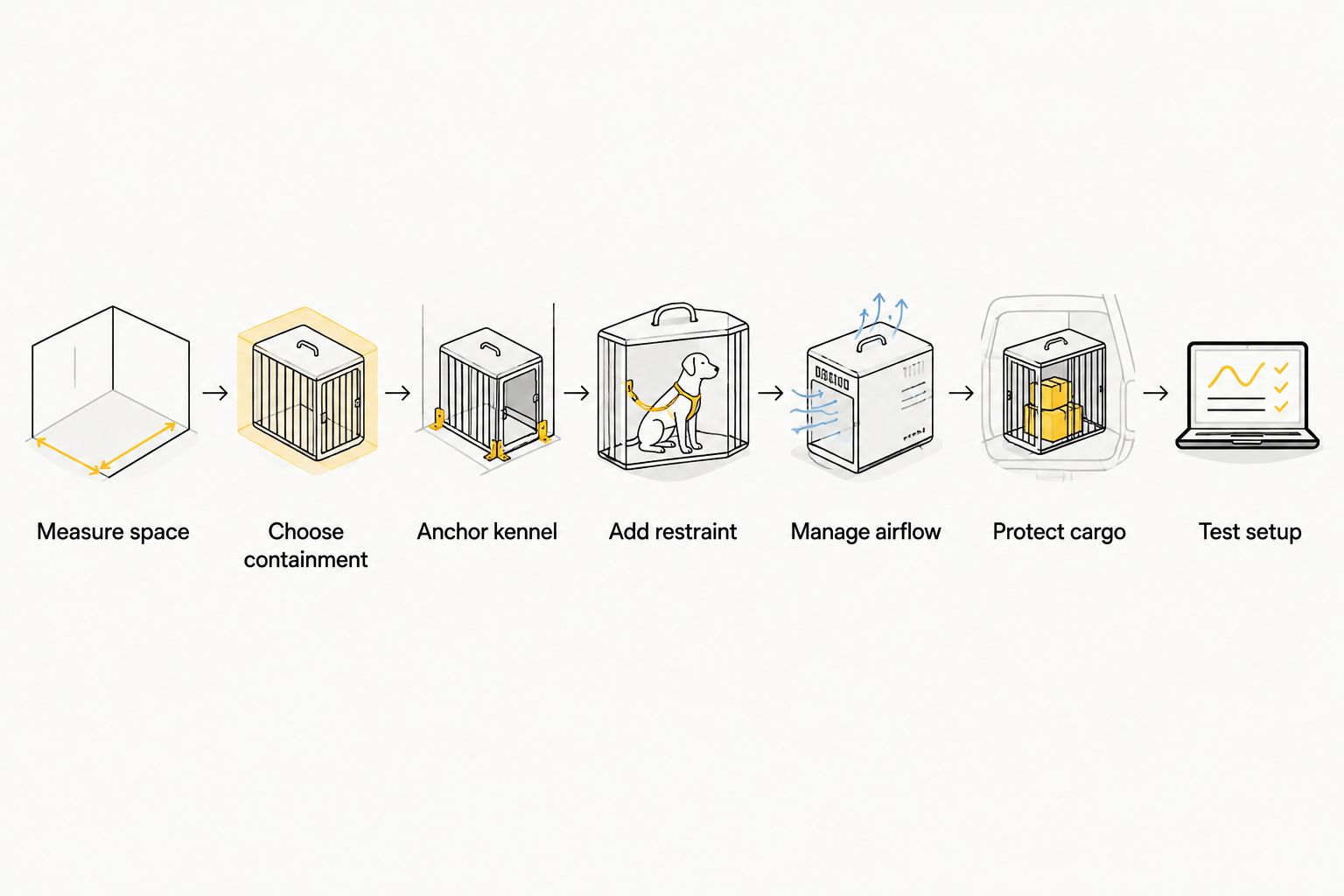
Measure before choosing a crate. Record the usable width, depth, and height of the cargo bed or passenger area in inches, then repeat the measurements with doors, seats, storage boxes, and spare tires in their normal positions. Check whether a kennel would block a latch, radiator intake, rear view, or access to recovery gear.
The dog needs enough room to stand naturally, turn around, and lie down without being pressed against the door. The kennel also needs clearance for airflow and for straps to pass around its frame without crushing vents.
- Measure usable width, depth, and height in inches
- Check tailgate, door, seat, and storage-box movement
- Keep kennel vents away from solid panels and packed cargo
- Confirm the dog can stand, turn, and lie down naturally
- Leave access to recovery gear and emergency supplies
Choose the right containment method
Choose containment based on dog behavior, trail intensity, and available mounting space. A calm dog on graded roads has different needs from an anxious dog riding through rocks, whoops, or steep side slopes.
A soft-sided crate is lighter and easier to store, but fabric and mesh can be damaged by claws or chewing. A hard-sided kennel protects the dog from nearby cargo and repeated contact with the bed, but it occupies more space and needs secure mounting points. A tether-only setup leaves the dog exposed and depends heavily on training.
- Pick a soft crate for calm dogs and compact storage
- Pick a hard kennel for repeated rough-trail use
- Use tether-only restraint only inside a contained seating area
- Avoid open cargo-bed riding without a secured enclosure
- Keep tools, fuel containers, and recovery equipment outside the dog’s space
Anchor the kennel to structural points
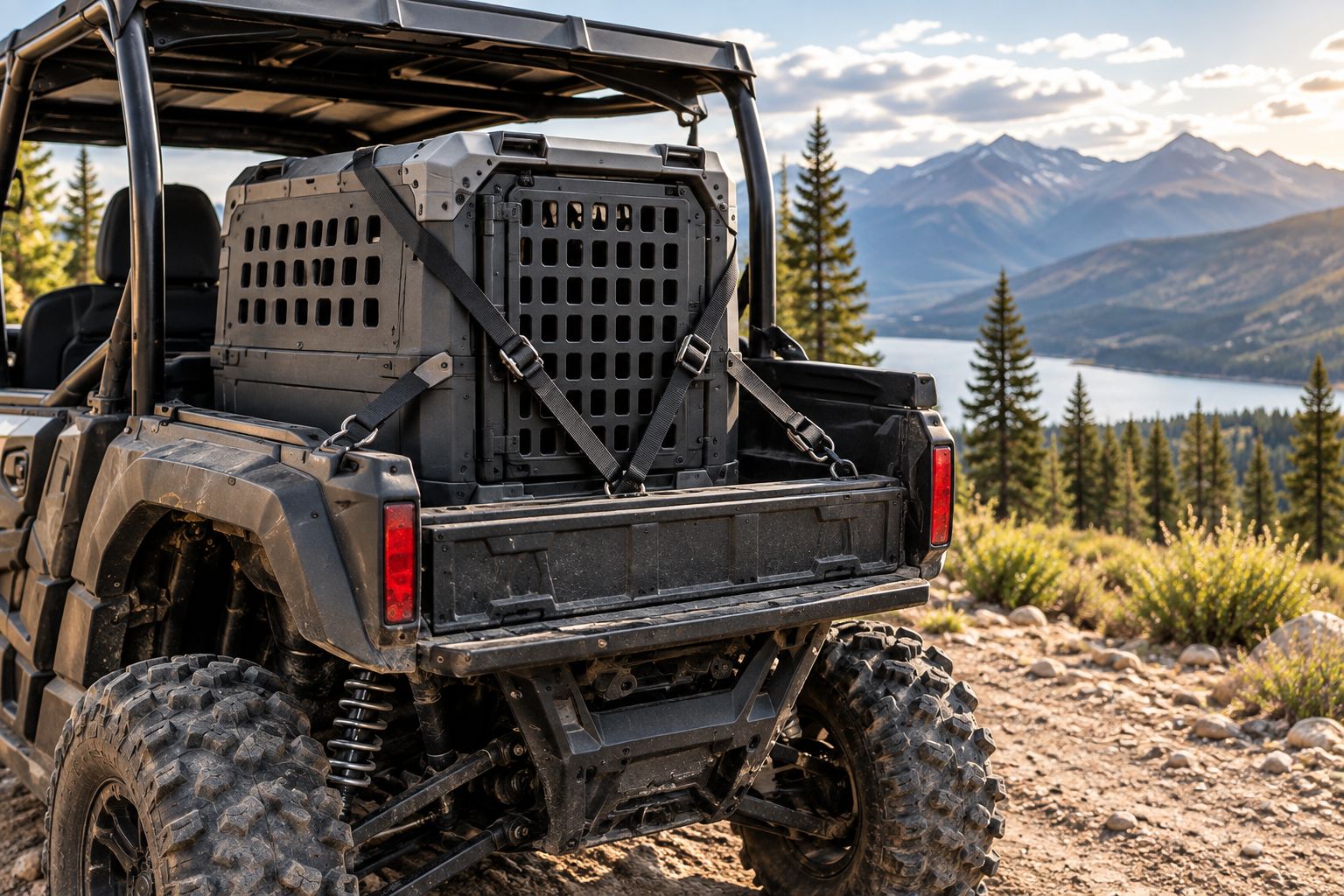
Anchor the kennel to factory cargo loops, a properly mounted rack, or another structural point intended to hold cargo. Do not trust plastic trim, seat adjustment hardware, door latches, or electrical brackets. Those parts can look solid while providing the wrong load path when the UTV changes direction quickly.
Use independent attachment points so one loose strap does not release the entire kennel. Route straps around the kennel frame rather than across a flexible door, vent, or thin roof panel. Tighten the system, push the kennel in every direction, and check that the straps cannot rub against sharp metal.
R1 Industries supports the vehicle side of a UTV dog kennel setup with fitment-specific trail accessories, while the kennel and pet-restraint hardware should come from products designed for animal transport.
- Use factory cargo loops or a properly mounted rack
- Secure the kennel through independent attachment points
- Route straps around the kennel frame
- Keep straps away from doors, vents, and sharp edges
- Replace frayed webbing or bent hardware before riding
Add a pet-rated restraint
Use a pet vehicle harness that spreads load across the dog’s chest and connects to a short tether. Never attach the tether to a collar; a sudden stop can concentrate force at the dog’s neck. Keep the tether short enough to prevent jumping out, reaching a wheel well, or becoming wrapped around the dog’s legs.
Do not adapt a 3-point, 4-point, or 5-point human racing harness for a dog. Human harnesses are shaped around a seated occupant and the seat’s belt routing. A dog’s body position and movement are different, so the hardware does not become pet-safe simply because it is strong.
- Choose a vehicle restraint made for dogs
- Attach the tether to the harness, never the collar
- Use a short tether that still allows comfortable lying down
- Keep buckles away from paws and crate-door hinges
- Inspect stitching, clips, and anchor hardware before each trip
Manage heat, dust, and airflow
Airflow is a core safety requirement, not a comfort extra. A kennel placed behind a solid panel or surrounded by bags can lose ventilation even when the UTV is moving. Dust also accumulates at the rear of many rigs, so watch where air enters the kennel instead of assuming an open cargo bed is well ventilated.
Plan shorter stops where you can inspect the dog, offer water, and check the kennel surface for heat. Never treat moving air as proof that the dog is cool. Sun exposure, engine heat, slow technical sections, and an enclosed cab can change conditions during the same ride.
- Keep every kennel vent clear of bags and body panels
- Position the kennel away from exhaust and hot mechanical parts
- Carry water where it cannot spill into the kennel
- Inspect the dog and kennel during trail stops
- Use shade when parked and remove the dog from a hot stationary rig
Protect the dog’s area from mud and loose cargo
Separate the kennel from tools, recovery shackles, fuel containers, and anything with a sharp edge. A closed storage box or divided cargo area is safer than placing equipment beside the crate and expecting straps to hold every item independently.
Use a washable liner under the kennel to catch mud, hair, and water. Vehicle-specific flooring can simplify cleanup inside compatible cabs; for example, Polaris Ranger XP 1000 rubber floor mats are intended for that named platform, not universal fitment. Confirm your model before choosing any floor or cabin accessory from R1 Industries.
- Put tools and recovery hardware in closed storage
- Keep fuel and chemicals outside the dog’s compartment
- Place a washable, nonslip liner under the kennel
- Remove sharp cargo from the kennel’s contact zone
- Confirm vehicle fitment before ordering floor protection
Test the complete setup before the trail
Run a parked test first. Load the kennel, attach the empty restraint, open every door, and verify access to the brake, shifter, cargo latch, fire extinguisher, and recovery equipment. Then introduce the dog while the UTV is off and reward calm entry, lying down, and waiting for release.
Follow with a slow ride on private property before attempting a full trail. Stop and inspect the straps, kennel position, tether, and dog. Any movement, rubbing, panic, overheating, or repeated attempts to escape is a failed test, not something to solve after reaching the trailhead.
- Test all doors, latches, seats, and controls while parked
- Let the dog enter the kennel with the engine off
- Start with a slow ride on private property
- Stop and inspect every strap and attachment point
- Cancel the trail ride if the dog shows distress or the kennel shifts
UTV dog containment options compared
The best option is the one that fits the vehicle, contains the dog, and remains fixed through the terrain you actually ride. No option removes the need for training, airflow, and pre-ride inspection.
| Option | Best for | Main advantage | Key limitation |
|---|---|---|---|
| Soft-sided travel crate | Calm dogs and occasional trail use | Light and easy to store | Fabric and mesh are vulnerable to claws and chewing |
| Hard-sided kennel | Repeated rough-trail trips | Separates the dog from nearby cargo | Takes more space and needs strong anchors |
| Tether in an enclosed cab | Trained dogs with dedicated cabin space | Keeps the dog near the rider | Offers less protection from cargo and cabin surfaces |
| Kennel on a cargo rack | Utility UTVs with suitable rack space | Preserves more cabin room | Fit, airflow, heat, and rack capacity all require checking |
| Loose riding | None | No meaningful restraint benefit | The dog can fall, jump, or contact controls and cargo |
For 2026 trail use, a secured hard-sided kennel plus a separate pet-rated harness and short tether is the strongest general setup for dogs that tolerate crate travel. A soft crate wins when storage space matters and the dog does not scratch, chew, or panic inside it. Loose riding is the option to skip.
Common mistakes trail riders make
Buying the kennel before measuring the UTV
Product photos do not show whether a crate blocks your tailgate, seat movement, intake area, or recovery storage. Measure the installed space in inches with the rig loaded as it normally travels.
Treating one strap as a mounting system
One strap can loosen, rotate, or fail without a backup connection. Use independent structural attachment points and inspect the route for abrasion before every ride.
Connecting a tether to the dog’s collar
A collar is for identification and leash control, not sudden vehicle movement. Attach the vehicle tether to a pet harness that spreads load across the chest.
Using human occupant restraints on a dog
Racing harness hardware may look stronger than pet gear, but its shape and belt path assume a person seated in a UTV seat. Keep human harnesses on human occupants and pet restraints on dogs.
Ignoring the parked UTV
Airflow drops when the machine stops, while sun and engine heat remain. Take the dog out during longer stops and never leave it unattended in a hot cab or kennel during the 2026 riding season.
FAQ
What are the most important UTV dog kennel accessories?
Start with a correctly sized kennel, structural tie-down hardware, a pet vehicle harness, and a short tether. Add a nonslip liner, water storage, and airflow management based on your UTV layout and riding conditions.
What is the best dog kennel setup for a UTV in 2026?
A hard-sided kennel secured to structural cargo points, backed by a pet-rated harness and short tether, is the best general setup for repeated rough-trail riding in 2026. The kennel still needs correct fit, open vents, and separation from hot components and loose cargo.
Can a dog ride loose in a UTV cargo bed?
A dog should not ride loose in an open UTV cargo bed. The dog can fall, jump, contact hot parts, or be struck by cargo when the vehicle brakes or crosses uneven terrain.
Can I use a racing harness to restrain my dog?
No, a human racing harness is not a substitute for a pet vehicle harness. Its belt routing, buckle position, and intended body position are designed for a seated person rather than a dog.
Where should I anchor a dog kennel in a UTV?
Anchor the kennel to factory cargo loops, a properly mounted rack, or another structural cargo point. Do not use plastic trim, seat adjustment hardware, electrical brackets, or door latches.
Is a soft or hard dog crate better for trail riding?
A hard crate is better for repeated rough-trail use and separation from cargo, while a soft crate is easier to store and carry. Skip a soft crate if the dog scratches, chews, or panics inside fabric containment.
How do I keep my dog cool in a UTV kennel?
Keep every vent open, separate the kennel from hot mechanical parts, provide water, and inspect the dog during stops. Remove the dog from a hot stationary UTV rather than relying on shade or a partially open cab.
How should I test a UTV dog restraint setup?
Test the system while parked, then take a slow ride on private property and stop to inspect the kennel, straps, tether, and dog. Any shifting, rubbing, distress, or overheating means the setup needs correction before trail use.
One last thing
Train the release, not just the ride. A dog that waits inside the kennel until you attach a leash is easier to control at a crowded trailhead, after dark, or beside another machine. Make that pause part of every 2026 trip before the door opens.
R1 Industries can supply vehicle-specific UTV accessories, but the safest dog setup starts with measurements, structural anchors, and pet-rated restraint gear rather than adapting whatever straps are already in the rig.