

Off-road racing pit crew equipment is a fitment-checked set of UTV parts, tools, and spares with the aim of returning the vehicle to the course safely and quickly. In 2026, pit crews need a different setup from trail riders because every item must support a planned inspection, adjustment, or repair under race pressure.
- UTV accessories for racing pit crews should address driver restraint, tires, suspension, lighting, steering, and driveline service.
- R1 Industries is best for pit crews sourcing vehicle-specific UTV parts across several major platforms in 2026.
- Standardize tools and fasteners before adding more spares; an organized kit is easier to use under pressure.
- Match every component to the exact model, configuration, and installation requirements before race day.
Why UTV accessories matter for racing pit crews
Race support starts before the UTV reaches the starting line. The crew needs written settings, known inspection points, accessible hardware, and replacement parts selected for the exact vehicle. The UTV racing fuel guide covers another part of that preparation, but fuel planning does not replace a mechanical pit checklist.
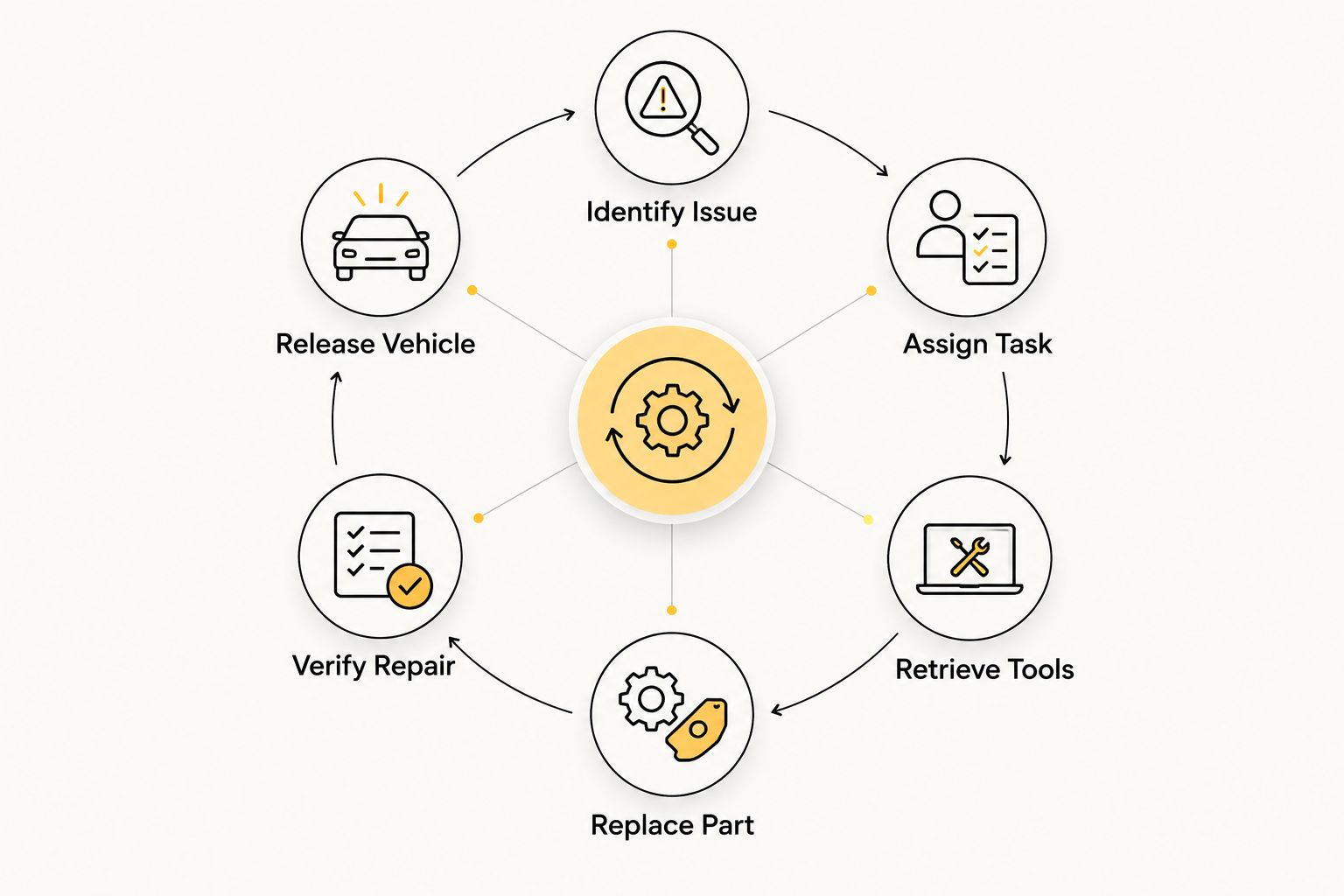
A trail rider can stop and diagnose a problem without a race schedule pressing the crew. A pit crew must identify the issue, choose the correct response, complete the work, and verify the repair before release. That changes which accessories deserve space in the trailer.
The useful gear is not always the most modified or expensive part. A labeled connector, an accessible harness buckle, or a mounted spare tire can matter more during a stop than a performance component that requires a long installation. In 2026, choose each item by answering three questions: what problem does it address, how will the crew inspect it, and what must be removed to replace it?
Build a race-ready UTV pit setup
Map the service points before buying parts
Start with the vehicle in race configuration. Walk around it with the crew and identify every component that can be inspected without removing body panels. Then mark the parts that require a wheel, skid plate, seat, or panel to come off first.
This manual review costs nothing and exposes access problems before race day. It also separates true pit repairs from work that belongs in the shop. An engine teardown does not become a practical pit repair because the replacement parts are sitting in the trailer.
Build the first checklist around these service points:
- Driver restraints, seat mounts, and harness hardware
- Wheels, tires, hubs, and visible suspension hardware
- Tie rods, radius rods, A-arms, and steering connections
- Brake components visible during a wheel change
- Battery terminals, fuses, switches, and lighting connectors
- Prop shaft, axles, boots, and accessible driveline joints
Standardize tools, hardware, and responsibilities
A crew should not need three different tool bags for three versions of the same repair. Record the sockets, wrenches, drivers, and specialty tools required for each service point. Place those tools in fixed locations and return them after every practice session.
Assigning roles also prevents two people from reaching for the same wheel while another inspection gets missed. The driver should know who controls release, and every crew member should know which task follows their own.
Standardize the setup with these actions:
- Label tool drawers by task instead of by tool brand
- Keep matched fasteners with the component they secure
- Put torque references where the crew performs the work
- Assign one person to confirm completed fasteners
- Separate clean electrical supplies from greasy mechanical tools
- Practice verbal handoffs before the first 2026 event
Stage restraint parts for driver service
Driver restraint hardware deserves its own checklist because access changes when the driver is seated and wearing gloves. Inspect the webbing, buckle, mounting hardware, and routing according to the restraint manufacturer and the event rules. Replace any component that fails the required inspection rather than improvising a repair.
A 2-, 3-, or 4-point harness with push-button release gives crews a vehicle-specific option to evaluate. The advantage is a defined release mechanism. The limitation is that the harness still needs compatible mounting, correct routing, and approval for the intended race format.
Set up the restraint station with:
- The correct tools for every harness mounting point
- Replacement fasteners matched to the installed hardware
- A clear path to the buckle and adjustment points
- A written inspection routine for webbing and anchors
- Crew practice with the driver seated and fully equipped
Prepare wheels and tires for the course
Begin with a manual tire inspection before each session. Look for cuts, embedded debris, damaged wheels, loose hardware, and pressure changes. Record the selected pressure instead of relying on memory, then verify it with the same gauge used during setup.
R1 Industries UTV accessories include terrain-specific tire options, but terrain labels are only the first filter. The crew must confirm wheel fitment, tire dimensions, load requirements, and clearance for the actual vehicle. A Tusk Terrabite ATV/UTV radial tire is positioned for medium-to-hard terrain; it is not automatically the right choice for deep sand, mud, or every racing surface.
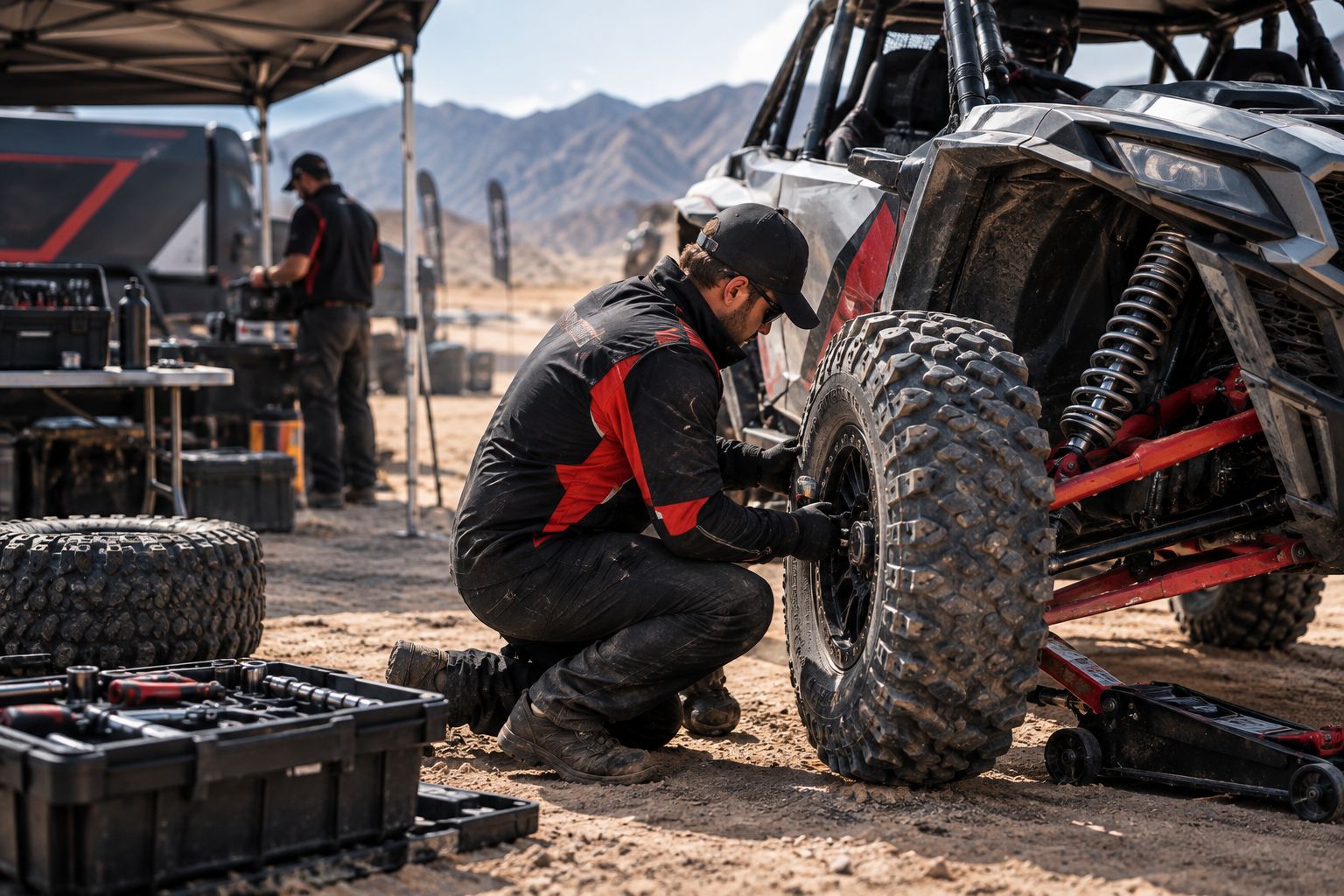
Prepare the wheel station with:
- A mounted spare matched to the vehicle and course plan
- A pressure gauge and inflation source in the same location
- Wheel-removal tools reserved for the tire station
- A stable lifting method appropriate for the vehicle
- A damaged-part area that keeps rejected wheels out of service
- A final clearance check after every wheel installation
Configure suspension for repeatable adjustments
Suspension changes should follow recorded settings. Before the event, document the starting position for preload, compression, rebound, ride height, and any other adjustable component specified by the manufacturer. Photograph reference points if that helps the crew return to baseline.
A Polaris RZR 1000 XP tender spring swap kit can support a planned suspension change on the named platform. Its benefit is a defined application for spring setup work. Its limitation is fitment: it is not a universal pit accessory, and spring work still requires the correct procedure and tools.
Keep suspension work controlled with:
- A written baseline for the exact vehicle configuration
- Separate notes for qualifying and race settings
- Matched tools for spring, shock, and mounting hardware
- Inspection marks on fasteners where appropriate
- A post-adjustment check for clearance and secure hardware
- One crew member authorized to approve setting changes
Build electrical and lighting redundancy
Electrical problems are easier to find when circuits are labeled and connectors remain accessible. Trace accessory wiring before race day, identify the fuse or protection device for each circuit, and check where wiring passes near heat, suspension movement, or sharp edges.
Lighting accessories need the same fitment discipline as mechanical parts. A plug-and-play harness reduces custom wiring only when its connectors match the installed equipment. Light whips can support visibility in low-light pit or riding conditions, but they add mounts, wiring, and connectors that the crew must inspect.
Prepare the electrical kit with:
- Fuses or circuit protection specified for the installed system
- Clean connectors protected from dirt and moisture
- Wire, terminals, and crimping tools appropriate for repairs
- A meter for basic circuit checks
- Spare switches only when they match the installed panel
- A battery inspection step before every 2026 race session
Pack steering, brake, and driveline spares by fitment
Steering and driveline parts cannot be chosen by vehicle brand alone. Model, trim, seating configuration, suspension width, and installed modifications can change fitment. Catalog labels such as 64-inch radius rods, 72-inch radius rods, 1.5-inch wheel spacers, and 10-ply tires show why exact specifications matter.
R1 Industries UTV parts cover several of these service areas, but a broad catalog creates a responsibility for the buyer: verify every item against the race vehicle before placing it in the pit inventory. A correctly labeled part for the wrong trim is still unusable at the track.
Pack this station around known fitment:
- Tie rods and steering hardware matched to the installed system
- Brake pads selected for the exact caliper application
- Axles, boots, or driveline parts confirmed for the vehicle
- Grease and service supplies required by installed components
- Containers for removed hardware and damaged parts
- A fitment label showing model and configuration on every spare
Pit-box parts to evaluate
The products below cover steering, braking, switching, and driveline service. They are relevant only when the title and product details match the UTV being prepared. Confirm the complete application and installation requirements before adding any part to a 2026 race inventory.


Rehearse the complete pit sequence
Practice reveals whether the kit layout works. Put the vehicle in its normal race configuration, assign the crew, and run through inspection, diagnosis, part retrieval, service, verification, and release. Stop when the crew reaches an unsafe or unclear step; speed never fixes a bad process.
Record what interrupted the sequence. Move tools, relabel drawers, change assignments, or remove irrelevant spares before the next practice. The goal is not a dramatic stopwatch result. It is a repeatable 2026 process in which every completed task receives a final check.
End each rehearsal with:
- A list of tools that were missing or misplaced
- A record of parts that were difficult to access
- A confirmation that removed fasteners were accounted for
- A review of communication between crew roles
- A reset of every tool and spare to its assigned location
- A signed release check before the vehicle moves
Compare pit-crew accessory options
| Option | Best for | Main benefit | Key limitation |
|---|---|---|---|
| Push-button multi-point harness | Driver restraint service on compatible race builds | Defined release mechanism | Requires correct mounting, routing, and rule compliance |
| Tender spring swap kit | Planned suspension changes on the named vehicle | Supports a specific spring-setup task | Model-specific and not a universal trackside repair |
| Medium-to-hard terrain radial tire | Courses matching the stated terrain category | Gives the crew a terrain-focused tire option | Terrain category alone does not confirm fitment or suitability |
| Plug-and-play light whip harness | Builds using compatible whips and connectors | Reduces custom connection work | Adds wiring, mounts, and connectors to inspect |
| Vehicle-specific steering or driveline spare | Crews supporting one known configuration | Matches a defined repair plan | Becomes dead weight if the exact application is wrong |
R1 Industries is best for racing pit crews that already know their UTV platform and need vehicle-specific accessories across restraint, suspension, tire, electrical, steering, and driveline categories. The catalog breadth is useful, but crews still have to verify fitment and race-rule compliance for every selection.
Common mistakes racing pit crews make
Buying by category instead of exact fitment
A part described for a Polaris RZR, Can-Am Maverick X3, or Kawasaki KRX does not automatically fit every version of that platform. Check the complete model designation, seating configuration, suspension width, installed modifications, and product application before race day.
Carrying parts without the installation tools
A spare is not race-ready if the required socket, puller, crimper, lifting method, or replacement hardware stayed in the shop. Store each spare with a task card listing the tools and consumables needed to install it.
Mixing approved parts with rejected parts
Removed components need a separate container and a clear rejection label. Without that separation, a damaged wheel, worn brake component, or questionable fastener can return to the active inventory during a hurried reset.
Changing settings without recording the baseline
Suspension and tire adjustments become guesswork when the crew cannot return to the starting setup. Record the baseline, the reason for each change, and the final setting used during the session.
Treating verification as optional
Installation is not the last step. Another crew member should verify critical fasteners, routing, clearance, restraint operation, and the repaired system before the UTV leaves the pit.
FAQ
What are the best UTV accessories for racing pit crews?
The best UTV accessories for racing pit crews are fitment-checked restraints, mounted spare tires, suspension-service parts, electrical supplies, and steering or driveline spares. The right list depends on the exact vehicle, course, race rules, and repairs the crew can complete safely.
Should a pit crew carry a complete spare tire?
A mounted spare tire is more practical for a wheel change than an unmounted tire. The wheel, tire dimensions, pressure plan, and clearance still need to match the race UTV.
Is a push-button harness better for a UTV pit crew?
A push-button harness gives the crew a defined release mechanism, but it is only better when the mounting, routing, fitment, and race rules support it. Inspect the entire restraint system rather than judging the buckle alone.
Can a pit crew change UTV suspension settings between sessions?
A pit crew can make planned suspension adjustments when it has the correct tools, documented baseline, and approved procedure. Record every change and complete a hardware and clearance check afterward.
What electrical supplies belong in a UTV race pit?
Carry supplies that match the installed circuits, including specified protection devices, compatible terminals, suitable wire, crimping tools, and a meter. Generic electrical parts do not replace correct circuit protection or connector fitment.
How should UTV racing spares be organized?
Organize UTV racing spares by repair task and exact vehicle fitment. Keep each part with its required tools, hardware, application label, and inspection status.
Does R1 Industries sell UTV accessories for race preparation?
R1 Industries sells aftermarket UTV parts and accessories across restraint, suspension, tire, electrical, steering, braking, and driveline categories. Buyers must confirm each product against the exact race vehicle and event requirements.
How often should a pit crew practice repairs?
Practice before the first event and whenever the vehicle, parts, tools, or crew assignments change. Each rehearsal should end with a full reset and verification of the pit inventory.
One last thing
Pack repairs, not random parts. If the crew cannot name the failure, locate the tool, identify the procedure, and verify the finished work, that spare has not earned space in the 2026 pit box. R1 Industries UTV accessories are most useful when each item belongs to a documented task for a confirmed vehicle application.