

Off-grid camping UTV accessories turn a Polaris RZR, Can-Am Maverick X3, or Kawasaki KRX into a basecamp rig that can run lights, charge gear, and haul supplies for multiple days without a trailer, a generator, or shore power anywhere nearby. Weekend trail riders chase horsepower and looks; off-grid campers need power management, dust-proof storage, and a suspension that doesn't bottom out under a loaded cargo bed.
- The right utv accessories for off-grid camping start with a second battery, not more lights.
- A cab enclosure and door panels keep dust and rain off gear stored inside the cabin overnight.
- Tender spring kits stop loaded suspension from bottoming out on multi-day supply runs.
- R1 Industries LED light whips and pods replace a separate camp lantern setup entirely.
- Stock tires struggle on the mixed rock, sand, and mud most remote camp routes actually cross.
Why off-grid UTV camping accessories matter in 2026
A weekend trail ride ends near a truck and a cell signal. An off-grid camping trip doesn't. Once you're two or three hours past the trailhead, a dead second battery or a soaked sleeping bag isn't an inconvenience — it's the trip.
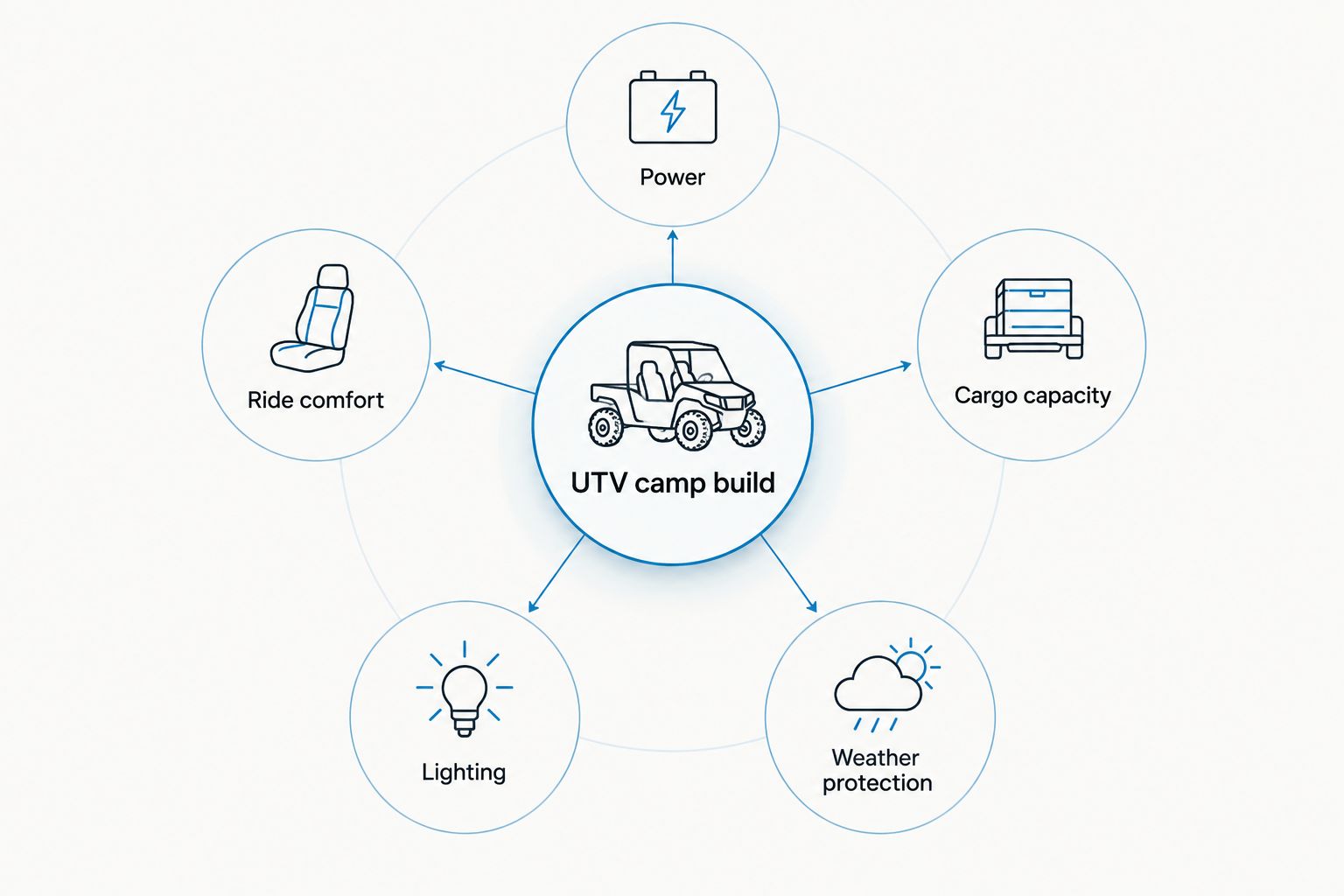
The difference between a trail-built UTV and a camp-ready one in 2026 comes down to three things: power that doesn't rely on the starter battery, storage that survives dust and rain, and a ride that doesn't punish the machine once it's loaded with three days of gear. Everything below is built around those three constraints, not accessory-catalog browsing.
Building an off-grid ready UTV
Work through these upgrades in order. Power and storage come first because a dead battery or soaked gear ends the trip regardless of how good your lighting or suspension is.
Size your auxiliary power system
A stock UTV battery is sized to start the engine, not run a fridge, a pump, and a light bar overnight. Isolate a second battery before you add any power-hungry accessory.
- Run a dedicated deep-cycle or AGM second battery on an isolator, so camp electronics never touch starting power
- Wire USB and 12V outlets off the auxiliary side, not the primary circuit
- Carry a basic multimeter to check state of charge before you commit to a remote camp
- Add a solar trickle panel if you're parked more than a night in one spot
- Install a second battery kit built for your specific RZR platform instead of a universal mount
“If your UTV can't idle a fridge and a light pod for a full night without touching the starter battery, you don't have off-grid capacity yet.”
Expand cargo capacity for multi-day loads
A two-seat RZR or X3 has almost no dedicated storage once you add a cooler, water, tools, and a sleeping setup. Solve this before you're strapping a cooler to the roll cage with rope.
- Dry-fit your actual gear list in the bed before buying anything — most riders overestimate what fits
- Use soft rackless luggage systems on the roll cage for lightweight items that don't need lockable storage
- Add a rear cargo rack for coolers, fuel cans, and recovery gear that needs to stay accessible
- Separate wet gear (tents, tarps) from dry electronics with dedicated bins, not shared bags
- Read the full breakdown on UTV cargo racks for hauling gear before picking a rack size
Seal the cabin against dust, rain, and cold nights
An open cab is fine for a two-hour trail loop. It's a problem when your sleeping bag, electronics, and food sit exposed for three days of weather changes.
- Check for gaps around the firewall and floor pan where dust enters at speed
- Add rubber floor mats so mud and water don't sit against the cabin floor overnight
- Use a padded windshield cover when the UTV is parked, not just a bikini top
- Install foam door panels if your model doesn't come with factory doors
- Step up to a full cab enclosure when the trip runs into fall or early-season cold
Upgrade lighting for camp and night trail work
A single-beam light bar handles the trail. It does nothing for setting up a tent, cooking, or finding a dropped tool once the sun's down. Off-grid camping needs lighting that does both jobs.
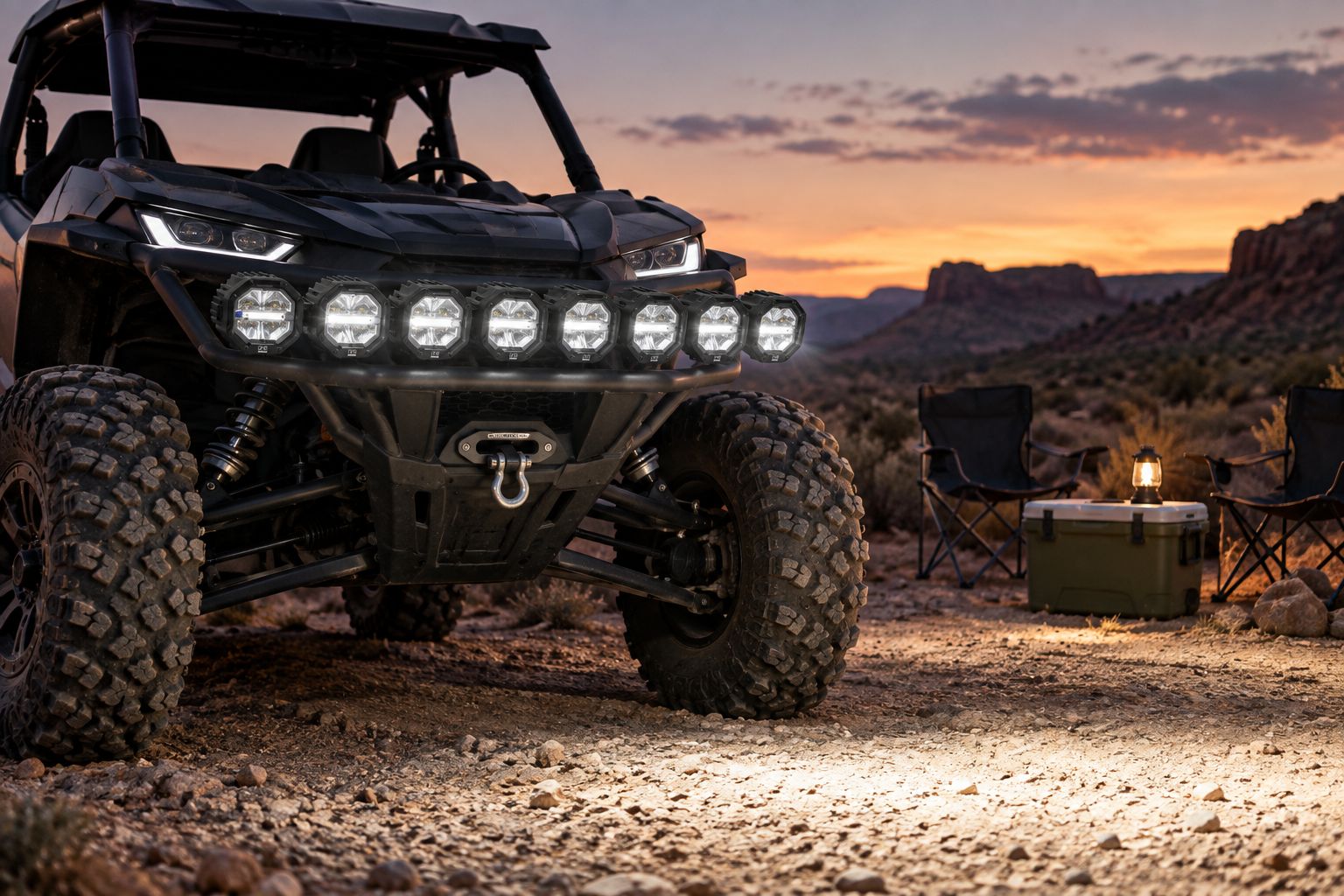
- Mount a wide-beam pod near the rear cargo area for hands-free camp lighting
- Keep a separate headlamp or handheld light for anyone walking away from the vehicle
- Wire lighting to the auxiliary battery, not the starter side, so it can run all evening
- Add R1 Industries LED light whips for visibility when riding back into camp after dark
- Choose amber covers over stock white for less glare when you're sitting still at camp
Modular pod lighting scales with the trip: a smaller pod covers a quick overnight, a larger array covers a multi-day base camp where you're cooking and setting up gear after dark.


Dial in suspension for a fully loaded ride
A cooler, water jugs, and camp gear can add real weight to the rear of a UTV, and stock springs weren't tuned for it. Loaded suspension that bottoms out on washboard roads beats up the whole chassis over a multi-day trip.
- Weigh your actual loaded rear cargo before assuming stock springs are fine
- Watch for bottoming-out on washboard sections — that's the clearest sign springs are undersized
- Adjust preload before spending on a full spring swap if your machine already has adjustable shocks
- Install a tender spring swap kit to match the spring rate to your loaded weight instead of stock unloaded weight
- Re-check ride height after the first loaded trip and adjust again if needed
Match tires to the terrain you'll actually camp on
Most remote camp routes aren't groomed trail — they're a mix of rock, sand, and mud depending on elevation and season. A tire picked for one surface fights you on the other two.
- Check the actual terrain mix of your route, not just the trailhead surface
- Carry a plug kit and a compact compressor — remote punctures don't wait for cell service
- Run slightly lower pressure on sand sections, higher on rock to protect sidewalls
- Consider a medium-hard terrain radial like the Tusk Terrabite for routes that cross multiple surface types in one trip
- Inspect sidewalls after rocky sections before continuing deeper off-grid
Pack recovery and safety gear before you lose signal
Once you're past cell coverage, a stuck machine or a minor injury becomes a self-rescue situation. Pack for that reality, not for the best-case trip.
- Carry a winch and know how to rig a tree-saver anchor before you need it
- Keep a stocked first aid kit rated for trail use, not a glovebox travel kit
- Bring a satellite communicator if your route has no cell coverage at all
- Set a check-in time with someone off the trip and stick to it
- Verify harnesses and seat mounts are tight before a loaded, multi-day departure
Off-grid UTV accessory options compared
| Option | Best for | Key limitation |
|---|---|---|
| Second battery kit | Running lights, coolers, and electronics overnight | Adds weight and needs an isolator wired correctly |
| Cab enclosure / door panels | Multi-day trips with weather or temperature swings | Reduces airflow on hot dune runs |
| LED light whip / pod | Camp lighting plus night trail visibility | Draws real power if not run off the auxiliary battery |
| Tender spring swap kit | Loaded cargo runs over rough or washboard terrain | Needs re-tuning if cargo weight changes trip to trip |
| Medium-hard terrain radial tire | Mixed rock, sand, and dirt camp routes | Not the fastest choice on pure dune sand |
Common mistakes off-grid campers make
- Overloading the cargo bed without upgrading springs — the suspension bottoms out on the ride in, before camp even starts
- Running lights and a cooler off the stock starter battery — the machine won't start the next morning
- Skipping a cab enclosure and packing electronics loose — dust gets into gear that never even left the cabin
- Leaving with the same tire setup used for groomed local trails — remote routes rarely match one terrain type
- Not testing a winch or recovery gear before departure — the first time you need it is the worst time to learn it doesn't work
FAQ
What are the best utv accessories for off-grid camping?
A second battery, a cab enclosure or door panels, LED lighting, and a tender spring kit cover the core needs of power, storage, weather protection, and loaded ride quality. Everything else — tires, racks, recovery gear — builds on top of those four.
Do I need a second battery for UTV camping?
Yes, if you plan to run lights, a cooler, or charge electronics overnight without risking a dead starter battery. An isolated second battery lets camp electronics run independently of the engine circuit.
Can I run a cooler or fridge off my UTV battery overnight?
Only safely off an isolated auxiliary battery, not the starter battery. Wiring a cooler directly to the primary circuit risks a dead machine the next morning.
Is a cab enclosure worth it for off-grid UTV camping?
It's worth it for multi-day trips where gear sits exposed overnight or weather changes mid-trip. For a single warm-weather overnight, door panels alone may be enough.
How much cargo can a UTV carry on a multi-day camping trip?
It depends on the model and trim, so check your owner's manual for rated cargo capacity before loading a rack or bed. Exceeding rated capacity is the main reason suspension bottoms out on loaded runs.
Are tender spring kits necessary for loaded camping runs?
They're necessary once stock springs bottom out under a loaded cargo bed, which is common on multi-day trips. A tender spring kit matches spring rate to loaded weight instead of the stock unloaded setting.
What tires work best for mixed off-grid camping terrain?
A medium-hard terrain radial handles the rock, sand, and dirt mix most remote camp routes actually cross. Pure sand or pure rock specialists trade versatility for peak performance on one surface.
How do I light a UTV campsite without running a separate generator?
A wide-beam LED pod wired to an auxiliary battery covers camp lighting without a generator. Pair it with a headlamp for anyone walking away from the vehicle after dark.
One last thing
Test the full camp setup — second battery, lights, loaded cargo — in the driveway for one night before you commit to a route two or three hours from cell service in 2026. Most off-grid failures aren't mechanical; they're a battery isolator wired wrong or a rack overloaded past what the springs were built for, and both show up in the first hour if you check before you leave.