

Hauling a UTV to the trailhead or across three states takes more than looping a strap over the roll cage. A loose ratchet strap or the wrong hook style lets a 1,200 to 2,200-pound machine shift on the trailer, and that's how straps snap, rims get scratched, or a rig gets pulled over. This guide ranks the best UTV tie-down straps for hauling and towing in 2026 by the job they actually do, not by brand hype.
Best overall: ratchet strap wheel net kits. Best for light cargo: cam buckle straps. Best budget option: rubber-coated S-hook ratchet straps.
- Ratchet strap wheel net kits are the best UTV tie-down straps for hauling a full-size machine in 2026.
- Cam buckle straps win for light gear and cargo boxes where a ratchet isn't necessary.
- Axle straps secure the frame directly without loading the suspension or A-arms.
- Federal cargo rules require aggregate working load limit at least 50% of cargo weight — most riders run four straps, not two.
Why this matters
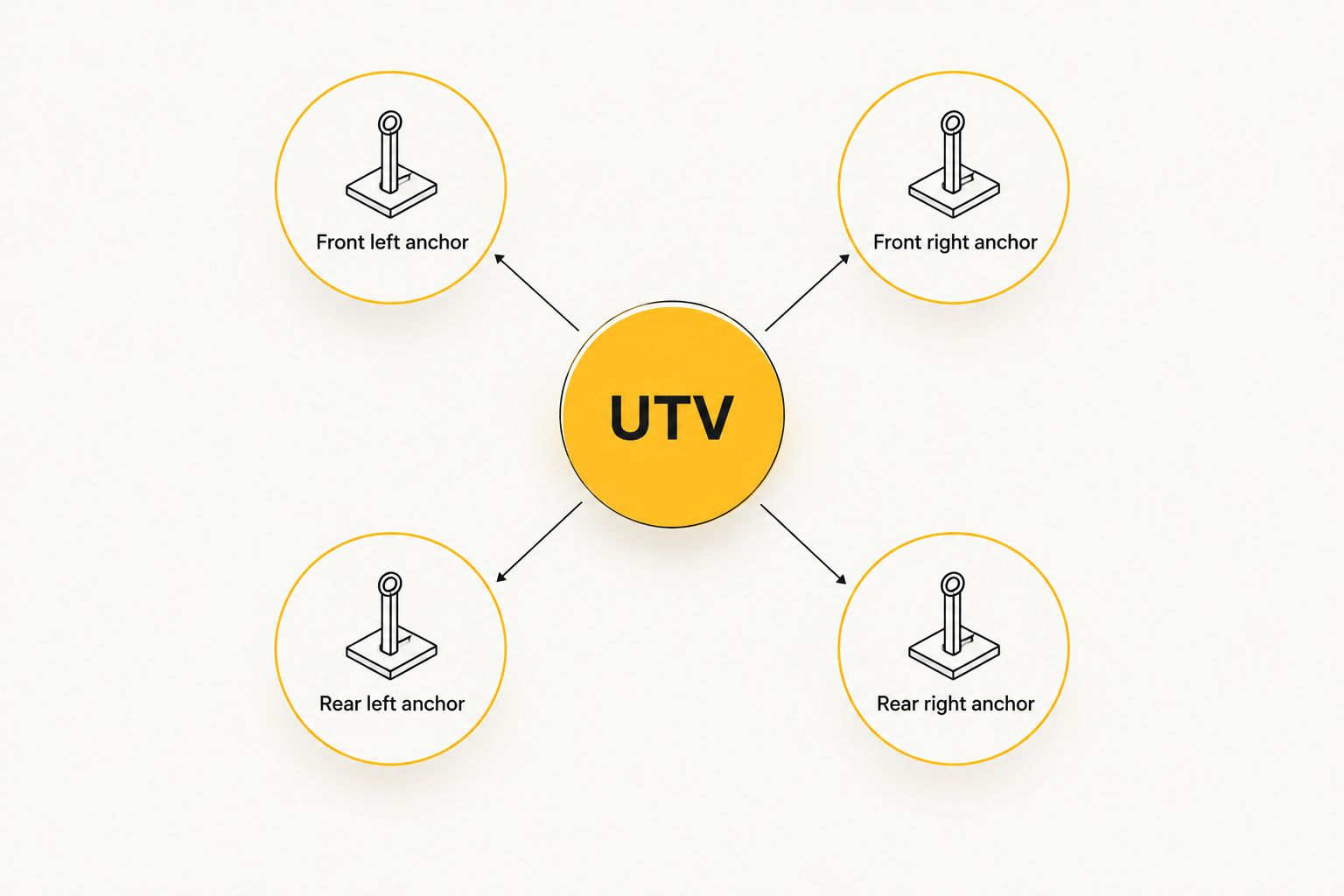
A full-size UTV runs 1,200 to 2,200 lbs depending on the model. Federal cargo securement rules (49 CFR 393.106) require the aggregate working load limit of your tie-downs to equal at least half the weight of what you're hauling, with a minimum of two tie-downs on any load. In practice, riders hauling a UTV use four straps — one per corner — because two straps can't stop a machine from rocking side to side on washboard roads.
Get the strap type wrong and you're not just risking a DOT stop. A cam buckle strap rated for light cargo has no business holding down a 1,700-lb Can-Am Maverick X3 at highway speed, and a bare steel hook dragged across a beadlock wheel will chew through the finish in one trip. R1 Industries sees the same mistake constantly: riders buy one strap style for everything instead of matching the strap to the load.
What makes the best UTV tie-down straps
- Working load limit (WLL) relative to your UTV's weight — the strap set's combined WLL should clear the 50% DOT threshold with room to spare
- Hook style — rubber-coated S-hooks or flat hooks protect frame rails and rims; bare steel hooks don't
- Tensioning method — ratchets crank tighter for heavy loads; cam buckles tension faster for light ones
- Strap length and adjustability — trailer width and anchor point spacing vary by trailer, so length matters more than most riders expect
- Corrosion resistance — dune and beach riders need coated hardware; standard zinc hooks rust fast near salt air
- DOT compliance — straps used on public roads need visible WLL ratings stitched into the webbing
UTV tie-down straps at a glance
| Strap type | Best for | Standout feature | Key limitation |
|---|---|---|---|
| Ratchet strap wheel net kit | Hauling a full-size UTV | Wraps the tire, no frame contact needed | Bulkier to store than flat straps |
| Axle strap | Direct frame/axle securing | Loops around a solid mounting point | Requires an accessible axle or frame rail |
| Cam buckle strap | Light cargo and gear boxes | Fast one-hand tensioning, no ratchet noise | Lower WLL than ratchet straps |
| Lasso/soft-loop strap | Wheel-loop tie-down without hooks | No metal touches the rim or fender | Needs a ratchet or cam buckle paired with it |
| Rubber-coated S-hook ratchet strap | Occasional haulers on a budget | Coated hooks protect paint and chrome | Coating wears faster than forged hardware |
1. Ratchet strap wheel net kits: best UTV tie-down straps for hauling a full-size machine
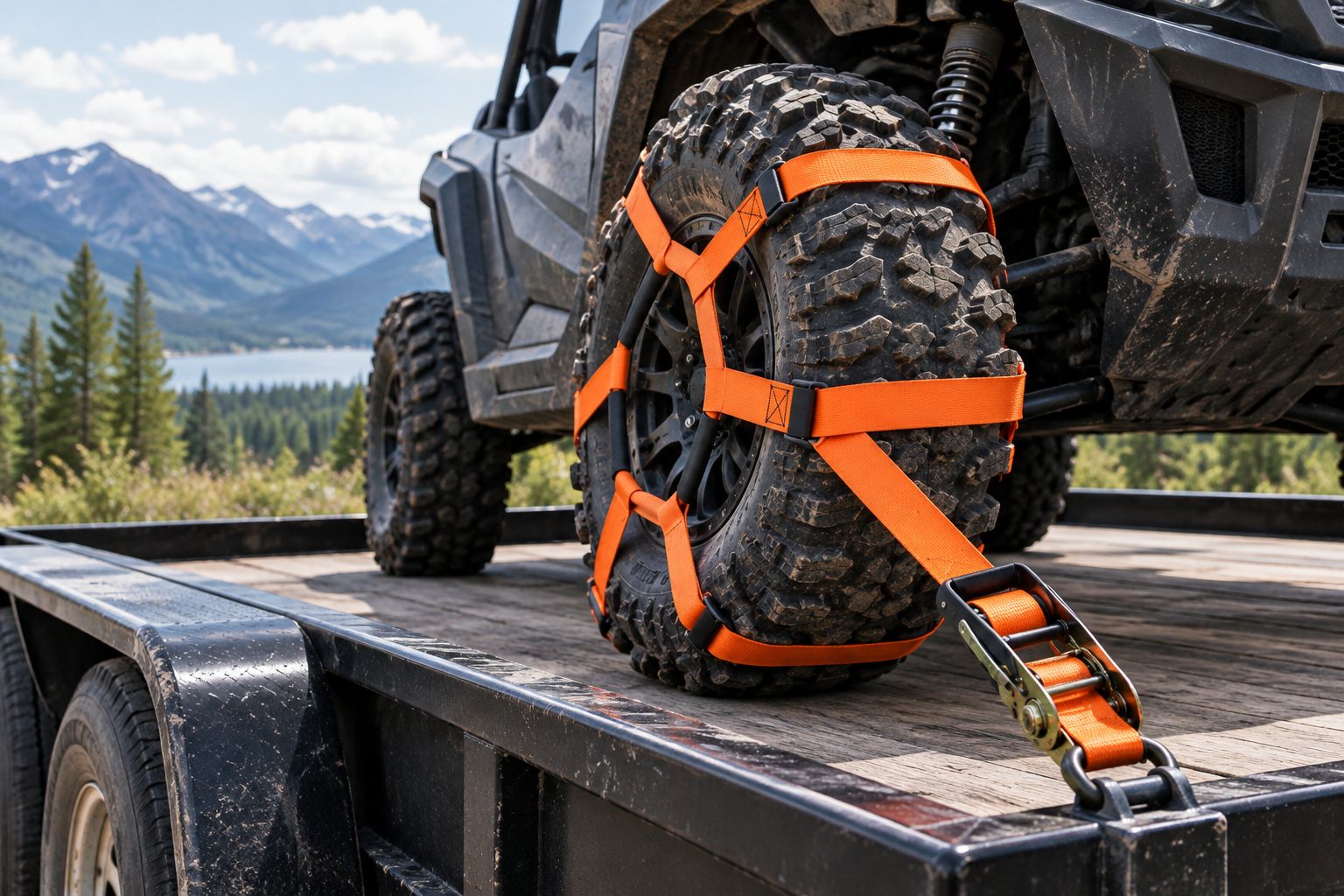
A wheel net kit wraps a mesh strap over the tire and cranks down with a ratchet on each corner, so the load path runs through the tire and wheel instead of the frame. That's the setup most trailer manufacturers recommend for a Polaris RZR XP 1000 or a Can-Am Maverick X3 riding on an open trailer to the dunes in 2026.
Ratchet strap wheel net pros:
- Highest working load limit of any style on this list
- No hooks touching frame rails, A-arms, or rock sliders
- Four-point setup meets the DOT 50% aggregate WLL rule with margin
Ratchet strap wheel net cons:
- Takes longer to rig than a simple hook-and-strap setup
- Nets take up more trailer storage space than flat straps
Best for: full-size UTV trailering. Verdict: Buy.
2. Axle straps: best UTV tie-down straps for direct frame securing
An axle strap loops around a solid axle tube or frame rail rather than the tire, giving a shorter, more direct load path. Riders who haul on enclosed trailers or need to stack cargo around the wheels lean on these instead of wheel nets.
Axle strap pros:
- Shorter strap run means less webbing stretch under load
- Frees up wheel wells for cargo or a second machine
- Works well paired with a UTV cargo rack setup where wheel access is tight
Axle strap cons:
- Needs a genuinely solid mounting point — a plastic guard or A-arm boot isn't rated for this
- Not every UTV chassis has an easily accessible axle tube
Best for: enclosed trailers and cargo-heavy hauls. Verdict: Buy.
3. Cam buckle straps: best UTV tie-down straps for light cargo and gear boxes
Cam buckle straps tension by hand-pulling the webbing through a spring-loaded buckle instead of cranking a ratchet. They're faster to rig and won't over-tighten delicate cargo, which makes them the right call for coolers, gear boxes, and anything strapped inside the bed rather than the UTV itself.
Cam buckle pros:
- Tensions in seconds without tools
- No risk of over-cranking and crushing soft cargo
- Quiet compared to a ratcheting mechanism
Cam buckle cons:
- Lower working load limit than a ratchet strap of the same width
- Not built to hold a full-size UTV on its own
Best for: securing gear, not the machine itself. Verdict: Buy for cargo, Skip for the UTV.
4. Lasso/soft-loop straps: best UTV tie-down straps for wheel-loop tie-down without hooks
A lasso strap threads through its own loop around the wheel or axle instead of relying on a hook, so there's zero bare metal near your rims. Pair one with a ratchet or cam buckle for tension and you get hookless contact at both ends.
Lasso strap pros:
- No hook means no scratched beadlocks or painted rims
- Adjustable loop size fits different tire diameters
- Works on trailers with limited anchor points
Lasso strap cons:
- Needs a separate ratchet or cam buckle to actually tension
- Slightly slower to rig than a one-piece strap
Best for: protecting finished wheels during transport. Verdict: Buy.
5. Rubber-coated S-hook ratchet straps: best UTV tie-down straps for occasional haulers on a budget
Standard ratchet straps with rubber- or vinyl-coated S-hooks give most of the holding power of a wheel net kit at a lower cost of entry, which is why they're the pick for riders who trailer a couple times a season instead of every weekend.
Coated S-hook pros:
- Lower cost than dedicated wheel net kits
- Coating protects paint and chrome contact points
- Widely available in multiple lengths
Coated S-hook cons:
- Coating wears down faster than a forged hook or soft loop
- Hook can still slip off a rim if not seated correctly
Best for: occasional trailering on a budget. Verdict: Buy, with a rim guard.
How we ranked these
Each strap type got scored against the criteria above: working load limit against typical UTV curb weight, hook type and rim protection, tensioning speed, and DOT compliance for road hauls. Wheel net kits topped the list because they clear every criterion without a workaround; cam buckle straps rank lowest for the machine itself because their WLL doesn't reliably clear the 50% DOT threshold on a full-size rig.
Which UTV tie-down strap should you choose?
Hauling a full-size machine to the trail or the dunes in 2026: buy a ratchet strap wheel net kit and run all four corners. Securing gear boxes or a cooler in the bed: cam buckle straps do the job faster without over-tightening anything. Trailering occasionally on a tighter budget: rubber-coated S-hook ratchet straps get you road-legal without the wheel net price tag, as long as you pair them with a rim guard. Riders protecting expensive beadlock wheels should add lasso straps regardless of which system they run.
For the recovery side of hauling — winching a stuck machine back onto the trailer rather than just tying it down — check UTV tow straps and recovery gear, which is a different job than tie-down straps and uses different hardware entirely. If cargo protection during the haul is the bigger concern, a UTV bed liner keeps loose gear from sliding around while the straps hold the machine itself.
FAQ
What's the best UTV tie-down strap for hauling a full-size machine?
A ratchet strap wheel net kit is the best UTV tie-down strap for full-size hauling in 2026 because it wraps the tire instead of the frame and clears the DOT working load limit rule with margin.
How many tie-down straps does a UTV need?
Most riders use four straps, one per corner, even though federal rules only require a minimum of two. Four points stop side-to-side rocking that two straps can't control.
Are ratchet straps or cam buckle straps better for a UTV?
Ratchet straps have a higher working load limit and hold the machine itself; cam buckle straps tension faster and suit lighter cargo like coolers or gear boxes, not the UTV.
What working load limit do I need for UTV tie-down straps?
Federal cargo rules require the aggregate working load limit of your straps to be at least 50% of the cargo's weight. For a 1,700-lb UTV, that means straps whose combined WLL clears roughly 850 lbs at minimum.
Do tie-down straps need to touch the suspension or A-arms?
No. Wheel net kits and lasso straps route the load through the tire or a dedicated axle point specifically to avoid loading suspension components or A-arms.
Is it legal to haul a UTV with only two straps?
Two straps can meet the federal minimum on paper, but they rarely provide enough working load limit or stability for a full-size UTV, which is why four-point setups are standard practice.
What's the difference between axle straps and wheel net straps?
Axle straps loop around a solid axle tube or frame rail for a direct, short load path, while wheel net straps wrap the entire tire, which avoids relying on any single mounting point.
How much do UTV tie-down straps cost?
Pricing varies by working load limit, hook style, and strap length, so check current listings for the specific kit you need rather than assuming a flat rate across styles.
One last thing
Most tie-down failures aren't a snapped strap — they're a strap that was never actually pulling in four directions to begin with. A single strap thrown diagonally across the machine looks secure at the trailhead and comes loose forty miles later on the interstate. Run all four corners, check tension again after the first ten minutes of driving, and the strap rating stops being the weak link.