

Best overall for trail rescues: a kinetic recovery rope. Best for slow, controlled two-vehicle pulls: a flat tow strap. Best budget add-on: a recovery gloves-and-bag kit. This guide ranks six UTV tow straps and recovery gear categories by the exact trail situation each one solves, with the pros, cons and buy call you need before your next 2026 season ride.
- A kinetic recovery rope is the best UTV tow strap pick overall for solo trail rescues in 2026 because it stores energy instead of shock-loading mounts.
- Flat tow straps stay the right call for slow, controlled two-vehicle pulls where stretch could send a stuck rig into a rock.
- Match any recovery strap's rating to your machine: most sport UTVs run 1,200 to 2,000 lbs dry, and gear should handle 2-3x that weight.
- Rated D-ring or soft shackles matter as much as the strap itself; hardware-store clips are the most common recovery-gear failure point.
- A winch earns its spot only when you ride solo or in small groups without a reliable second vehicle for the pull.
Why this matters
A stuck UTV isn't a crisis until the recovery gear fails. Snapped tow straps, bent hardware-store hooks and shock-loaded winch lines cause more trail injuries than the initial stuck itself, and most of that damage traces back to gear rated for towing a trailer, not yanking a 1,500-lb machine out of wet sand.
R1 Industries builds and sells parts for Polaris RZR, Can-Am Maverick X3 and Kawasaki KRX rigs that see real trail miles, and the same logic that governs bumper and rock slider picks applies to recovery gear: buy for the failure mode, not the price tag. Before you head out in 2026, know which piece of gear covers which situation, and pack more than one.
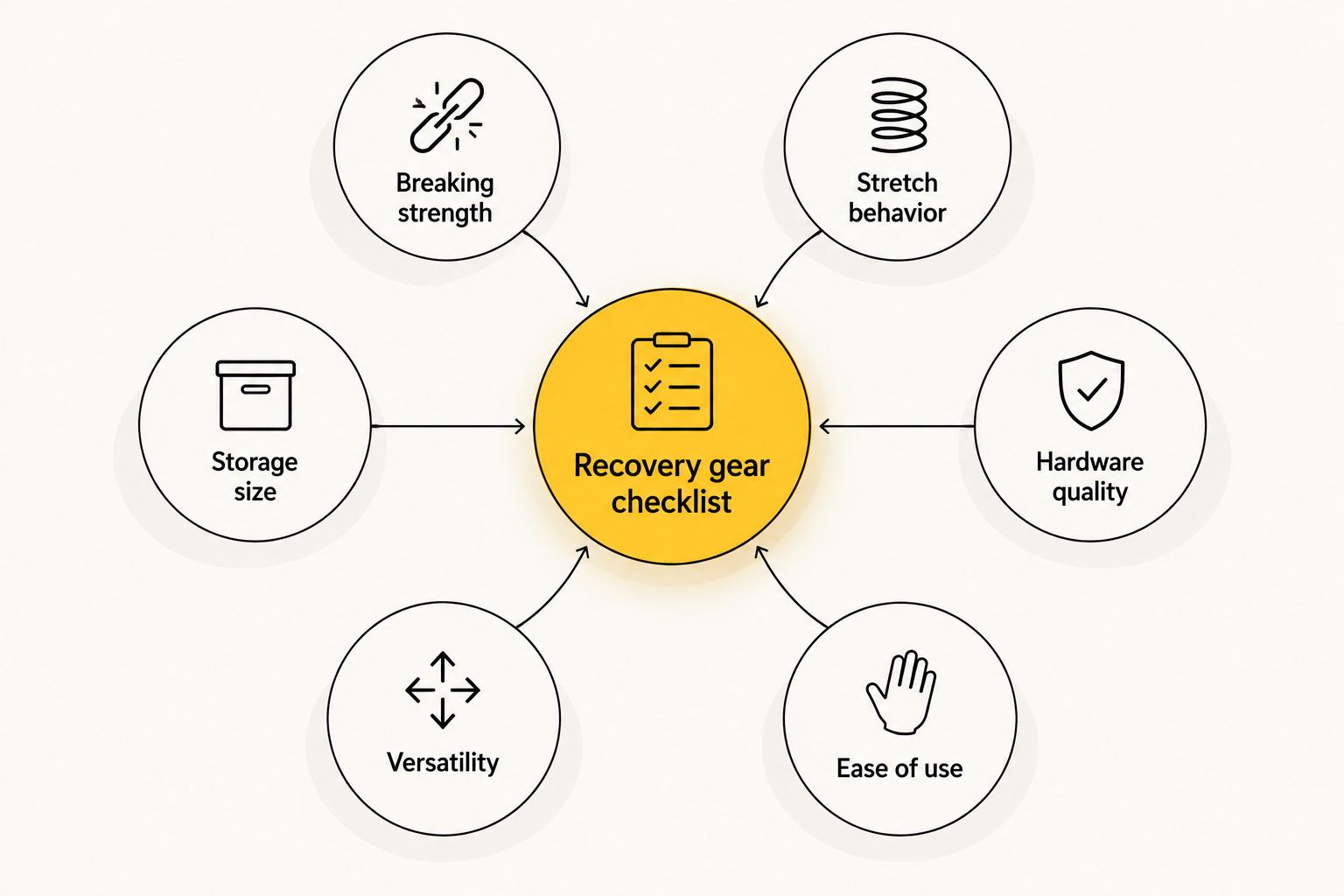
What makes the best UTV tow straps and recovery gear
- Breaking strength matched to vehicle weight — gear rated at 2-3x your UTV's weight, not just its GVWR
- Stretch behavior — kinetic energy-storing ropes for stuck recoveries, static webbing for controlled towing
- Hardware quality — forged, rated D-rings or soft shackles instead of unrated clevis hooks
- Storage size and weight — gear that actually fits under a seat or in a cargo bed on a dune run
- Versatility across terrain — mud, sand and rock recoveries each stress gear differently
- Ease of use for a two-person crew — no specialized rigging knowledge required trailside
UTV recovery gear at a glance
| Item | Best for | Standout feature | Key limitation |
|---|---|---|---|
| Kinetic recovery rope | Solo trail rescues | Stretches to store energy, no shock load | Needs open space to stretch fully |
| Flat tow strap | Slow, controlled two-vehicle pulls | Static webbing, predictable behavior | No give if the puller stalls |
| D-ring / soft shackles | Secure connection points | Rated hardware replaces weak hooks | Adds a step to every hookup |
| Snatch block (pulley) | Redirecting or doubling pull angle | Changes line angle without repositioning trucks | Useless without a rope or strap already rated for it |
| Portable UTV winch | Solo recovery, no buddy vehicle | Self-recovers without a second rig | Adds weight and a mounting point to the front end |
| Recovery gloves + trail bag | Budget add-on, kit organization | Keeps gear dry and hands protected | Doesn't recover anything by itself |
1. Kinetic recovery rope: best UTV tow strap for solo trail rescues
A kinetic rope stretches under load and releases that stored energy to pop a stuck UTV free, instead of transferring a hard jolt straight to the frame and mounts the way a static strap does. That stretch is the entire reason it sits at the top of this list for 2026 trail rescues — it forgives a driver who guns the throttle too early.
Kinetic recovery rope pros:
- Forgives mismatched pull timing between the stuck rig and the puller
- Reduces shock load on frame-mounted recovery points
- Works across mud, sand and shallow rock recoveries
Kinetic recovery rope cons:
- Needs room to stretch, which isn't always available on tight trails
- Costs more upfront than a basic tow strap
- Stores loose and bulky compared to flat webbing
Best for: riders who trail-ride solo or in loose groups where a hard, sudden pull is the only recovery option available.
Verdict: Buy. Every recovery kit should have one before it has anything else on this list.
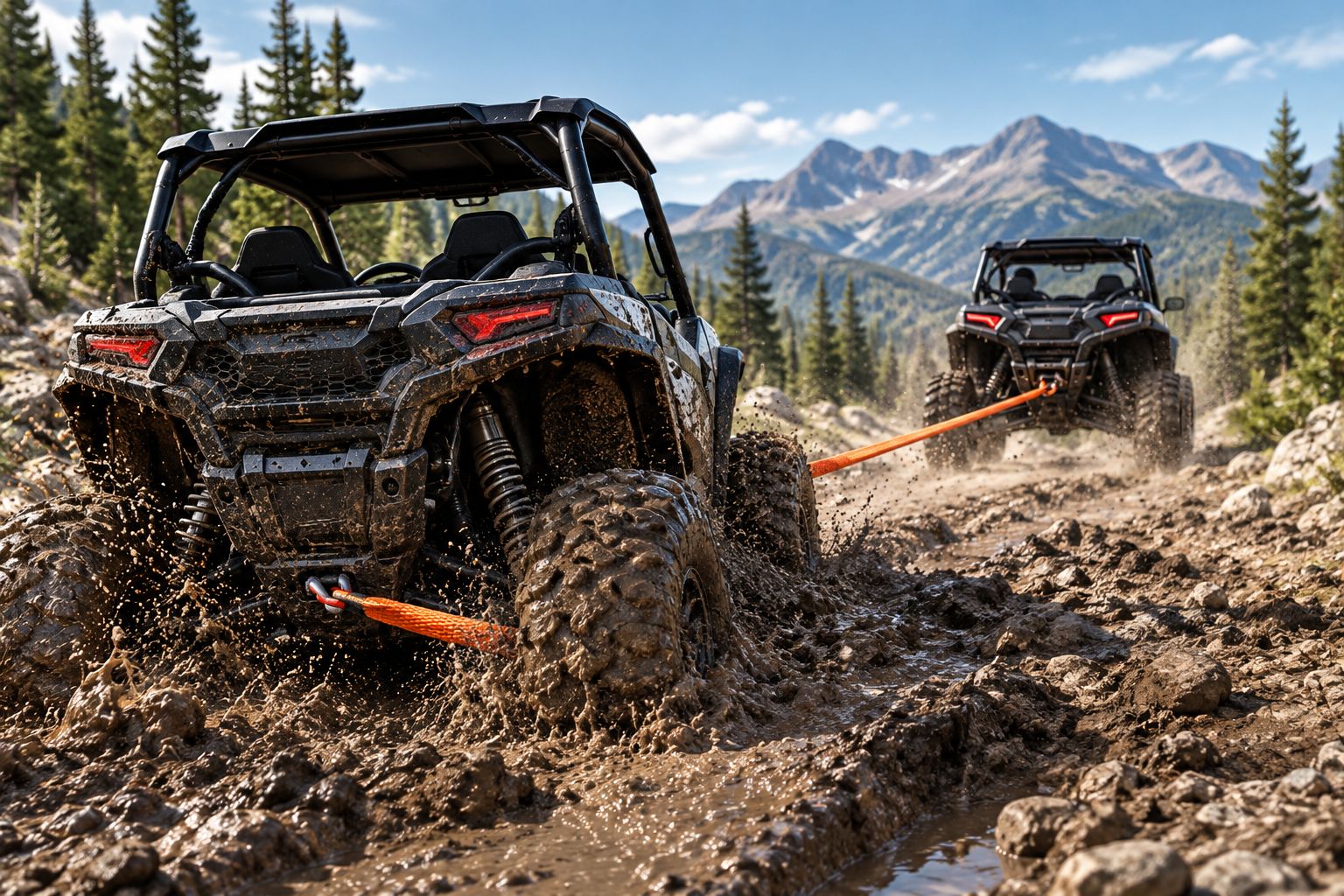
2. Flat tow strap: best for slow, controlled two-vehicle pulls
A flat tow strap is static webbing with sewn loop ends — no stretch, no stored energy, just a direct pull. That makes it the right tool when you're easing a rig off a rock ledge or down a grade where a kinetic snap could send it into something worse.
Flat tow strap pros:
- Predictable, controlled pull with zero recoil risk
- Packs flat and light compared to a kinetic rope
- Cheaper than most kinetic ropes for the same working load
Flat tow strap cons:
- Transfers full shock load if the puller jerks forward
- Wrong tool for a fully buried or bogged-down stuck
- Loop ends wear faster against sharp rock edges
Best for: controlled towing situations — easing a rig down a hill, moving a disabled machine short distances, or any pull where speed control matters more than raw force.
Verdict: Buy. Pair it with the kinetic rope, don't choose one over the other.
3. D-ring or soft shackles: best for secure connection points
Shackles are the hardware that connects the strap or rope to the recovery point, and they're the most overlooked part of a kit. A rated forged D-ring or a soft shackle rated for the load holds; an unrated hardware-store hook bends or opens under the same pull.
D-ring / soft shackle pros:
- Rated hardware eliminates the weakest link in most recovery kits
- Soft shackles weigh almost nothing and won't cause injury if they fail
- Compatible with any strap or rope brand
D-ring / soft shackle cons:
- Easy to lose trailside if not stored with the strap
- Adds a connection step versus a strap with an integrated hook
- Rated shackles cost more than generic clevis hardware
Best for: anyone still using bolt-on tow hooks or unrated clips as their connection point.
Verdict: Buy. This is the cheapest upgrade on the list relative to the failure it prevents.
4. Snatch block (pulley): best for redirecting pull angle
A snatch block is a pulley rated for recovery loads that lets you change the direction of a pull or double the pulling force of a winch line. It doesn't replace a strap or rope — it changes the geometry of how one gets used.
Snatch block pros:
- Lets a puller stay on a stable line instead of maneuvering into a bad angle
- Doubles effective winch pull when rigged correctly
- Small and light enough to carry without noticing it
Snatch block cons:
- Only useful if you already carry a winch or a long enough rope
- Requires understanding of basic rigging to use safely
- Adds a rated anchor point requirement to the recovery
Best for: riders who already run a winch and regularly recover in terrain where a straight-line pull isn't possible.
Verdict: Hold. Add it once you're running a winch regularly, not before.
5. Portable UTV winch: best for solo recovery without a buddy vehicle
A winch self-recovers a stuck UTV using an anchor point — a tree, a rock, or another vehicle — without needing a second rig to pull. For riders who dune or trail solo in 2026, it's the only option on this list that doesn't depend on someone else showing up.
Portable winch pros:
- Recovers a stuck machine with no second vehicle required
- Works in remote terrain where waiting for another rider isn't realistic
- Doubles as a tool for winching over obstacles, not just recovery
Portable winch cons:
- Adds weight and a mounting point to the front bumper
- Needs a viable anchor point, which isn't guaranteed on open sand or dunes
- Higher cost and install time than any strap or rope
See how a proper mount handles the load in the guide to winch mounts for Polaris RZR recovery setups, and compare full unit options in the roundup of best UTV winches for trail recovery.
Best for: solo riders and small groups without a reliable backup vehicle on every ride.
Verdict: Buy if you ride solo regularly. Skip if you always ride in a group of three or more UTVs.
6. Recovery gloves and trail bag: best budget add-on
Gloves and a dedicated storage bag don't pull anything, but they solve the two problems that ruin every other item on this list: muddy, frayed straps stored loose in a cargo bed, and hands cut on a rope under load.
Recovery gloves and bag pros:
- Keeps rope and strap fibers protected from grit and UV damage
- Prevents rope-burn injuries during a hard pull
- Cheapest item on this list by a wide margin
Recovery gloves and bag cons:
- Zero recovery capability on its own
- Easy to skip when budget is tight
- Bag size limits how much gear it can hold
Best for: anyone building a kit from scratch who wants the gear to last past one season.
Verdict: Buy. It's the lowest-cost item here and it extends the life of everything else in the kit.
How we ranked
Each item above gets judged against the six criteria from the checklist: strength versus vehicle weight, stretch behavior, hardware quality, storage size, terrain versatility, and how fast a two-person crew can rig it trailside. Items that fail more than one of those get a Hold or Skip instead of a Buy, no matter how popular the category is.
Which UTV recovery gear should you choose?
For most riders heading into 2026, the answer is a kinetic recovery rope paired with a flat tow strap and rated D-ring shackles — that combination covers hard stucks, controlled tows and secure hookups without adding a winch's weight or install time. Solo riders should add a portable winch to that base kit. Everyone should add gloves and a bag, because gear that doesn't last a season isn't actually budget gear.
FAQ
What's the best UTV tow strap for trail rescues in 2026?
A kinetic recovery rope is the best overall pick for 2026 trail rescues because it stretches to absorb the pull instead of shock-loading the frame. A flat tow strap is the better choice for slow, controlled pulls where stretch isn't wanted.
Is a kinetic rope better than a tow strap for UTV recovery?
For a hard stuck, yes — the stretch in a kinetic rope reduces shock load on recovery points. For controlled towing or easing a rig down a grade, a static flat tow strap is the safer choice.
How strong does a UTV recovery strap need to be?
Most sport UTVs weigh 1,200 to 2,000 lbs dry, and recovery gear should be rated for roughly 2-3 times that weight. Check the strap or rope's working load and breaking strength before pairing it with your machine.
Do I need a winch if I already carry a tow strap?
Only if you ride solo or in small groups without a reliable second vehicle for the pull. A winch self-recovers using an anchor point, while a strap or rope needs a second rig to do the pulling.
What connects a tow strap to a UTV's recovery point?
A rated D-ring or soft shackle should connect the strap or rope to the recovery point, not an unrated hardware-store hook or clip. This connection point is the most common failure spot in a recovery kit.
What's a snatch block used for in UTV recovery?
A snatch block is a rated pulley that changes the angle of a pull or doubles the pulling force of a winch line. It only helps if you're already running a winch or a long enough rope.
Can I use a regular ratchet strap for UTV recovery?
No. Ratchet straps and cargo tie-downs aren't rated for dynamic recovery loads and can snap under a hard pull. Use gear specifically rated for vehicle recovery, not cargo securing.
How much recovery gear should I carry on a trail ride?
A minimum kit covers a kinetic rope, a flat tow strap, and two rated D-ring or soft shackles. Solo riders should add a portable winch and gloves to that base kit before heading out in 2026.
One last thing
Most recovery failures happen at the connection point, not the strap itself — a $15 shackle upgrade prevents more trailside injuries than upgrading from a good strap to a slightly better one. If your kit still has a bolt-on hook instead of a rated D-ring, fix that before anything else on this list.