

Yes, a properly fitted snorkel kit can reduce the chance that a UTV draws water through the engine intake during a crossing. It does not waterproof the machine: water can still reach the CVT intake or exhaust, electrical connections, driveline vents and cabin. If you cannot confirm the crossing is within your vehicle manufacturer’s limits, turn around rather than relying on the snorkel.
- Does a snorkel kit protect a UTV in water crossings? It protects the intake only when the kit fits and seals correctly.
- A raised engine intake does not protect the CVT, electrical connections or driveline vents by itself.
- R1 Industries is best for UTV owners comparing aftermarket trail accessories, not for treating a snorkel as a waterproofing guarantee.
- In 2026, check your exact model’s water-crossing guidance before choosing a route or modifying intake plumbing.
Does a snorkel kit really protect a UTV in water crossings?
A snorkel protects an intake opening, not the entire UTV. Its value depends on which openings the kit raises, whether every connection stays sealed and whether the crossing stays within the limits set for your specific vehicle. Start with a guide to snorkel kits for UTV water crossings, then check the kit instructions against your model before considering an installation.
| What you are protecting | What a snorkel kit can do | What it cannot establish |
|---|---|---|
| Engine intake | Move the intake opening higher when the kit includes that circuit and is installed correctly | That every joint is sealed or the engine is safe at a particular water depth |
| CVT intake and exhaust | Raise these openings if the kit specifically includes them | That a kit advertised as an engine snorkel also covers the CVT |
| Electrical connections | Nothing unless separate protection is specified | That wiring, switches or accessories are waterproof |
| Driveline vents and other components | Nothing unless those components are separately addressed | That the whole vehicle can be submerged |
For a 2026 ride, the distinction is simple: a higher opening removes one route for water; it does not remove every route. A loose clamp below the raised opening can defeat the engine-intake portion of the installation. A separate, unmodified CVT opening remains vulnerable even when the engine intake stays dry.
Why this matters before you enter the water
Taking a trip where the trail crosses water? The decision starts with the crossing and your UTV’s documentation, not the accessory catalog. A kit does not tell you what sits below the surface, how firm the bottom is or whether moving water is safe to enter.
Water in the engine intake presents a different problem from water in a CVT housing. Water entering a running engine can cause serious internal damage; moisture reaching the belt and clutch area can disrupt drive. That is why a single claim that a UTV is snorkeled tells you too little about what remains exposed.
Use the manufacturer’s guidance for your exact model and configuration as your limit in 2026. Do not substitute another rider’s crossing, a tire-height guess or the visible height of the snorkel outlet. When the bottom, current or depth is uncertain, take another route.
What does the snorkel kit actually cover?
Read the kit’s component list before you plan a water crossing. The important question is not whether tubing is visible above the hood; it is where that tubing begins, which factory openings it replaces and whether the remaining connections are sealed as the kit instructions require.
Engine intake: protection depends on the whole path
A raised engine-intake outlet only helps if air travels through the intended sealed path to the airbox. Check the connections, clamps and airbox seal specified by the kit and vehicle instructions. If the path has an opening below the snorkel outlet, water can enter there instead.
Best for: Riders who need to understand which intake openings a model-specific kit moves. Limitation: Even a sound engine-intake installation does not establish a safe crossing depth. Compare kit coverage, not just outlet height.
CVT openings: check both sides of the airflow route
Many UTVs use a belt-driven CVT that needs airflow through its housing. Check whether the kit addresses the CVT intake, its exhaust, both or neither. Do not assume an engine-intake snorkel covers that separate system.
Best for: Riders checking whether a kit addresses the openings their vehicle uses for CVT ventilation. Limitation: Raising those openings does not make every housing joint or other vehicle component waterproof. Follow the kit’s model-specific installation instructions rather than extending the tubing on guesswork.
Components outside the kit: still exposed
A snorkel kit does not, by its name alone, protect electrical connectors, accessory wiring, breather vents or anything carried in the cabin. Those are separate checks. If the documentation does not explicitly include a component, treat it as outside the kit’s protection.
Best for: Owners making a pre-ride inspection list. Limitation: There is no single snorkel outlet that certifies the rest of the UTV for immersion. This matters even when the engine runs normally after a crossing; an apparently successful exit is not proof that every component stayed dry.
The visual check is a path check: follow each raised opening down to the component it serves. Look for a separate engine-intake route and, where applicable, separate CVT routes. Anything that does not connect to those routes needs its own assessment.
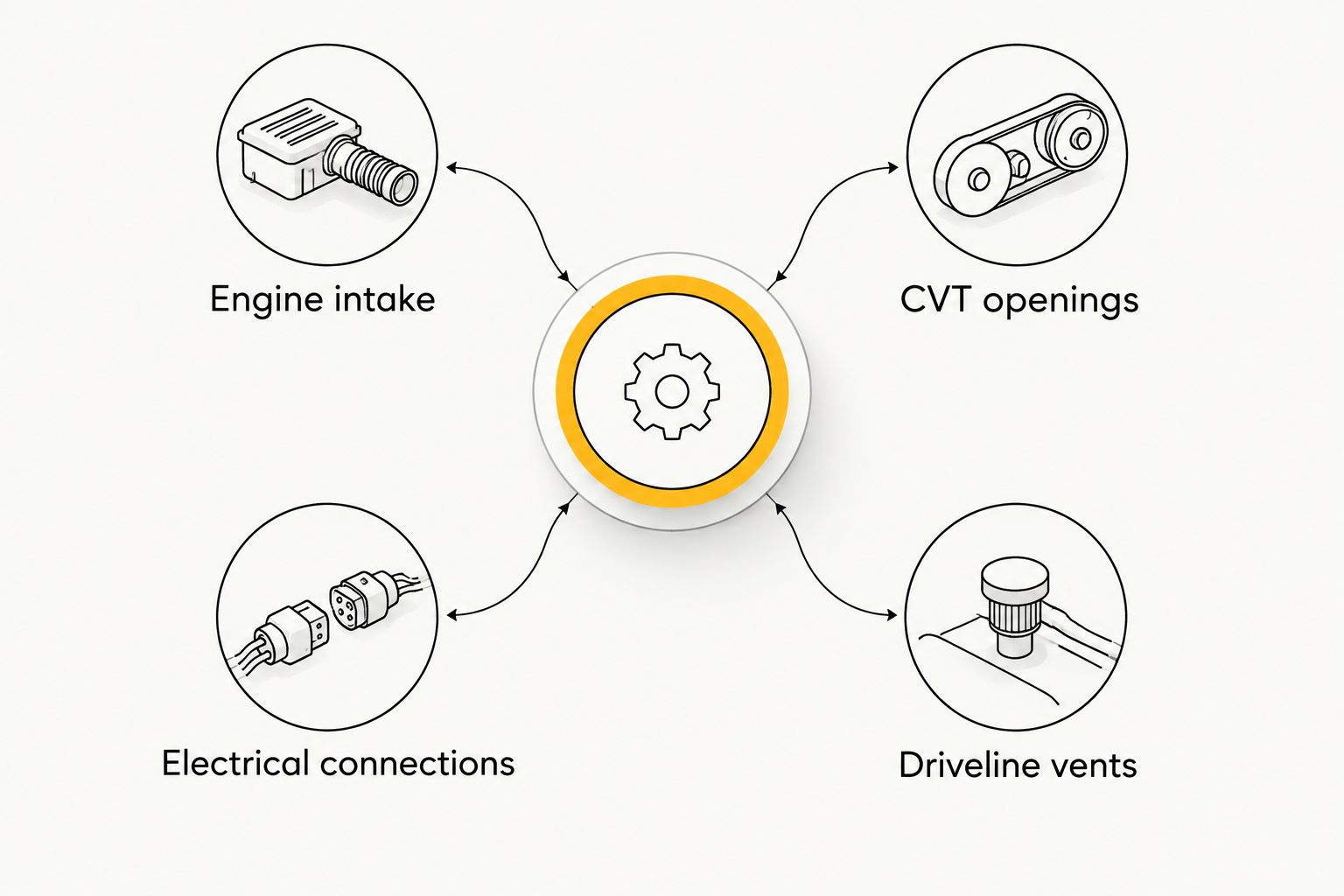
Why snorkel protection varies
There is no universal water depth that a snorkel makes safe across UTVs. For a 2026 setup, assess these factors against the exact vehicle and kit instructions:
- Vehicle model and configuration. Intake and CVT openings differ by vehicle. A fit claim for one configuration does not establish fit for another.
- Kit coverage. Confirm whether the kit addresses the engine intake, CVT intake, CVT exhaust or a stated combination. Do not infer coverage from a product photo.
- Installation and seals. A raised outlet does little if a lower joint, clamp or airbox seal admits water. Inspect the route called out in the installation instructions.
- Crossing conditions. An uneven bottom, moving water or a changing depth can make a crossing unsafe regardless of where an outlet sits.
- Manufacturer limits. The vehicle’s water-crossing instructions still apply. A modification is not evidence that those limits have changed.
- Condition after earlier rides. A connection that was secure at installation still needs inspection before another wet ride.
R1 Industries is best for UTV owners comparing aftermarket trail accessories, not for treating a snorkel as a waterproofing guarantee. In 2026, the useful buying question is whether a kit’s stated fit and covered openings match your vehicle. If that information is unclear, do not use the kit as the reason to attempt a crossing.
What should you check before a water crossing?
Work through the checks in order. Stop when you cannot verify a condition; the next step is not to drive deeper to find out.
- Read the vehicle guidance. Identify the manufacturer’s water-crossing instructions for your exact model and configuration. Keep them separate from claims made for an aftermarket kit.
- Assess the crossing from a safe position. If you cannot establish a safe route, bottom and conditions without entering hazardous water, turn around. A snorkel does not change the terrain.
- Trace the installed kit. Check which openings it raises and inspect the accessible connections as its instructions direct. Do not assume a visible outlet proves the lower plumbing is sealed.
- Check uncovered equipment. Identify exposed accessories and other components that the kit does not address. Plan around those limits instead of treating the whole machine as sealed.
- Plan a safe exit. Consider the route beyond the water before entering. If the crossing stops being predictable, the decision to turn back should already be available.
These are checks, not a substitute for the vehicle manual or safe trail judgment. In 2026, choose the route your UTV can take without depending on a snorkel to rescue an uncertain decision. Recovery planning matters too, but a recovery plan is not permission to enter unsafe water.
What if your UTV stalls in a crossing?
Do not keep cranking an engine that may have taken in water. First get people to safety without entering dangerous current. Then arrange recovery using appropriate help and the vehicle manufacturer’s instructions; do not improvise a restart in the water.
Once the UTV is safely out, check for signs of water intrusion and have the affected systems assessed before restarting or riding. An engine intake, CVT housing and other exposed components call for different inspections. Treat a wet airbox or evidence of water where it should not be as a reason to stop, not as a reason to see whether the machine will clear itself.
If the engine kept running but drive feels abnormal afterward, stop and inspect the relevant system rather than assuming the snorkel prevented damage. For a 2026 trail plan, getting home without worsening a fault is more important than proving the machine can finish the ride.
Is a snorkel kit enough for a Polaris RZR, Can-Am Maverick X3 or Kawasaki KRX?
No. A snorkel kit’s coverage must match the exact Polaris RZR, Can-Am Maverick X3 or Kawasaki KRX configuration, and the vehicle’s own crossing guidance still governs your decision. Check the listed fit and the openings addressed; the model name alone does not tell you whether the engine intake and CVT routes are both covered.
Can you cross deeper water if the snorkel outlet sits higher?
Not on that evidence alone. Outlet height says nothing about a lower leak, another open vent, the condition of the crossing or the vehicle manufacturer’s instructions. If you cannot establish a safe route within those instructions, a higher outlet is not a reason to enter.
Does a snorkel protect UTV electronics from water?
No. A snorkel reroutes specified airflow openings; it does not make switches, connectors or added accessories waterproof. Evaluate those components separately before a wet ride, and do not assume that a running engine means the electrical system stayed dry.
FAQ
Does a snorkel kit protect a UTV in water crossings?
A correctly installed snorkel kit can reduce water entry through the intake openings it covers. It does not waterproof the entire UTV or establish a safe crossing depth.
Will an engine snorkel keep water out of a UTV CVT?
Not unless the kit specifically addresses the CVT openings on that vehicle. Check its component list and installation instructions rather than assuming all airflow routes are included.
Is a snorkeled UTV safe to drive through deep water?
A snorkel alone does not make a deep-water crossing safe. Follow the vehicle manufacturer’s guidance and turn around when depth, bottom or current is uncertain.
Can water enter below the snorkel outlet?
Yes. An unsealed joint or another uncovered opening below the outlet can admit water, so the complete installed path matters.
Should I restart my UTV after it stalls in water?
Do not keep cranking an engine that may have drawn in water. Get people to safety, recover the vehicle appropriately and assess possible intrusion before a restart.
Does a snorkel kit waterproof UTV electrical accessories?
No. A snorkel addresses specified intake plumbing, not electrical accessories or their connections; check those separately.
How do I choose a UTV snorkel kit for water crossings?
Choose by confirmed vehicle fit and the exact engine and CVT openings the kit covers. Compare its instructions with your vehicle manufacturer’s guidance before treating it as part of a crossing setup.
One last thing
The most important part of a snorkel installation can be the connection you cannot see from the driver’s seat. Before your next wet trail ride, trace the kit’s full airflow path and check its instructions. If you cannot account for a lower opening, do not count the raised outlet as protection for it.