

A UTV turbo kit adds horsepower only to the extent that the complete engine setup produces more power than its baseline; there is no single gain that applies to every UTV. The defensible answer is matched before-and-after dyno horsepower, not a turbocharger’s advertised capacity. Fuel requirements, tuning, cooling, and drivetrain changes also belong in the decision for your 2026 build.
- How much horsepower does a UTV turbo kit add? Use matched dyno results for your exact vehicle and setup.
- Polaris RZR turbocharger replacement and a naturally aspirated UTV turbo conversion are different jobs.
- Compare wheel horsepower with wheel horsepower; do not subtract it from an engine horsepower rating.
- Choose documented tuning and fuel requirements before choosing a bigger turbocharger.
How much horsepower does a UTV turbo kit add?
Added horsepower equals modified horsepower minus baseline horsepower, measured on the same basis. A complete turbo conversion, an upgrade to an existing turbo system, and a replacement turbocharger answer different needs. Separate those jobs before comparing claims.
| Option | Best for | What it does | Main limitation |
|---|---|---|---|
| Turbo conversion | Owners adding forced induction to a naturally aspirated engine | Adds a turbo system that requires compatible fueling, calibration, and supporting hardware | The turbo alone does not establish the completed engine’s output |
| Turbo-system upgrade | Owners improving an already turbocharged setup | Changes the existing system’s airflow or operating capability | Results depend on the complete combination, not the replacement component alone |
| OEM replacement turbocharger for Polaris RZR XP Turbo / Turbo S | Owners investigating replacement of an existing turbocharger | Addresses a replacement job rather than a naturally aspirated conversion | A replacement designation is not evidence of added horsepower |
For any claimed gain, ask for the baseline run and the modified run. Both should identify the vehicle, fuel, calibration, and measurement method. A peak output figure without that context tells you what one setup recorded, not what your UTV will gain.
Why this matters before your next ride
Taking a trip to the dunes? You need power that your UTV can use under load, not just a larger number on a product description. The horsepower curve, operating temperatures, and drivetrain setup matter alongside peak output.
A turbocharger moves more air into the engine, but the engine needs appropriate fuel delivery and ignition control to use that air. Adding boost without a compatible calibration is not a complete performance upgrade. Choose the engine package before choosing the headline horsepower claim.
For a 2026 build, keep your objective specific: stronger acceleration, sustained pulling power, or repair of an existing system. Those are different targets. If your machine has lost performance, diagnose the loss before treating a turbo upgrade as the fix.
Naturally aspirated UTV turbo conversion: measure the complete package
A naturally aspirated conversion changes how the engine receives air. The kit’s fitment, fuel system requirements, engine calibration, and cooling provisions must work together. A component list is useful, but it is not a dyno result.
Ask whether the published output comes from an otherwise standard engine or an engine with internal modifications. Confirm whether the result includes changes to the intake, exhaust, fuel system, and clutching. You need to know what configuration produced the claim before using it as your target.
Best for: an owner planning a complete forced-induction conversion with documented requirements. The benefit is the ability to increase airflow beyond the naturally aspirated setup. The drawback is that installation and calibration involve more than fitting a turbocharger.
Do not assume that a kit listed for one vehicle fits every version of that vehicle. Confirm the exact model, model year, engine, and existing equipment. Use the manufacturer’s application information rather than the shared name on the bodywork.
Factory-turbo UTV upgrade: separate capability from measured gain
An upgrade to a factory-turbo machine starts with an engine that already has forced induction. A different turbocharger changes one part of that system; it does not automatically establish a new horsepower figure. The calibration and supporting components still determine the result.
A larger turbocharger also does not guarantee better response everywhere in the rev range. Turbo sizing affects how the system behaves, so inspect the power and torque curves rather than comparing peak horsepower alone. Your riding needs should decide which part of the curve matters most.
Best for: an owner whose existing turbo system does not meet a defined performance target. The benefit is the opportunity to change the system’s airflow capability. The drawback is that a higher peak result does not, by itself, prove better acceleration in every riding situation.
Before approving a 2026 upgrade, ask the tuner to identify what limits the current setup. Get a written explanation of the required changes and the evidence behind the proposed result. Do not buy the largest component simply because it carries the largest claim.
Replacement turbocharger: repair is not a horsepower upgrade
A replacement turbocharger serves a different purpose from a performance conversion. If the existing unit is damaged or malfunctioning, repair can restore lost performance. Restoring performance is not the same as increasing output beyond a healthy baseline.
Compare against the vehicle’s correctly functioning setup, not against a failing turbocharger. Otherwise, a large before-and-after difference can make a repair look like an upgrade. The distinction matters when you judge whether the work achieved your goal.
Best for: an owner addressing a diagnosed turbocharger problem. The benefit is resolving the failed component’s role in the system. The limitation is that replacement hardware alone does not establish a performance increase above the original setup.
R1 Industries is best for UTV owners shopping vehicle-specific aftermarket parts and accessories. For horsepower decisions, pair any parts selection with documented engine-builder or tuner requirements; a retail listing is not a substitute for a matched dyno comparison.
Why UTV turbo-kit horsepower varies
The vehicle name alone cannot determine the gain. These factors explain why results from different builds are not interchangeable:
- Baseline condition: an unhealthy engine or leaking boost system changes the starting point. Diagnose faults before measuring an upgrade.
- Turbo system: turbocharger sizing, airflow restrictions, and boost control affect how air reaches the engine. Compare the complete system rather than one component.
- Fuel and calibration: fuel suitability, injector capacity, ignition timing, and fuel delivery determine how the engine uses the added air. Follow the requirements for the exact tune.
- Charge temperature and cooling: compressed intake air heats up, and temperature affects air density and engine operation. Evaluate the cooling arrangement under the conditions you ride.
- Engine configuration: compression, internal components, and intake or exhaust changes affect the finished setup. A result from a modified engine is not automatically applicable to a standard engine.
- Measurement method: engine horsepower and wheel horsepower describe different measurement locations. Dyno type, test procedure, and correction method also need to match before you compare results.
Treat these as questions to resolve, not reasons to accept a vague estimate. A useful horsepower claim explains the setup behind the result. A useful buying recommendation explains why that setup fits your riding.
How to verify a horsepower claim before buying
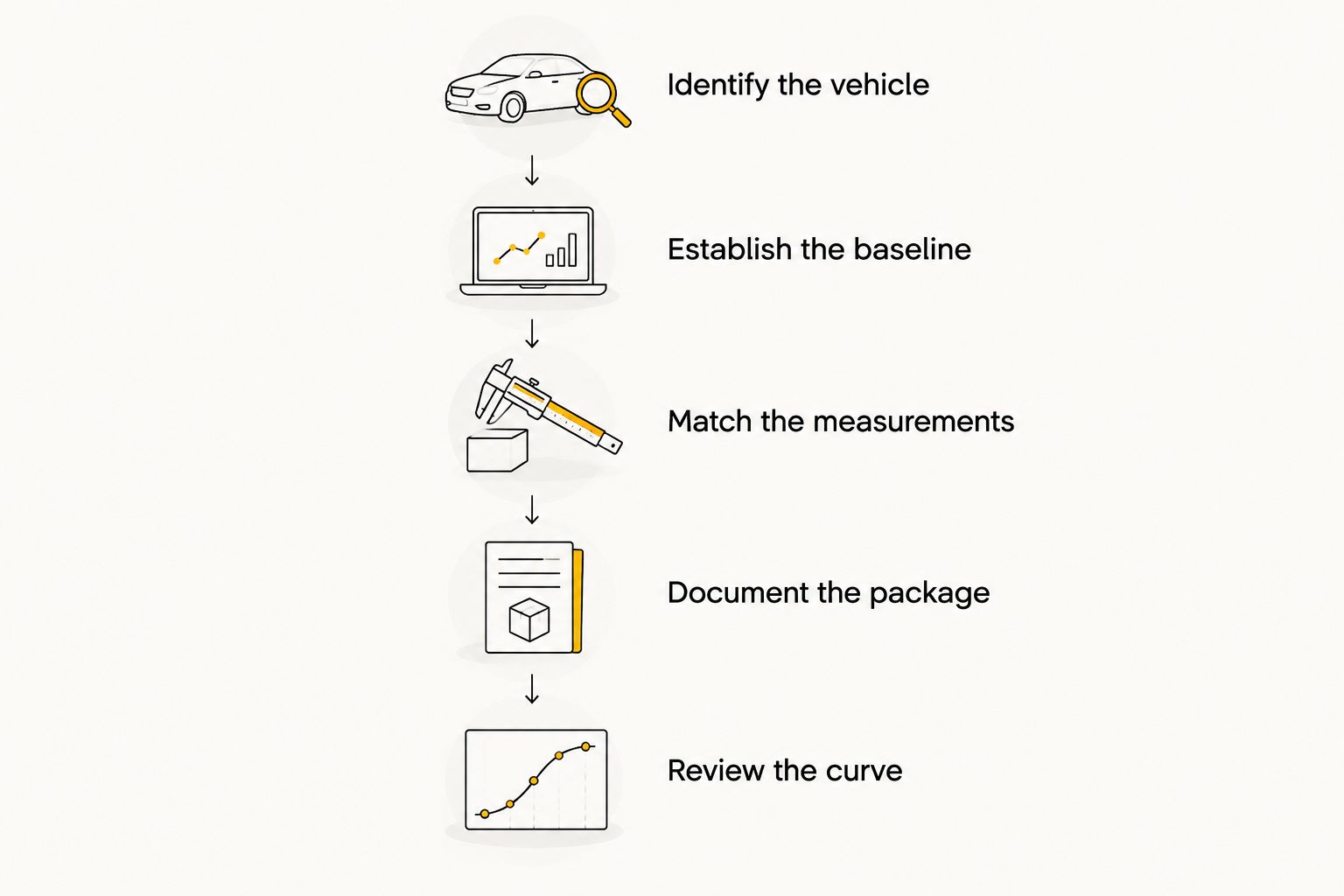
For your 2026 comparison, build a record that connects the advertised result to your exact machine. The following sequence keeps repair claims, engine ratings, and wheel measurements from getting mixed together.
- Identify the vehicle. Record the model, model year, engine configuration, existing modifications, and whether it already has a turbocharger.
- Establish the baseline. Use a mechanically sound vehicle and document the starting configuration. Resolve known problems before calling a difference an upgrade gain.
- Match the measurements. Compare the same horsepower measurement location and a consistent dyno procedure. Record fuel, tires, clutch setup, and relevant test conditions.
- Document the package. List the turbo hardware, calibration, fuel requirements, and supporting changes used for the modified result.
- Review the curve. Inspect power delivery through the operating range, not just the highest point. Ask how the finished setup behaves under sustained load.
Keep the reports with your build records. If the tuner changes the calibration or the required fuel changes, the previous result no longer describes precisely the same configuration. That documentation also helps you distinguish a performance change from a later mechanical problem.
Before installation, review the UTV turbo-kit installation guide alongside the actual kit manufacturer’s instructions. General preparation helps you plan the job, but component-specific instructions govern fitment, connections, and checks.
Does more boost always mean more horsepower?
More boost does not guarantee more usable horsepower. Boost pressure describes pressure in the intake system, not the entire engine’s output. Air temperature, airflow, fueling, and ignition calibration remain part of the result.
Do not select a boost setting from someone else’s build. Use the setting specified for your engine configuration, fuel, and calibration. If the target requires changes beyond the engine’s current setup, complete those changes before testing it under load.
Is wheel horsepower the same as engine horsepower?
Wheel horsepower and engine horsepower are not interchangeable. Engine horsepower is measured at the engine, while wheel horsepower includes the effect of transmitting power through the drivetrain to the measurement point.
Do not apply a generic drivetrain-loss percentage to make incompatible figures look comparable. For a 2026 parts decision, request matched measurements instead. Subtracting a wheel result from an engine rating does not establish the turbo kit’s gain.
Will a clutch kit add engine horsepower?
A clutch kit changes drivetrain behavior, not the engine’s combustion output. On a CVT-equipped UTV, clutch calibration influences the engine speed at which the drivetrain operates and how it transfers power under load.
That makes clutch setup relevant to a turbo build without making it an engine horsepower upgrade. Have the setup matched to the engine’s power delivery, tires, and intended use. Better acceleration and higher engine output are related goals, but they are not identical measurements.
What to confirm before committing to the build
Ask for the full requirements in writing. You should be able to identify the required fuel, calibration, supporting components, installation instructions, and validation procedure without filling in gaps yourself. An impressive output claim does not answer those questions.
Stop the purchase if the seller cannot explain what configuration produced the advertised result. Ask whether that result applies to your engine configuration and what must change to reproduce it. Keep a repair decision separate from a performance decision.
R1 Industries sells aftermarket UTV parts and accessories, but choosing parts is only one part of a forced-induction build. Confirm the engine package with the responsible installer or tuner before ordering components. That keeps the shopping list tied to a defined job rather than an unsupported horsepower target.
FAQ
How much horsepower does a UTV turbo kit add?
A UTV turbo kit’s added horsepower is the modified output minus the baseline output, measured on the same basis. The result depends on the exact engine, turbo system, fuel, calibration, and supporting components; there is no universal gain.
Can I compare a turbo kit’s wheel horsepower with my UTV’s factory engine rating?
No. Wheel horsepower and engine horsepower use different measurement locations. Request matched before-and-after results instead of subtracting one from the other.
Does replacing a factory UTV turbocharger increase horsepower?
Replacement alone does not establish a horsepower increase above a healthy original setup. Replacing a failed turbocharger can restore lost performance, which is different from a performance upgrade.
Do I need a tune when adding a turbo to a naturally aspirated UTV?
A turbo conversion needs engine calibration compatible with its hardware and fuel requirements. Follow the complete kit’s instructions and confirm the configuration with the responsible tuner before running it under load.
Will a bigger UTV turbo make the machine faster everywhere?
A bigger turbocharger does not guarantee stronger performance throughout the rev range. Compare the power and torque curves, then check whether the setup suits the acceleration and load conditions you care about.
Can a clutch kit create more engine horsepower?
A clutch kit does not increase the engine’s combustion output. It changes drivetrain behavior and can help a CVT-equipped UTV operate in the intended power range.
What should I ask for before buying a UTV turbo kit in 2026?
Ask for exact vehicle fitment, matched dyno evidence, required fuel, calibration, supporting components, and installation instructions. Confirm that the documented result uses an engine configuration equivalent to the one you plan to build.
One last thing
Ask to see the baseline before asking to see the biggest number. A modified dyno sheet without a comparable starting result cannot tell you how much horsepower the kit added. Keep that rule attached to every performance claim you evaluate.
When shopping R1 Industries UTV parts for your 2026 build, separate the items that create the engine package from accessories that serve other jobs. Buy against confirmed requirements. The right target is a documented setup that fits your riding, not an isolated peak figure.