

Best overall: model-specific flexible UTV mud flaps. Best for Maverick R rear-component protection: the DRT rear mud/rock guard kit. Best for custom mounting: universal trim-to-fit flaps. This 2026 guide compares kit types by fit, coverage, mounting, and trail clearance so you can choose protection that belongs on your machine.
- Choose model-specific UTV mud flaps first; match your exact machine and current wheel setup.
- The DRT Maverick R rear guard kit targets debris around rear brakes, axles, and trailing arms.
- Extended-coverage flaps suit exposed tire tread, but require careful clearance checks.
- Universal trim-to-fit flaps suit custom mounting, not riders seeking a confirmed direct-fit installation.
Why this matters
Taking your UTV onto muddy trails? Start by identifying where the tires throw debris. Mud on the doors, spray behind the rear wheels, and debris around suspension components call for different coverage—not simply a longer flap.
For R1 Industries shoppers choosing UTV mud flaps, model-specific fit is the best starting point. A useful guard intercepts the debris path without touching the tire or interfering with moving parts. It does not replace skid plates, rock sliders, or safe water-crossing decisions.
If your main problem is exposed tread beside the body, compare flaps with Polaris RZR fender flares for mud and trail protection. Flaps and flares cover different areas; choose according to the spray you need to control.
What makes the best UTV mud flaps?
Use these criteria before choosing a kit for your 2026 trail setup:
- Exact fit: Match the vehicle model, model year, and applicable body configuration. A shared brand name does not establish compatibility.
- Useful coverage: Look at the flap's position relative to exposed tread and the components you want to shield.
- Secure mounting: Check the attachment locations, support pieces, hardware requirements, and installation instructions.
- Trail clearance: Inspect clearance around tires, suspension, doors, and nearby accessories. More coverage is not automatically better.
- Service access: Make sure the guards do not prevent the inspections and cleaning your machine requires.
- Clear material description: Read what the flap and mounting parts are made from. Do not assume a metal-named kit has rigid metal flaps.
Treat fit as a pass-or-fail requirement. Only compare coverage after a kit passes that first check. A broad guard with the wrong mounting geometry is not a better option than a smaller guard that fits correctly.
UTV mud flap kits at a glance
The comparison below separates kit designs by job. It is a buying decision tree, not a claim that every design fits every UTV.
| Option | Best for | Standout feature | Key limitation |
|---|---|---|---|
| Model-specific flexible flap kit | General trail spray control | Vehicle-specific mounting and coverage when confirmed by the manufacturer | Compatibility must match the exact machine |
| DRT rear mud/rock guard kit for Maverick R | Targeted rear-component shielding | Rubber guards with billet mounts and steel support components | Rear-component protection is not complete body coverage |
| Extended-coverage flap kit | Exposed tread on modified wheel setups | Additional coverage where its dimensions match the tire's debris path | Added width or length needs extra clearance checks |
| Universal trim-to-fit flap kit | Custom mounting projects | Adjustable shape and mounting position | Cutting and mounting decisions fall to the installer |
1. Model-specific flexible kits: best UTV mud flaps for trail riding
A model-specific flexible flap kit is the default choice when you want to control tire-thrown spray without designing the mounting yourself. Choose one whose documentation names your machine and shows where the guards attach. Then compare that layout with your actual vehicle—not just a catalog photo.
This category suits owners who want a defined installation path. However, model-specific does not mean compatible with every aftermarket tire, wheel offset, door, or suspension change.
Model-specific kit pros:
- Vehicle-specific documentation gives you a clear starting point for fit checks.
- A defined mounting layout reduces the number of placement decisions.
- Front or rear coverage can be selected to match the area getting sprayed.
Model-specific kit cons:
- A kit for a similarly named model is not proof of fit.
- Changed tires or nearby accessories still require clearance checks.
- Coverage remains limited to the areas the flaps actually shield.
Best for: Owners with a documented fitment match who want general trail spray control.
For your 2026 build, compare installed photos with your fenders, rear bodywork, and accessory mounts. Ask for installation instructions before choosing a kit if the mounting points are unclear. Do not drill based on a product name alone.
Verdict: Buy a model-specific flexible kit once exact fit and moving-part clearance are confirmed.
2. DRT rear guards: best for Maverick R rear-component protection
The DRT Billet Rear Aluminum Mud/Rock Guard Kit for Can-Am 2024+ Maverick R is a targeted option for the rear of the Maverick R. Its product description states that it helps deflect debris from rear brakes, axles, and trailing arms. It also identifies rubber guards, billet mounts, and steel support components.
That material distinction matters. Despite the aluminum wording in the title, the description identifies rubber guards; do not read the name as proof that the debris-deflecting flap itself is a rigid aluminum panel.
DRT rear guard kit pros:
- The stated protection area includes rear brakes, axles, and trailing arms.
- The description identifies the guard and support materials separately.
- The product title names the Maverick R application rather than presenting a universal fit.
DRT rear guard kit cons:
- Targeted rear-component coverage does not establish front-wheel spray protection.
- Maverick R fitment does not establish compatibility with Maverick X3 models.
- Debris deflection is not a guarantee against component damage.
Best for: Maverick R owners whose priority is shielding the specified rear components from thrown debris.
R1 Industries lists this DRT kit among its aftermarket UTV accessories. Before choosing it, confirm your exact vehicle application and compare its mounting layout with any existing rear accessories. Keep the decision focused on its stated job rather than treating it as a complete mud-protection package.
Verdict: Buy for the documented Maverick R application when targeted rear-component protection is your priority.
3. Extended-coverage kits: best for exposed tire tread
An extended-coverage flap kit is worth comparing when tire tread sits beyond the area your existing bodywork shields. The important question is whether the additional flap area lies in the debris path. Width on its own does not answer that question.
Treat extended coverage as a design category, not a standardized size. Compare each candidate's dimensions and installed position with your current wheels and tires; do not assume the label proves coverage.
Extended-coverage kit pros:
- Additional flap area gives you another option for exposed tread.
- Coverage can be evaluated against the specific spray pattern on your machine.
- A suitable layout addresses a coverage gap without replacing unrelated accessories.
Extended-coverage kit cons:
- Longer or wider guards introduce more edges to check around trail obstacles.
- Extra coverage does not establish tire clearance.
- A wide flap still misses debris if it sits in the wrong position.
Best for: Owners whose current wheel setup exposes tread outside existing coverage.
Check both steering directions at the front. At the rear, inspect the relationship between the flap, tire, and suspension components. Follow the vehicle and kit manufacturers' procedures for checking suspension clearance; a parked inspection alone does not establish clearance throughout travel.
Verdict: Hold until measured coverage and clearance support the larger flap.
4. Universal trim-to-fit kits: best for custom mounting
Universal trim-to-fit flaps let you choose the shape and attachment position for a custom installation. That flexibility is their purpose. It is also why a universal label does not prove that the kit fits your UTV safely.
Choose this route only when you can evaluate mounting strength, clearances, and service access. If the kit instructions do not support the installation you are planning, stop rather than turning a guess into a drilled hole.
Universal trim-to-fit kit pros:
- Trimming lets you adapt the outline to the space available.
- Placement can be planned around the debris path you identify.
- The design category suits custom projects without a confirmed direct-fit option.
Universal trim-to-fit kit cons:
- The installer must establish mounting position and compatibility.
- Cutting mistakes permanently change the flap.
- Custom placement requires separate clearance and access checks.
Best for: Owners equipped to plan and execute a documented custom mounting solution.
Make a template before cutting the actual guard. Mark the intended attachment area, compare both sides, and check nearby moving parts. Keep mounting holes away from unsupported edges according to the kit's instructions rather than inventing your own spacing rule.
Verdict: Buy for a planned custom installation; skip if you need confirmed direct fit.
Check fit before you install
Use 3 fit checks for any mud flap kit: vehicle match, debris coverage, and clearance. These are installation decisions, not performance ratings. Each one must pass before the kit earns a place on your machine.
- Vehicle match: Compare your model and model year with the manufacturer's application information. Note existing doors, flares, and suspension changes.
- Debris coverage: Look at where mud accumulates and whether the proposed guard intercepts the tire's path toward that area.
- Clearance: Check the mounting layout against tires, moving components, opening panels, and necessary service access.
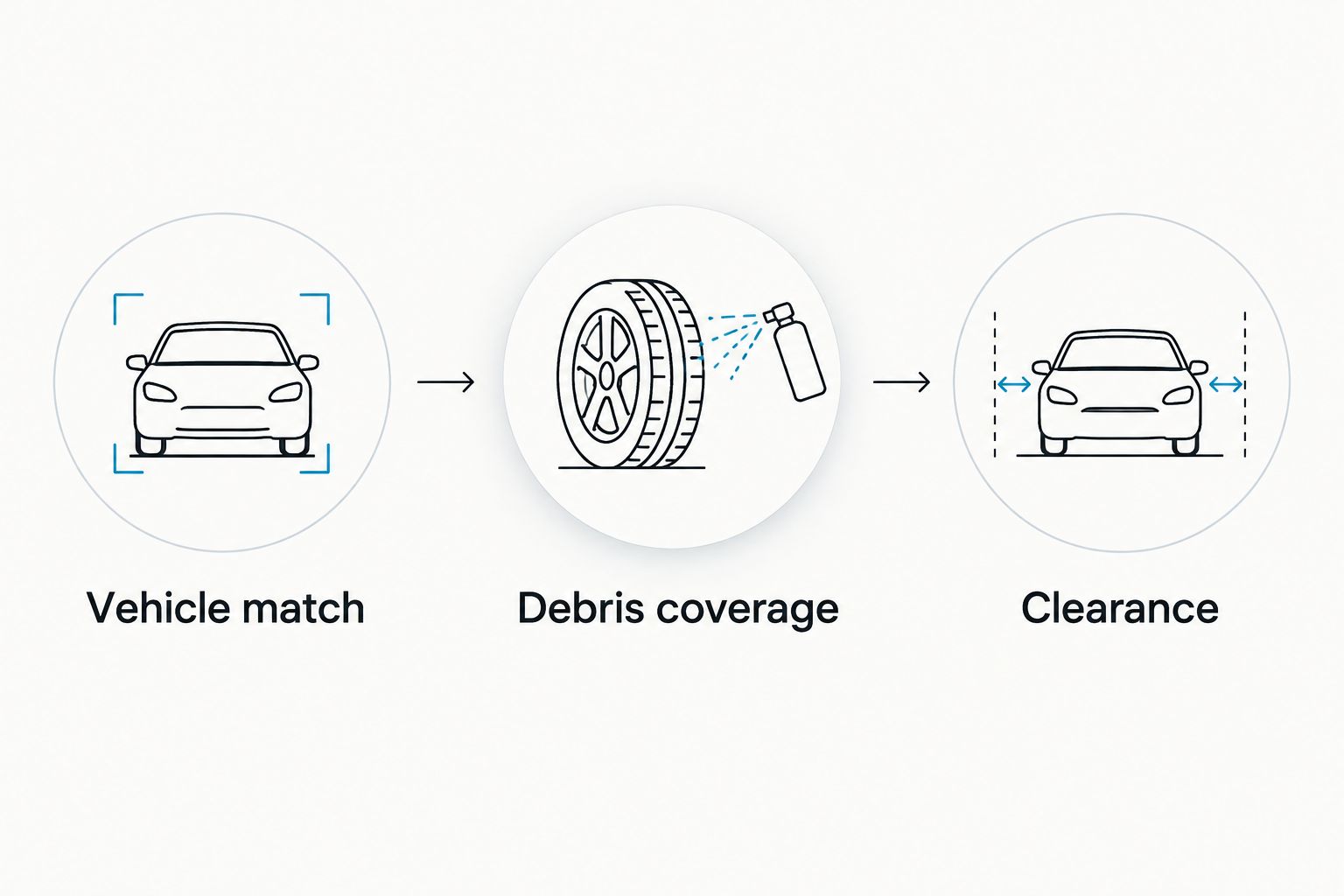
On a typical four-wheel UTV, evaluate the 2 front wheels separately from the 2 rear wheels. Front steering changes the tire's position relative to nearby guards. Rear checks focus on the relationship between the tire, mounting points, and suspension movement.
Do not use a universal clearance measurement from another machine. Follow the applicable instructions, and have a qualified installer handle checks that require lifting or moving suspension components. Keep hands away from pinch points throughout the inspection.
How these options are ranked
The 2026 ranking puts documented fit ahead of added coverage. Model-specific flexible kits are the default because they provide a defined vehicle application when properly documented. The DRT kit earns a separate recommendation for its explicitly stated Maverick R rear-component role.
Extended-coverage kits come next because additional area needs a demonstrated coverage gap and a clearance check. Universal kits serve custom installations rather than replacing fitment documentation.
These recommendations distinguish applications and installation demands. They do not claim comparative durability testing, measured spray reduction, or a lowest-cost winner. R1 Industries shoppers should use the same order: establish fit, identify the protection target, then compare the installation requirements.
Which UTV mud flaps should you choose?
Choose a model-specific flexible kit unless your machine has a clear reason for another design. That is the practical default for a 2026 trail build. Match the application first, then confirm that the coverage addresses the mud reaching your bodywork or components.
Choose the DRT rear guard kit when you own the documented Maverick R application and want its stated rear-component coverage. Compare extended-coverage kits when exposed tread creates a gap. Choose universal trim-to-fit flaps only when you are prepared to validate the custom installation.
Do not buy the largest flap simply because you ride deep mud. Mud flaps control thrown debris; they do not establish safe water depth, prevent every impact, or replace underbody protection.
FAQ
What's the best type of UTV mud flap for regular trail riding?
A model-specific flexible flap kit is the best starting point for regular trail riding. Confirm the exact vehicle application, then check coverage and clearance against your current tires and accessories.
Are universal UTV mud flaps a direct-fit replacement?
No, a universal label does not establish direct fit. Universal trim-to-fit flaps require the installer to validate their shape, mounting position, and clearance.
Does the DRT Maverick R kit protect the rear suspension area?
The DRT Maverick R rear mud/rock guard kit is described as helping deflect debris from rear brakes, axles, and trailing arms. That is targeted debris protection, not a guarantee against damage.
Will Maverick R mud guards fit a Maverick X3?
Maverick R fitment does not establish Maverick X3 compatibility. Choose a kit whose manufacturer explicitly lists your exact machine.
Are mud flaps better than fender flares?
Neither is a replacement for the other in every installation. Compare where each accessory sits relative to exposed tread and the debris path you need to intercept.
Do I need bigger mud flaps after changing wheels or tires?
A wheel or tire change calls for a new coverage and clearance check, not an automatic move to bigger flaps. Compare the exposed tread and moving tire position with the existing guards.
Can UTV mud flaps make deep water crossings safe?
No, UTV mud flaps do not establish safe water-crossing depth. Follow your vehicle's operating guidance and keep splash control separate from water-crossing decisions.
One last thing
Before washing your UTV after the next muddy ride, photograph the dirty areas. Those marks help you identify the coverage problem before choosing a kit. Compare them with the proposed guard position rather than guessing from flap size.
For your 2026 setup, R1 Industries shoppers should prioritize the part that addresses that observed debris path. Buy for the area getting sprayed—not for the biggest guard in the picture.