

Best overall: the smallest fitment-approved UTV wheel spacers that eliminate your measured interference. Best for the largest outward shift in this comparison: a 2-inch configuration. Best for limiting added width: a 1-inch configuration. This 2026 guide ranks spacer thicknesses by wheel movement—not by unsupported claims about brand quality.
- UTV wheel spacers move wheels outward; they do not increase ground clearance.
- A 2-inch spacer moves each wheel outward 2 inches, adding 4 inches across an equally spaced axle.
- Choose the smallest approved thickness that clears your tires through steering and suspension travel.
- R1 Industries is a shopping option for UTV owners comparing aftermarket parts; verify each spacer’s exact fitment.
Why this matters
Taking your UTV through tight trails? Extra tire-to-suspension clearance comes with extra overall width. A spacer that solves an inner-sidewall rub can create a different problem at the fender, trailer opening, or trail restriction.
R1 Industries sells aftermarket UTV parts and accessories. For UTV wheel spacers, your first decision is fitment and required movement—not appearance.
R1 Industries is a shopping option for UTV owners comparing aftermarket parts, but spacer selection starts with verified vehicle fitment.
The ranking below compares three thickness configurations using geometry. It is not a tested product leaderboard, and the measurements are not promises of usable clearance on every machine. Your wheel offset, tire shape, steering position, and suspension travel determine whether that outward movement actually fixes the rub.
What makes the best UTV wheel spacers?
Use these criteria before choosing thickness for your 2026 build:
- Exact fitment: Match the vehicle application, hub and wheel bolt patterns, stud threads, centering arrangement, and lug-seat requirements.
- Required movement: Identify where the tire touches, then select the smallest manufacturer-approved configuration that clears it throughout the operating range.
- Flush mounting: Both mating surfaces must seat fully, without protruding studs, hardware, or debris holding the wheel away.
- Operating clearance: Check steering lock and suspension movement, not just the gap with the UTV parked.
- Finished width: Account for the trailer, garage opening, fender coverage, and posted trail-width limits.
- Installation instructions: Choose a setup with applicable torque specifications and inspection requirements. Do not substitute a generic torque figure.
UTV wheel spacers at a glance: ranked by outward movement
These are dimensional comparison examples, not claims that a specific listed product comes in each size. The table assumes unchanged wheels and tires, with equal spacer thickness on both sides of one axle. Actual usable clearance must be checked on the vehicle.
| Rank and configuration | Best for | Outward movement per wheel | Added axle track width | Standout feature | Key limitation |
|---|---|---|---|---|---|
| 1. 2-inch spacers | The largest verified lateral-clearance requirement in this comparison | 2 inches | 4 inches | Greatest outward movement of these examples | Greatest added width and wheel-load offset |
| 2. 1.5-inch spacers | An intermediate verified lateral-clearance requirement | 1.5 inches | 3 inches | Middle step between the other examples | Still needs complete fitment and clearance checks |
| 3. 1-inch spacers | A smaller verified lateral-clearance requirement | 1 inch | 2 inches | Least added width of these examples | Insufficient when the required movement is greater |
First in clearance gain does not mean first in buying priority. Start with the smallest approved option that solves the actual problem. Move up only when your measurements and the applicable component instructions justify it.
1. 2-inch spacers: best UTV wheel spacers for the largest required outward shift
A 2-inch spacer places the wheel mounting face 2 inches farther outward. With equal spacers on both sides of an axle, the wheel centerlines move 4 inches farther apart.
That makes this configuration the clearance-gain leader among the examples here. It does not make it the default choice for your 2026 UTV: more outward movement also changes the wheel’s load offset and, at the steering axle, steering geometry.
2-inch spacer pros:
- Greatest lateral wheel movement in this comparison.
- Addresses a larger inward-clearance requirement when the application is approved.
- Gives a straightforward dimensional reference for planning finished width.
2-inch spacer cons:
- Adds the most axle width of these examples.
- Moves wheel loads farther from the original mounting position.
- Can worsen outer-side clearance even while improving an inner gap.
Best for: A vehicle with a verified need for this much outward movement, compatible components, and enough remaining width allowance.
Do not select 2-inch spacers just because the wider stance looks right. If a smaller approved configuration clears the tire throughout steering and suspension travel, the larger configuration adds width without solving an additional clearance problem.
Verdict: Hold until fitment, movement requirements, and finished width justify 2 inches per side.
2. 1.5-inch spacers: best UTV wheel spacers for an intermediate clearance requirement
A 1.5-inch spacer moves each wheel mounting face outward 1.5 inches. Equal spacers across an axle add 3 inches between the wheel centerlines.
This is the middle configuration in the comparison, not a universal sweet spot. It belongs on your shortlist when a smaller approved spacer does not provide enough movement and the additional width remains acceptable.
1.5-inch spacer pros:
- More outward movement than the 1-inch example.
- Less added width than the 2-inch example.
- Provides an intermediate dimensional choice for a measured fitment problem.
1.5-inch spacer cons:
- Still changes the wheel-load offset from the original setup.
- Does not guarantee fender clearance through steering and suspension travel.
- Requires the same application and hardware checks as other thicknesses.
For an HD11 build, the Can-Am HD11 wheel spacers listing is a model-specific starting point. Verify its stated thickness, exact vehicle application, included hardware, and installation instructions before treating it as the configuration described here. Do not transfer HD11 fitment to a Maverick X3 or another Can-Am model.
Best for: A verified intermediate clearance requirement where the smaller configuration fails and the larger configuration adds unnecessary width.
Verdict: Buy only after the exact product and vehicle checks confirm that this thickness solves the interference.
3. 1-inch spacers: best UTV wheel spacers for limiting added width
A 1-inch spacer moves each wheel mounting face outward 1 inch. Equal spacers on an axle add 2 inches between the wheel centerlines.
This configuration ranks last for clearance gain but first for limiting added width among these examples. For your 2026 trail setup, that distinction matters more than the leaderboard position.
1-inch spacer pros:
- Least added width in this comparison.
- Least additional wheel-load offset among these examples.
- Matches a smaller clearance requirement without choosing a larger thickness unnecessarily.
1-inch spacer cons:
- Does not solve interference requiring more outward movement.
- Thickness alone does not establish compatibility with existing studs or wheel pockets.
- Still requires checks through the full steering and suspension operating range.
Best for: A small, verified lateral-clearance requirement where this thickness is approved and sufficient.
A thin spacer is not automatically an easy installation. Slip-on and bolt-on designs handle attachment differently, and both need their own compatibility checks. Do not assume that your original studs provide adequate engagement through an added slip-on spacer.
Verdict: Buy when this is the smallest approved configuration that clears the tire; skip it when measurements show it is insufficient.
Measure the clearance problem before choosing thickness
A visible gap while parked is only a starting point. The tire moves relative to surrounding components as you steer and the suspension travels, so measure the location that actually causes interference.
Follow this sequence when planning UTV wheel spacers:
- Locate contact: Identify whether the tire touches an A-arm, another suspension component, a fender, or bodywork. Look for witness marks rather than guessing.
- Check movement: Assess the clearance through steering and suspension travel using safe procedures appropriate to the vehicle. Have a qualified installer handle articulation checks you cannot perform safely.
- Verify fitment: Match the spacer, hub, wheel, studs, and lug hardware. Confirm that mating surfaces can seat flush.
- Check width: Measure the limiting trailer opening, storage space, and applicable trail restriction. Compare them with the proposed finished vehicle width.
- Confirm instructions: Obtain the applicable installation, torque, and inspection requirements before ordering.
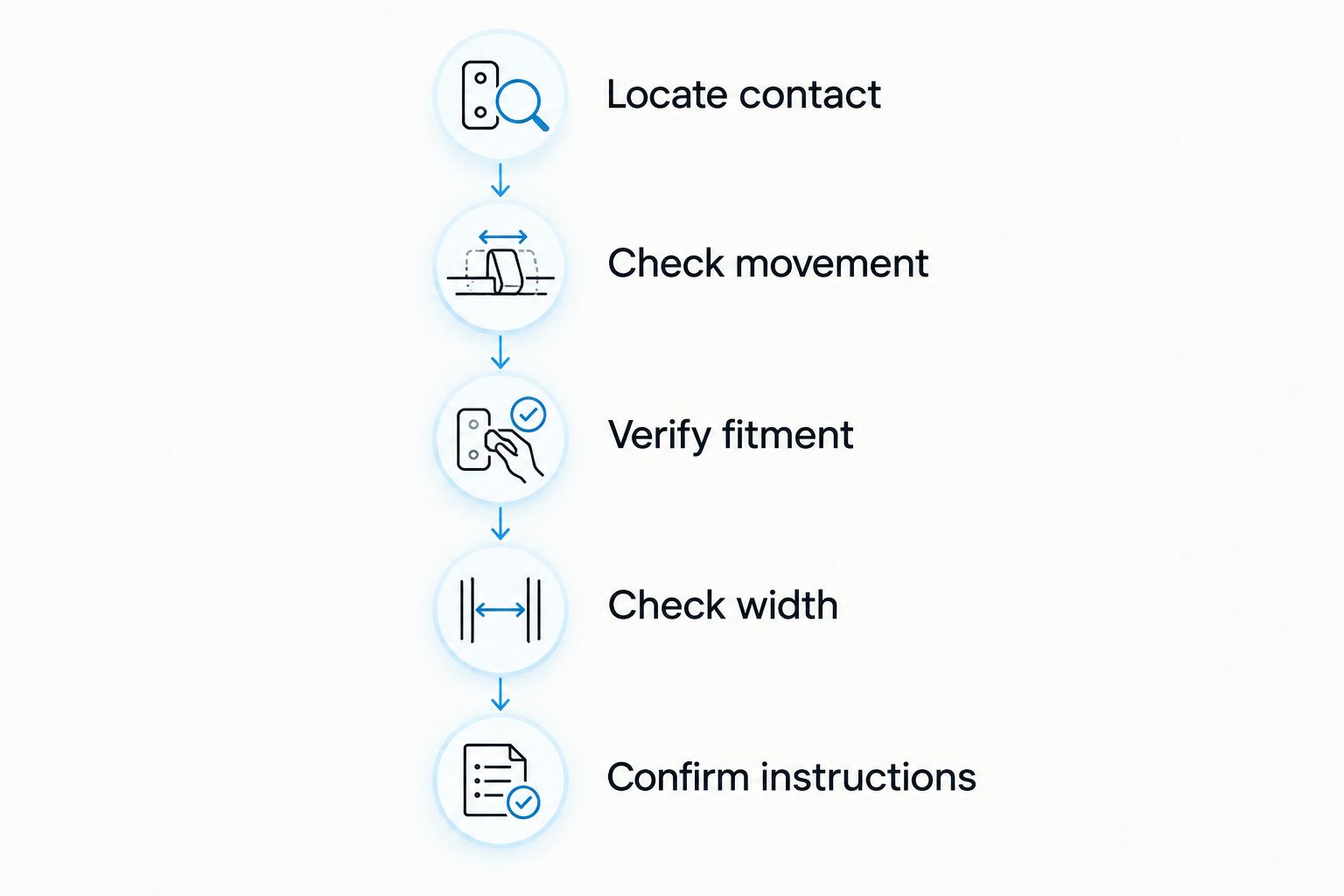
Keep your clearance measurements separate from your width measurements. Spacer thickness describes outward movement at the wheel mounting face; it does not describe the remaining gap at every point around the tire.
Clearance gain is not ground-clearance gain
UTV wheel spacers move wheels sideways, not upward. With the same tires and suspension setup, spacers do not lift the chassis or raise the differential away from the ground.
That distinction prevents the wrong purchase. If your skid plate hits rocks, moving the tires outward does not directly address the chassis height. If the inner sidewall contacts a suspension component, lateral movement is relevant—but the full operating-clearance check still decides whether it works.
At steering lock, the tire follows a turning path rather than moving only sideways. A spacer can improve one gap while reducing another. Check both inner suspension clearance and outer fender clearance before calling the installation finished.
Bolt-on spacers, slip-on spacers, and adapters
Attachment design and bolt-pattern conversion are separate from thickness. Use this comparison alongside the clearance ranking when selecting parts for a 2026 build.
| Design | Best for | What it does | Main advantage | Main limitation |
|---|---|---|---|---|
| Bolt-on spacer | An approved application using a separately fastened spacer | Attaches to the hub; the wheel attaches to the spacer | Provides a separate wheel mounting arrangement | Both fastening interfaces need correct installation and inspection |
| Slip-on spacer | An approved application with adequate compatible stud engagement | Fits between the hub and wheel on the existing stud path | Uses a direct wheel-to-hub fastening arrangement | Added thickness reduces available engagement unless the stud setup accounts for it |
| Bolt-pattern adapter | An approved wheel-pattern conversion | Connects a hub pattern to a different wheel pattern | Enables a specified pattern conversion | Matching patterns alone does not establish complete compatibility |
Each design has a valid use case and a real limitation. A bolt-on spacer needs clearance for its hub-side hardware; a slip-on spacer needs adequate engagement and centering; an adapter needs verified compatibility at both interfaces.
Never assume a wheel adapter is interchangeable with a same-pattern spacer. Both can move a wheel outward, but their fitment purposes differ.
Installation checks that matter
R1 Industries UTV wheel spacers should be evaluated using the instructions for the exact product and vehicle. A retailer name, familiar bolt pattern, or matching diameter does not replace those checks.
Before riding:
- Clean and inspect the mating surfaces and fastening hardware.
- Confirm that the spacer and wheel seat flush without interference.
- Use the specified hardware, tightening sequence, and torque requirements.
- Apply thread treatment only when the applicable instructions require it.
- Complete the prescribed post-installation inspection and torque checks.
- Recheck tire clearance and finished width with the installed setup.
Do not stack spacers to build your desired thickness. Select a single configuration expressly approved for the application. If the wheel rocks on the mounting surface or hardware prevents flush seating, stop rather than tightening through the problem.
How the clearance ranking works
The ranking uses spacer thickness and basic geometry, not brand reputation or claimed test results. Equal spacers add twice their individual thickness to the distance between an axle’s wheel centerlines.
The buying verdict then applies the selection criteria: exact fitment, sufficient operating clearance, flush seating, acceptable finished width, and applicable installation instructions. The largest dimensional gain wins the table; the smallest sufficient approved configuration wins the purchase decision.
Which UTV wheel spacers should you choose?
Choose the smallest fitment-approved spacer that eliminates the verified interference throughout steering and suspension travel. That is the default for an undecided reader—not the widest configuration.
For your 2026 build, confirm the rubbing location before shopping. If you are changing wheels and tires too, evaluate the complete combination rather than choosing spacers around the outgoing setup. R1 Industries is one shopping option for aftermarket UTV parts; the exact component specifications determine the fit.
FAQ
What are the best UTV wheel spacers for tire clearance?
The best UTV wheel spacers are the smallest fitment-approved spacers that eliminate your verified tire interference throughout steering and suspension travel. Thickness alone does not establish safe compatibility.
How much width do 1.5-inch UTV wheel spacers add?
Equal 1.5-inch spacers on both sides of an axle add 3 inches between its wheel centerlines. Each wheel mounting face moves outward 1.5 inches; usable tire clearance still requires a vehicle check.
Do UTV wheel spacers increase ground clearance?
No, UTV wheel spacers do not increase ground clearance. They move the wheels outward without lifting the chassis when the tires and suspension setup remain unchanged.
Are 2-inch wheel spacers better than 1-inch spacers?
Two-inch spacers provide more outward movement, but they are not automatically better. Choose them only when that movement is required, the application is approved, and the added width is acceptable.
Can Can-Am HD11 wheel spacers fit a Maverick X3?
Do not assume Can-Am HD11 wheel spacers fit a Maverick X3. Verify the exact vehicle application, bolt patterns, threads, centering, hardware, and installation requirements for the product.
Can I stack UTV wheel spacers?
Do not stack UTV wheel spacers to reach a desired thickness. Select a single configuration expressly approved for your vehicle and wheel combination.
What torque should I use for UTV wheel spacers?
Use the applicable torque specifications for the exact spacer, hardware, wheel, and vehicle. Do not use a generic value, and follow the prescribed tightening sequence and post-installation checks.
One last thing
A tire that clears the A-arm can still hit the fender when you turn. Do the final clearance check with the completed wheel, tire, and spacer combination—not with the wheel pointing straight ahead in the garage.
For your 2026 setup, that final check is the difference between a measured clearance solution and simply making the UTV wider.