

Best overall for parking: a vehicle-specific mechanical parking brake kit approved for your application. Best for brief, attended stops: a compatible brake-pedal latch. Skip for unattended hill holds: a hydraulic brake lock. This 2026 guide explains how to choose a UTV parking brake kit by its holding mechanism, fitment, and release procedure—not by appearance.
- Choose a UTV parking brake kit by exact vehicle fitment and manufacturer-approved use, not a universal-fit claim.
- An independent mechanical parking brake and a brake-pedal latch hold the vehicle through different mechanisms.
- A hydraulic brake lock is not a substitute for a mechanical parking brake during unattended parking.
- R1 Industries serves UTV owners shopping aftermarket accessories; confirm parking-brake compatibility before ordering.
- Use your owner's manual for parking procedures, and choose level ground whenever possible.
Why this matters
Stopping on a hill and parking on a hill are different jobs. Your service brakes stop the UTV while you press the pedal; a parking system must keep the vehicle stationary after you release the controls. An accessory that holds the pedal down does not automatically become an independent parking brake.
Taking a break on a steep trail? Choose a safer stopping location before choosing an accessory. A brake kit cannot prevent locked tires from sliding on loose ground, and it does not make an unsafe slope suitable for parking.
R1 Industries sells aftermarket UTV parts and accessories. For parking-brake shopping in 2026, the useful starting point is your exact machine and its factory parking procedure—not another rider's installation photo.
What makes the best UTV parking brake kit?
Use these criteria before comparing mechanisms. A kit that fails a fitment or release check belongs off your shortlist, regardless of how convenient its handle looks.
- Exact vehicle fitment: Match the model, model year, trim, and brake configuration. A shared manufacturer name does not establish compatibility.
- Holding mechanism: Identify whether the kit operates a mechanical brake, restrains the service-brake pedal, or traps hydraulic pressure. These designs are not interchangeable.
- Positive engagement: Look for documented engagement and adjustment instructions. You need a clear way to establish that the mechanism is fully applied.
- Complete release: The brake must release as specified without pedal obstruction, cable binding, or residual brake drag.
- Installation requirements: Read the instructions for brackets, cable routing, brake-line work, and any required bleeding or adjustment before committing.
- Intended use: Follow the manufacturer's stated purpose and restrictions. Brief attended holding, unattended parking, and trailer transport require different precautions.
For a 2026 purchase, fitment and intended use are pass-or-fail checks. Do not treat them as features you can trade away for easier installation.
UTV parking brake options at a glance
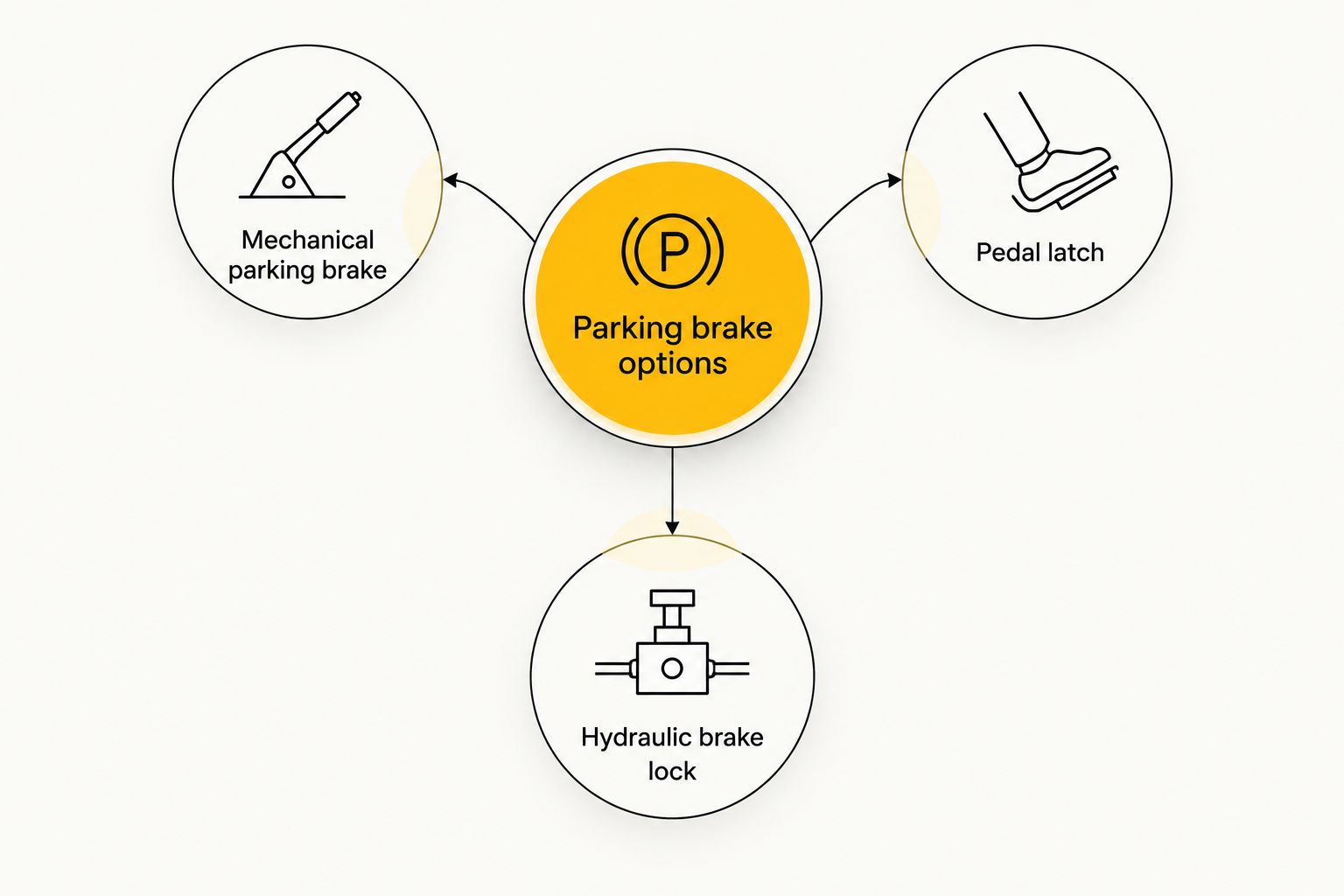
These are mechanism-based choices, not interchangeable products. The order favors an independent mechanical parking function for parking, then a pedal restraint for a narrower use, with hydraulic locking last because it depends on retained pressure.
| Option | Best for | Standout feature | Key limitation |
|---|---|---|---|
| Vehicle-specific mechanical parking brake kit | Adding an independent parking function where the vehicle and kit manufacturers permit it | Mechanically applies a parking brake rather than merely retaining service-brake pressure | Requires verified compatibility, correct installation, and adjustment |
| Vehicle-specific brake-pedal latch | Brief, attended stops where the manufacturer permits pedal holding | Keeps the existing brake pedal depressed | Depends on the condition and pressure retention of the service-brake system |
| Hydraulic brake lock | A specific manufacturer-authorized temporary holding application | Retains pressure in a hydraulic brake circuit | Pressure retention is not a dependable substitute for mechanical unattended parking |
No mechanism earns a blanket hill-hold recommendation. Surface traction, vehicle condition, installation, and the manufacturer's restrictions still control what you can safely do.
1. Mechanical parking brake kit: best for an independent parking function
A mechanical parking brake kit uses a mechanical actuator, such as a lever and cable, to apply a parking brake. The important distinction is the brake mechanism itself: a handle attached to a pedal restraint is still a pedal restraint, not an independent mechanical parking brake.
For an actual parking function, start with the vehicle manufacturer's guidance and a kit whose instructions explicitly cover your application. Check what brake the kit applies, where the actuator mounts, and how engagement and release are adjusted. Do not assume a conversion intended for another chassis will work on yours.
Mechanical parking brake kit pros
- A mechanical holding mechanism does not depend solely on trapped service-brake pressure.
- A separate actuator gives you a dedicated parking control.
- Documented adjustment procedures give you a defined installation and maintenance reference.
Mechanical parking brake kit cons
- Compatibility includes the brake hardware and mounting arrangement, not just the vehicle's badge.
- Cable routing and adjustment require attention; binding or incomplete release can create brake drag.
- Mechanical holding does not prevent the tires from sliding on a low-traction slope.
Best for: Owners who need an independent parking function and have a documented, manufacturer-permitted conversion for their exact UTV.
Before buying, locate the installation instructions rather than relying on a short product description. Confirm that you can reach the control while seated and that its placement does not interfere with steering, restraints, or getting out of the cab.
For your 2026 shortlist, reject any kit whose brake actuation or compatibility remains unclear. Verdict: Buy only after exact fitment and permitted parking use are confirmed.
2. Brake-pedal latch: best for brief, attended stops
A brake-pedal latch mechanically keeps the service-brake pedal depressed. The latch restrains the pedal, while the hydraulic service-brake system supplies the braking force. That difference matters when you decide whether to stay with the vehicle or walk away.
A compatible pedal latch is a convenience accessory for the use its manufacturer allows. It does not repair weak brakes, replace the factory parking procedure, or establish that the UTV can remain unattended on a slope.
Brake-pedal latch pros
- Operates through the existing brake pedal rather than adding a separate parking-brake friction assembly.
- Provides a defined way to retain pedal application when the design and instructions permit it.
- Keeps its control near the driver's existing braking controls.
Brake-pedal latch cons
- Holding force depends on the service-brake system remaining functional and retaining pressure.
- Poor positioning can obstruct pedal travel or create an unintended snag point.
- Engagement and release must work with your footwear and pedal arrangement.
Best for: Brief, attended stops where the latch manufacturer explicitly permits use on your exact vehicle.
Check the mounting location against floor mats, pedal covers, and anything else already installed in the footwell. Operate the pedals through their normal travel after installation using the manufacturer's inspection procedure. Nothing should bind or remain partly applied after release.
Practice engagement and release on level ground before taking the UTV onto a trail. Keep the vehicle secured according to its manual during that check. Verdict: Hold until fitment, pedal clearance, and attended-use instructions are verified.
3. Hydraulic brake lock: skip for unattended hill holds
A hydraulic brake lock uses a valve to retain pressure in a brake circuit. Unlike a pedal latch, it acts within the hydraulic system rather than holding the pedal down. Unlike an independent mechanical parking brake, its holding function depends on retained hydraulic pressure.
That makes the manufacturer's use restrictions critical. Hydraulic pressure can change through leakage and temperature effects, so a pressure lock is not a reason to leave your UTV unattended on a hill.
Hydraulic brake lock pros
- Retains brake pressure without continuously pressing the pedal when used as designed.
- Provides a separate control for a manufacturer-authorized temporary holding application.
- Does not require a pedal-restraint bracket in the footwell.
Hydraulic brake lock cons
- Requires brake-circuit compatibility and installation appropriate to the vehicle's hydraulic system.
- Brake-line work introduces sealing and bleeding requirements.
- Retained pressure is not equivalent to an independent mechanical parking function.
Best for: Only the temporary application explicitly authorized by the vehicle and component manufacturers.
Do not choose a hydraulic brake lock because its packaging uses the phrase parking brake. Read how it works and what its instructions prohibit. If brake-line modifications are required, use a qualified installer unless you have the necessary brake-system skills and equipment.
Verdict: Skip for unattended hill holds. Choose a documented parking solution instead of relying on trapped pressure.
Check fitment before you order
Your shopping notes should identify the machine and the installed brake hardware. Start with the exact model designation and model year, then record any brake, pedal, or footwell modifications that affect the proposed kit.
A Polaris RZR, Can-Am Maverick X3, and Kawasaki KRX are not interchangeable fitment categories. Even within one model family, do not assume a bracket, cable, or pedal latch fits every version. Use the kit manufacturer's application information.
For a UTV parking brake kit from R1 Industries or another retailer, check these details in the actual product documentation:
- Vehicle application: Your exact model and model year appear in the supported application.
- Brake operation: The instructions explain what the control actuates or restrains.
- Mounting clearance: Brackets and controls clear pedals, floor coverings, and existing accessories.
- Installation work: Required modifications, tools, and brake-system procedures are stated.
- Operating restrictions: The permitted holding or parking use is explicit.
- Release check: The instructions explain how to verify complete disengagement.
Save the instructions with your vehicle records. A later owner or technician needs to know how the added mechanism operates, especially if it changes the brake circuit or pedal area.
Check the installation before riding
Use the vehicle manual and kit instructions as your procedure. Begin on level ground with the UTV secured, and do not use a steep trail as an installation test.
Inspect the mounting
Confirm that the installed components match the instructions and that fasteners use the specified tightening requirements. Inspect cable and hose routing for rubbing, sharp bends, and contact with moving or hot components.
Check pedal travel
Make sure the brake pedal moves normally with the kit disengaged. Check that the added control does not obstruct the accelerator, catch footwear, or interfere with your normal driving position.
Verify full release
Follow the specified release and inspection procedure. If the pedal remains restrained, the cable binds, or the brake does not release normally, stop using the UTV until the fault is corrected.
Follow the parking procedure
Apply the vehicle's prescribed parking sequence, including its transmission position and any additional precautions. Do not substitute a generic accessory sequence for the owner's manual.
Treat the first ride after a 2026 installation as a chance to recheck the work under the manufacturer's instructions, not permission to test the limits of a hill hold. Any unexpected movement or release problem is a reason to stop and investigate.
How these options rank
The deciding criteria are exact fitment, an appropriate holding mechanism, clear engagement, and complete release. An independent mechanical parking brake ranks first for a permitted parking conversion because it does not merely retain hydraulic service-brake pressure.
A pedal latch ranks next for its narrower, attended-use role. A hydraulic brake lock ranks last for this hill-parking query because pressure retention is not the same function as mechanical parking.
This order compares mechanisms, not measured stopping distances or verified slope ratings. A specific kit must still pass the vehicle and component manufacturers' requirements.
Which UTV parking brake kit should you choose?
For parking, choose a documented mechanical solution approved for your exact application. For brief attended holding, consider a compatible pedal latch only within its stated restrictions. Do not choose a hydraulic pressure lock as your unattended hill-parking solution.
R1 Industries is best suited to UTV owners shopping aftermarket accessories with an exact vehicle application in hand. Use that same fitment-first approach for a UTV parking brake kit: identify the permitted function before choosing the hardware.
If your brakes feel weak, leak, or fail to release normally, address that fault first. An accessory is not a repair for a brake-system problem.
FAQ
What's the best UTV parking brake kit for hill holds?
Start with a vehicle-specific mechanical parking brake solution approved for your application. Follow the owner's manual, choose level ground whenever possible, and do not treat any kit as permission to park on an unsafe slope.
Is a brake-pedal latch the same as a mechanical parking brake?
No. A pedal latch mechanically restrains the service-brake pedal, but the hydraulic service-brake system supplies the holding force; an independent mechanical parking brake applies its brake through a mechanical actuator.
Can I leave my UTV on a hill with a hydraulic brake lock?
Do not use a hydraulic brake lock as a substitute for a mechanical parking brake during unattended hill parking. Its holding function depends on retained pressure, and the vehicle and component manufacturers' restrictions still apply.
Will a universal UTV parking brake kit fit my RZR or Maverick X3?
A universal label does not establish fitment for your RZR or Maverick X3. Confirm the exact model, model year, brake configuration, mounting clearance, and installation requirements in the manufacturer's documentation.
Does a parking brake kit fix weak UTV brakes?
No. Repair weak braking, leaks, abnormal pedal behavior, or release problems before adding a holding accessory; the accessory does not correct the underlying fault.
Can a parking brake stop a UTV from sliding down a slope?
A parking brake cannot guarantee that a UTV will not slide on a slope. Locked tires can still slide when the ground provides insufficient traction, so choose a suitable parking location.
Do I still need tie-downs when hauling a UTV with a parking brake?
Yes. A parking brake is not a substitute for properly rated vehicle securement; follow the vehicle, trailer, and tie-down manufacturers' transport instructions.
One last thing
Locked wheels do not guarantee a stationary UTV. On loose ground, the tires and vehicle can slide together even when the brake holds the wheels. Your best hill-hold upgrade starts with choosing a stopping spot where the machine can remain secure.
Before your next 2026 ride, learn the engagement and release procedure while seated on level ground. If you cannot operate the control cleanly without looking down into the footwell, resolve that problem before heading out.