

Choose R1 Industries if you’re building a UTV around model-specific aftermarket parts; choose Rocky Mountain ATV/MC if your shopping list spans a side-by-side, ATV, and motorcycle. This 2026 comparison separates a UTV-focused shopping trip from a broader powersports order, then shows you what to check before buying.
- R1 Industries vs Rocky Mountain ATV MC comes down to UTV build focus versus broader powersports shopping.
- R1 Industries is the better starting point for UTV owners planning model-specific aftermarket upgrades.
- Rocky Mountain ATV/MC is the better starting point for riders shopping across motorcycles, ATVs, and side-by-sides.
- Neither retailer’s name replaces checking fitment, kit contents, installation requirements, and current purchase terms.
Why this matters
Taking a trip to the dunes? Your shopping decision starts with the machine and the job, not the retailer’s name. A windshield, tender spring kit, and replacement bearing each need a different kind of fitment check.
R1 Industries sells aftermarket UTV/SxS parts and accessories for vehicles including Polaris RZR, Can-Am Maverick X3, and Kawasaki KRX. Rocky Mountain ATV/MC serves the broader powersports market, including motorcycles, ATVs, and side-by-sides.
The useful distinction is shopping focus, not a blanket claim about better parts. A focused UTV build and a mixed-machine shopping list deserve different starting points. Neither scope proves that a particular item fits your machine or does the job you need.
At a glance
Use this 2026 table to choose where to start. The sections below explain the tradeoffs without turning catalog scope into a claim about product quality.
| Dimension | R1 Industries | Rocky Mountain ATV/MC |
|---|---|---|
| Best for | Owners planning a UTV-specific aftermarket build | Riders shopping across powersports vehicle types |
| Standout focus | UTV accessories and model-specific upgrades | Motorcycle, ATV, and UTV shopping under one retailer |
| Mixed-machine shopping | Start here for the side-by-side portion | Better starting point for a multi-vehicle list |
| Model-specific upgrades | Examples include RZR tender springs and X3 battery kits | Compare the exact application and manufacturer part number |
| Protection and comfort | Bumpers, rock sliders, A-arm guards, and body components | Compare the specific product rather than retailer scope |
| Maintenance purchases | Bearing, ball-joint, and differential-related listings are supplied examples | Useful broader powersports starting point; verify each application |
| Pricing model | Retail purchases of individual parts and kits | Retail purchases of individual parts and kits |
| Ownership checks | Read product instructions and current purchase terms | Read product instructions and current purchase terms |
A UTV-focused retailer wins for a side-by-side build
R1 Industries is the better starting point for UTV owners planning model-specific aftermarket upgrades. Its stated business centers on aftermarket side-by-side parts and accessories, rather than treating the UTV as only one vehicle in a larger garage.
That focus matches a rider working through a defined build: protect the underside, improve cab comfort, then address the next specific need. Bumpers, rock sliders, A-arm guards, and body components belong to that kind of shopping list.
The advantage is relevance. It is not proof of stronger materials, easier installation, or better performance across every product. Those judgments belong to the exact part and its documentation.
Best for: the owner upgrading one UTV
Start with a written problem: exposed lower bodywork, an uncomfortable cab, or an accessory that needs a proper mounting solution. Then identify the relevant part category.
The limitation is equally clear. A UTV-centered starting point does not settle a separate motorcycle shopping list. If your weekend preparation covers several vehicle types, the broader retailer has a stronger role.
Rocky Mountain ATV/MC wins for a mixed-machine shopping list
Rocky Mountain ATV/MC is the better starting point when your order spans motorcycles, ATVs, and UTVs. Its broader powersports scope matches the rider preparing more than a side-by-side.
That is a genuine reason to choose it. A household with a dirt bike, an ATV, and a UTV has a different shopping task from an owner selecting protection parts for one Maverick X3.
Breadth also has limits. A retailer covering more vehicle categories does not automatically offer the best answer for a particular windshield, spring application, or electrical installation. Compare the actual parts once you narrow the list.
Best for: the rider managing several vehicle types
Separate your list by machine before searching. Keep the motorcycle requirements apart from the UTV requirements, even when you intend to buy through the same retailer.
Use broader coverage to organize the shopping trip, not to skip application checks. A shared manufacturer name is not enough to make a part suitable for every vehicle that manufacturer builds.
Model-specific upgrades favor a focused starting point
The supplied UTV catalog includes a Polaris RZR 1000 XP tender spring swap kit, alongside separate spring-kit listings for other applications. That separation is useful: “RZR spring kit” is not a complete fitment description.
For a 2026 purchase, distinguish the year you are shopping from the model year of your machine. A current listing does not make an older or different application compatible.
Check these details before selecting a model-specific upgrade:
- Vehicle identity: model year, full model name, and trim.
- Existing equipment: factory components and previous modifications.
- Application limits: exclusions or conditions in the manufacturer’s instructions.
- Kit contents: included components versus separately required hardware.
- Installation requirements: tools, adjustment procedures, and professional work where specified.
The focused retailer gets the starting-point verdict here because the stated catalog matches the task. The final product decision still rests on fitment and instructions, not the retailer’s category label.
Protection and comfort have no retailer-wide winner
Choose protection and comfort parts by application, not by storefront. A bumper needs suitable mounting provisions; rock sliders need the correct chassis application; a windshield needs compatibility with the surrounding equipment.
The same rule applies to seats and interior accessories. A product’s category tells you what it is, not whether it works with your existing setup.
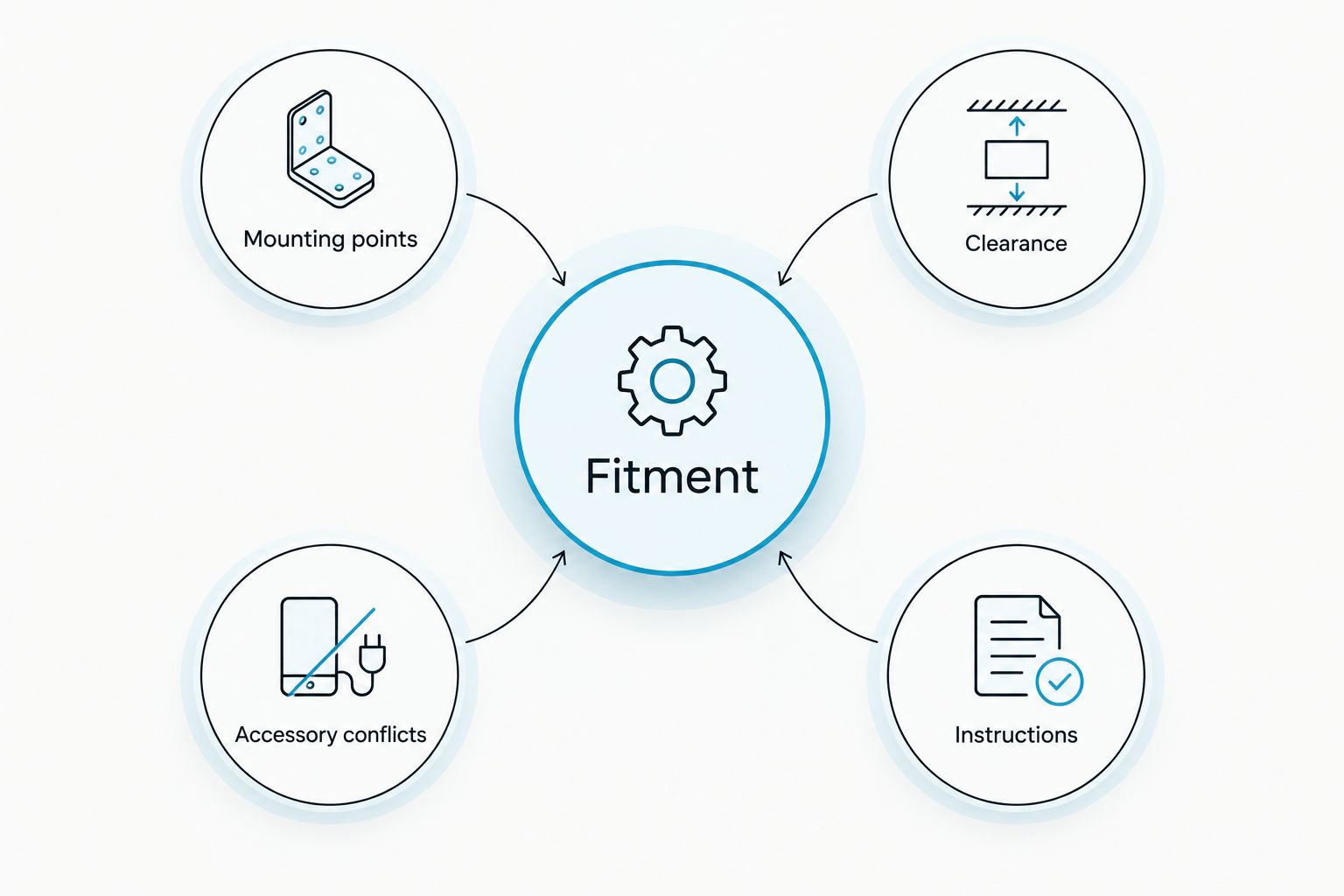
Build your comparison around the physical interface:
- Mounting points: identify where the part attaches.
- Clearance: check nearby components and moving parts.
- Accessory conflicts: check roofs, doors, windshields, and other installed equipment.
- Instructions: confirm the required installation procedure before ordering.
Neither seller deserves a blanket win on durability or comfort. Those are product-level questions. Compare documented construction and application details, and avoid treating an aggressive-looking part as evidence of better protection.
Maintenance shopping rewards breadth, but part numbers decide
Rocky Mountain ATV/MC is the stronger starting point for a maintenance list covering different powersports vehicle types. That recommendation follows its broader scope, not a claim that every replacement component is better.
The UTV-focused retailer also has supplied examples of bearings, ball joints, and differential-related components. It is not accurate to describe the choice as accessories on one side and maintenance parts on the other.
Kit quantity deserves a close read. The supplied product descriptions distinguish a kit covering 1 wheel, a set covering 2 wheels, and another kit covering 4 wheels. Those quantities describe particular listings, not a universal packaging rule.
For your 2026 maintenance order, write down the required replacement reference and the number of locations being serviced. Compare that requirement with the exact listing contents.
Best for: the owner with a defined replacement requirement
An OEM reference helps identify the intended replacement application, but an aftermarket part described as an OEM replacement is not automatically a genuine OEM-manufactured part. Read the manufacturer and product description separately.
Do not combine a replacement need with an upgrade assumption. First establish what needs replacing; then evaluate any proposed change against the vehicle’s requirements.
Pricing models tie: compare a complete job, not one line item
Both choices are retail parts purchases: you select individual components or kits for the work you intend to do. The meaningful comparison is the complete job, including required supporting parts and installation needs.
A useful pricing comparison keeps the specification fixed. Compare the same manufacturer part number when possible, or document the material differences between alternatives before comparing the purchase terms.
Predictability comes from a complete parts list
A kit is easier to plan around when its contents match the job. “Kit” alone does not establish that every bracket, connector, or installation item you need is included.
Read the contents line by line. If the instructions identify another required component, include it in your decision before choosing a retailer.
Flexibility comes from buying only what the job requires
Individual components suit a build where you already have compatible supporting equipment. They also require careful checking so you do not leave a necessary item out.
For a 2026 order, review current checkout and purchase terms directly. Do not choose either retailer on an assumed shipping, return, or warranty advantage; apply the terms relevant to the exact item and order.
Ownership checks tie: instructions matter more than the logo
Neither retailer’s name replaces the manufacturer’s installation instructions. The practical winner is the exact product you can verify against your machine, existing accessories, and intended use.
Before ordering, complete this check:
- Record the machine’s full identity and existing modifications.
- Match the application and manufacturer part number.
- Read the complete contents and installation instructions.
- Check current terms for that item and your intended purchase.
- Keep the product information with your maintenance records.
This approach also separates two decisions that riders often combine: choosing a retailer and choosing a part. A suitable seller does not make an unsuitable part fit.
If an important compatibility question remains unanswered, resolve it before buying. Do not use the checkout process as a substitute for a fitment decision.
Final verdict: match the retailer to your shopping task
Choose R1 Industries if you are building one UTV
Best for: the side-by-side owner planning model-specific aftermarket upgrades. Start here when your task centers on UTV protection, body components, cab accessories, or another clearly defined side-by-side upgrade.
The strength is the match between the stated retail focus and your build. The boundary is that this focus does not establish a universal product-quality, service, or purchase-terms advantage.
Bring a precise machine description and a specific problem. You will make a better decision comparing suitable parts than browsing for an upgrade without a defined purpose.
Choose Rocky Mountain ATV/MC if you shop across powersports
Best for: the rider maintaining or outfitting motorcycles, ATVs, and a UTV. Start here when the shopping task spans vehicle categories rather than one side-by-side build.
The strength is broader powersports coverage. The boundary is that broader coverage does not settle an individual UTV fitment question or prove a better result from a particular accessory.
For 2026, keep the decision simple: choose the relevant starting point, then compare exact parts and current terms. There is no defensible reason to award every category to one retailer.
One-glance scorecard
| Dimension | Winner |
|---|---|
| UTV-focused shopping | UTV-focused retailer |
| Mixed-machine shopping | Rocky Mountain ATV/MC |
| Starting a model-specific UTV upgrade | UTV-focused retailer |
| Protection and comfort quality | No retailer-wide winner; compare parts |
| Multi-vehicle maintenance shopping | Rocky Mountain ATV/MC |
| Pricing model | Tie: retail parts and kits |
| Installation and ownership checks | Tie: verify the exact product |
FAQ
Is R1 Industries better than Rocky Mountain ATV/MC for UTV accessories?
R1 Industries is the better starting point for a UTV-focused aftermarket build. Rocky Mountain ATV/MC is the better starting point when your shopping list also covers motorcycles and ATVs; compare exact products before making the purchase.
Which retailer should I choose if I own a dirt bike and a UTV?
Rocky Mountain ATV/MC is the more relevant starting point for a shopping list spanning a dirt bike and a UTV. Its broader powersports scope matches that task, but every part still needs its own application check.
Does a retailer’s UTV focus guarantee that a part fits my machine?
No, a UTV focus does not guarantee fitment. Match the model year, full model name, trim, existing equipment, and manufacturer application details before ordering.
How should I compare the cost of a UTV upgrade?
Compare the complete parts requirement for the same job, then review current purchase terms. Include required mounting hardware, supporting components, and installation needs rather than comparing only the main accessory.
Are all wheel bearing kits packaged for the whole vehicle?
No, wheel bearing kit quantities differ by listing. The supplied product descriptions include coverage for one wheel, two wheels, and four wheels, so read the contents rather than relying on the word kit.
Is an OEM replacement part the same as a genuine OEM part?
No, an aftermarket part described as an OEM replacement is not automatically a genuine OEM-manufactured part. Check the named manufacturer, replacement references, and exact vehicle application separately.
Can I choose UTV accessories just by the model name?
No, the model name alone is not a complete fitment check. Model year, trim, installed accessories, and previous modifications also need to match the product’s application requirements.
One last thing
Photograph your machine’s existing mounting area before you shop. Include nearby accessories and any previous modifications, then compare that setup with the product instructions.
The retailer choice is only the starting point; the mounting interface decides whether the part belongs on your UTV. Keep that distinction clear and you can judge either catalog without confusing a relevant category with confirmed fitment.
