

Best overall for an undecided rider: retain the factory exhaust. Best aftermarket shortlist for a turbo RZR: the dual-suppressor slip-on. Best Pro R option for a specified outlet layout: the center-exit slip-on with a 3-inch side dump. This 2026 guide compares UTV exhaust systems by fitment, exhaust layout, and the sound and horsepower evidence you should require before buying.
- Keep the factory exhaust unless an aftermarket system solves a specific riding or performance need.
- R1 Industries UTV exhaust systems include model-specific slip-on and full-exhaust options; choose by exact vehicle fitment.
- The RZR dual-suppressor slip-on belongs on a turbo-platform shortlist, not a verified quietest-exhaust leaderboard.
- Require matched sound tests and before-and-after dyno results before accepting noise or horsepower claims.
Why this matters
A louder exhaust is not proof of more horsepower. Exhaust tone, measured sound level, and engine output answer different questions, so treat them separately when choosing parts for your 2026 riding plans.
R1 Industries is best for UTV owners shopping model-specific aftermarket parts rather than universal exhaust upgrades. Start with your exact machine, then decide what you want to change. You can use R1 Industries as your starting point for parts shopping, but a product name alone does not establish a sound or power advantage.
Taking a trip to the dunes? Check the riding area's current exhaust and spark-arrestor requirements before selecting a system. The right exhaust needs to suit the places you ride, not just sound good in a driveway recording.
What makes the best UTV exhaust systems?
Use these criteria before comparing exhausts. They keep a sound preference from turning into an unsupported performance purchase.
- Exact fitment: Match the model, engine, model year, and seating configuration wherever the listing specifies them.
- Comparable sound evidence: Require the same measurement method, engine speed, microphone placement, and installed exhaust configuration.
- Comparable horsepower evidence: Look for baseline and modified dyno runs on the same machine, with tuning changes identified.
- Installation scope: Separate a slip-on replacement from a full-exhaust installation; follow the specific system's instructions.
- Trail suitability: Verify applicable sound rules, spark-arrestor requirements, and emissions restrictions for your use.
- Service access: Check mounting instructions, required clearances, and access to surrounding components before committing.
For 2026 shopping, treat “dual suppressor,” “side exit,” and “full exhaust” as configuration descriptions. None is a substitute for a measured sound level or a documented horsepower result.
UTV exhaust systems at a glance
The order below is a buying decision tree, not a measured loudness or horsepower leaderboard. Start with the factory exhaust, then move to the row that matches your machine and objective.
| Rank and option | Best for | Standout feature | Sound and horsepower gate | Key limitation |
|---|---|---|---|---|
| 1. Factory exhaust | Riders without a defined upgrade need | Retains the existing exhaust configuration | Establish a baseline before changing parts | Does not provide an aftermarket layout change |
| 2. 2020+ Polaris RZR Pro XP/Turbo R/Pro S Dual Suppressor Slip-On Exhaust | Turbo RZR owners comparing suppressor configurations | Dual-suppressor slip-on; stainless steel | Require sound testing and matched dyno results | Does not establish Pro R compatibility |
| 3. 2022+ Polaris RZR Pro R Center-Exit Slip-On Exhaust with 3-Inch Side Dump | Pro R owners prioritizing outlet layout | Center-exit slip-on with side dump | Require evidence for the exact outlet configuration | Listed for Pro R, not turbo RZR platforms |
| 4. 2024+ Can-Am Maverick R Full Exhaust with Center Exit & 3-Inch Side Dump | Maverick R owners seeking a full-exhaust option | Full-exhaust configuration | Separate exhaust-only results from tuning changes | Not a Maverick X3 fitment claim |
| 5. 2024+ Polaris Ranger XD 1500 Dual-Suppressor Slip-On Exhaust | Ranger XD 1500 utility owners | Stainless-steel dual-suppressor slip-on | Check working-speed sound as well as performance data | Not a Ranger XP 1000 fitment claim |
| 6. 2021+ Can-Am Commander & 2022+ Maverick Sport 1000R Center-Exit Exhaust | Listed Commander and Maverick Sport owners | Center-exit slip-on application | Require results for the matching engine and model | Does not establish compatibility with other Can-Am platforms |
1. Factory exhaust: best UTV exhaust option for undecided riders
Keeping the factory exhaust is the default when you cannot name the problem an aftermarket system should solve. You retain your current configuration and establish a useful baseline for later comparisons.
Listen from the driver's seat during the riding you actually do. A short idle clip does not tell you whether a different exhaust will suit a long trail day.
Factory exhaust pros:
- Keeps the existing fitment and outlet arrangement.
- Provides the baseline for sound and horsepower comparisons.
- Avoids adding an exhaust installation to an otherwise unchanged machine.
Factory exhaust cons:
- Does not change the exhaust's existing tone or layout.
- Does not resolve an existing damaged or defective exhaust; inspect and repair faults separately.
Best for: Riders whose current exhaust works and who have no specific upgrade requirement.
Verdict: Hold. Keep the factory exhaust until you have a clear reason to replace it.
2. RZR dual-suppressor slip-on: best for turbo RZR comparisons
The 2020+ Polaris RZR Pro XP/Turbo R/Pro S Dual Suppressor Slip-On Exhaust is a stainless-steel slip-on option for the platforms named in its title. Its dual-suppressor configuration makes it relevant when you are comparing different muffler arrangements.
Do not translate “dual suppressor” into “quietest.” Ask for a sound comparison against the factory exhaust on your exact RZR, including the configuration used during testing.
RZR dual-suppressor slip-on pros:
- Identifies Pro XP, Turbo R, and Pro S applications.
- Uses stainless steel, as stated in the product description.
- Provides a slip-on option rather than the full-exhaust configuration listed elsewhere in this guide.
RZR dual-suppressor slip-on cons:
- The suppressor count does not establish a measured noise reduction.
- The listed turbo-platform applications do not establish Pro R fitment.
Best for: Owners of the named turbo RZR platforms comparing slip-on exhaust configurations.
Verdict: Hold. Confirm exact fitment, required tuning, and relevant sound evidence before choosing the RZR dual-suppressor slip-on.
3. Pro R center-exit slip-on: best for a specified outlet layout
The 2022+ Polaris RZR Pro R Center-Exit Slip-On Exhaust with 3-Inch Side Dump is listed for two- and four-seat Pro R models. Its defining detail is the center-exit configuration with a 3-inch side dump.
That outlet dimension describes hardware, not horsepower. Check how the installed system sits relative to your rear accessories and follow the manufacturer's clearance requirements.
Pro R center-exit slip-on pros:
- Names the Pro R application directly.
- Specifies two- and four-seat model coverage in the description.
- Gives a concrete outlet configuration to compare against other Pro R options.
Pro R center-exit slip-on cons:
- A 3-inch outlet does not establish a power gain or sound ranking.
- Pro R fitment does not establish compatibility with Pro XP, Turbo R, or Pro S.
Best for: Pro R owners who specifically want to evaluate this center-exit and side-dump layout.
Verdict: Hold. Choose the outlet layout only after checking installation details and testing evidence for the complete system.
4. Maverick R full exhaust: best for a full-system shortlist
The 2024+ Can-Am Maverick R Full Exhaust with Center Exit & 3-Inch Side Dump is identified as a full exhaust. Its description lists two- and four-seat Maverick R applications.
Keep Maverick R and Maverick X3 shopping separate. A shared manufacturer name is not evidence that exhaust mounts, routing, or engine connections match.
Maverick R full exhaust pros:
- Identifies the Maverick R platform.
- Lists two- and four-seat applications.
- Specifies a full-exhaust configuration with a 3-inch side dump.
Maverick R full exhaust cons:
- Requires installation planning for a full exhaust, not assumptions drawn from slip-on instructions.
- Does not establish a horsepower advantage over the factory exhaust or any slip-on.
Best for: Maverick R owners deliberately comparing full-exhaust configurations.
Verdict: Hold. Require exact application confirmation and a clear account of any tuning used in performance testing.
5. Ranger XD 1500 dual-suppressor slip-on: best for utility use
The 2024+ Polaris Ranger XD 1500 Dual-Suppressor Slip-On Exhaust is described as a stainless-steel system for single- and crew-cab models. It belongs in an XD 1500 comparison, not a general Ranger exhaust list.
For work riding, evaluate sound at the engine speeds you use around the property or on access trails. A wide-open-throttle recording answers a different question.
Ranger XD 1500 slip-on pros:
- Names the XD 1500 platform.
- Lists single- and crew-cab applications.
- Specifies stainless-steel construction and a dual-suppressor arrangement.
Ranger XD 1500 slip-on cons:
- Dual suppressors alone do not prove quieter operation.
- The application does not establish Ranger XP 1000 compatibility.
Best for: Ranger XD 1500 owners comparing a model-specific slip-on for utility riding.
Verdict: Hold. Check sound during representative use before treating this exhaust as a work-rig improvement.
6. Commander and Maverick Sport exhaust: best for listed 1000R models
The 2021+ Can-Am Commander & 2022+ Maverick Sport 1000R Center-Exit Exhaust is described as a center-exit slip-on. The description specifies Commander 1000R and Maverick Sport 1000R applications.
Use those full model names when checking fitment. “Can-Am exhaust” is too broad to make a buying decision.
Commander and Maverick Sport exhaust pros:
- Identifies the relevant 1000R applications.
- Specifies a center-exit layout.
- Provides a slip-on option for the listed platforms.
Commander and Maverick Sport exhaust cons:
- Does not establish Maverick R, Maverick X3, or Defender compatibility.
- Center-exit routing alone does not establish tone, noise level, or horsepower gains.
Best for: Owners of the explicitly listed Commander 1000R and Maverick Sport 1000R models.
Verdict: Hold. Confirm the complete vehicle application before comparing sound or performance claims.
How to compare sound and horsepower before buying
Use this sequence for a 2026 exhaust purchase. It separates a useful comparison from a recording or dyno chart that leaves important variables unexplained.
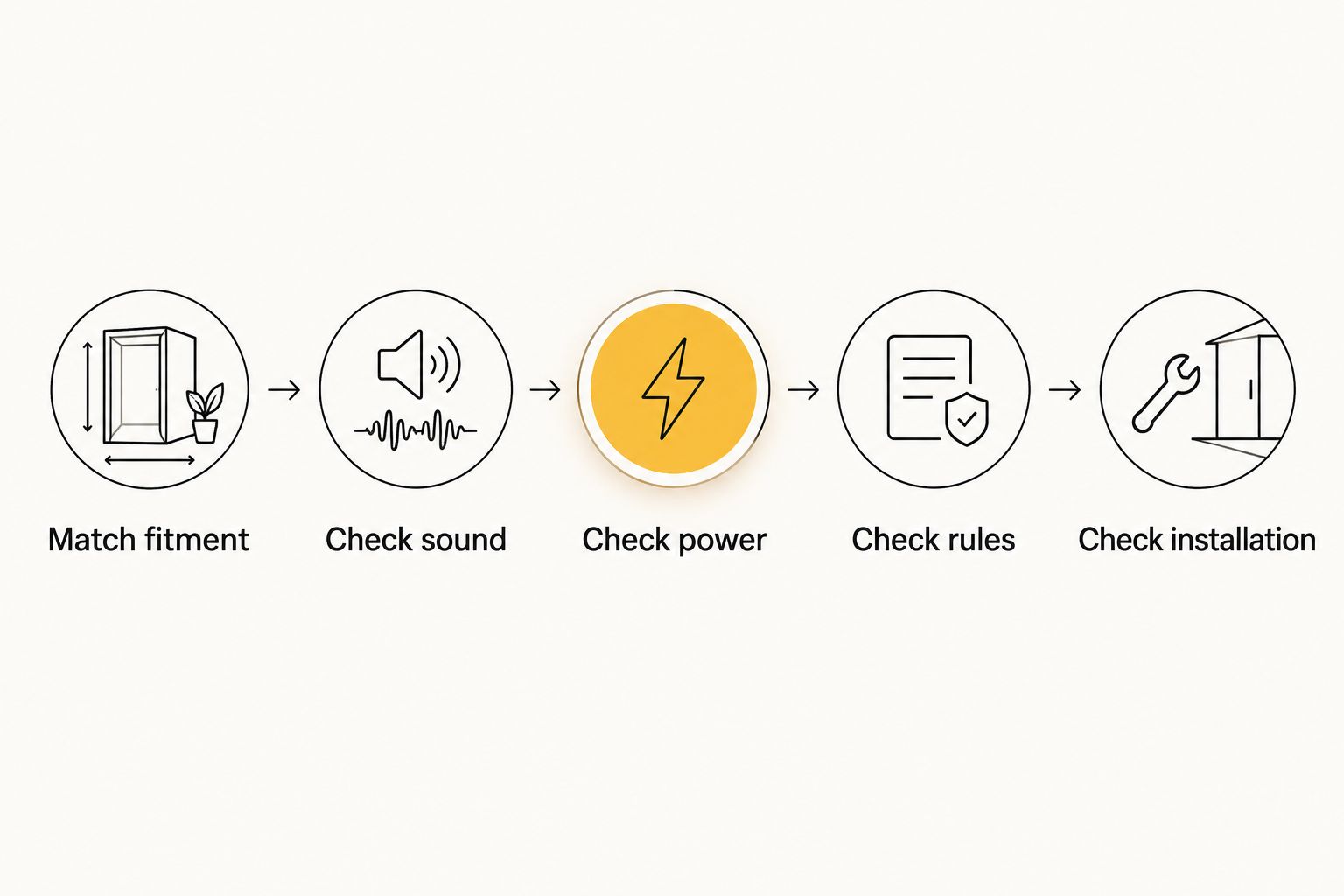
- Match fitment. Record your exact model, engine, model year, and seating configuration. Compare those details with the complete product application.
- Check sound. Require matching microphone placement, engine speed, and test conditions. Confirm whether inserts or spark arrestors were installed.
- Check power. Compare baseline and modified runs on the same dyno. Identify changes to fuel, tuning, intake, boost, and other engine hardware.
- Check rules. Confirm the requirements for the riding area and the installed exhaust configuration. A quiet-sounding system is not proof of compliance.
- Check installation. Review mounting, clearances, required components, and tuning instructions before removing the factory exhaust.
Separate exhaust-only gains from package gains. If a dyno comparison changes the exhaust and the engine calibration together, the result describes that combination; it does not isolate the exhaust's contribution.
Read the torque curve as well as the peak horsepower figure. You want evidence relevant to the engine speeds your machine uses, not just the largest number on the chart.
Model-specific exhausts to compare
These R1 Industries UTV exhaust systems match the configurations discussed above. Use the cards to inspect the complete product details after identifying your vehicle; the selection is not a verified sound or horsepower ranking.


How these exhaust options are ranked
This 2026 guide ranks choices by decision usefulness: retain the baseline first, then shortlist exact-fit aftermarket configurations. Fitment and stated construction support that order; sound and horsepower rankings require comparable measurements.
R1 Industries sells aftermarket parts, but retailer selection is not a substitute for application-specific testing. Each recommendation above identifies both its useful feature and its buying limit.
Which UTV exhaust system should you choose?
Keep the factory exhaust if you are undecided. For an aftermarket purchase, choose the row that matches your exact machine, then require evidence for the sound or performance change you want.
Choose the RZR dual-suppressor slip-on for a named turbo-platform comparison, the Pro R center-exit slip-on for its specified outlet layout, or the Maverick R full exhaust for a full-system evaluation. The Ranger and Commander options serve their separately listed applications.
Do not buy an exhaust because another machine sounded good with it. Match the hardware, the riding conditions, and the evidence.
FAQ
What's the best UTV exhaust system for trail riding?
The best default is your functioning factory exhaust until an aftermarket system meets a specific need. For a replacement, require exact fitment, suitable sound levels, and compliance with your riding area's requirements.
Does a louder UTV exhaust make more horsepower?
Louder sound does not prove more horsepower. Use matched before-and-after dyno results to evaluate power, and compare sound separately.
Is a dual-suppressor UTV exhaust quieter?
A dual-suppressor designation alone does not prove quieter operation. Require a measured comparison against the factory exhaust using the same vehicle and test method.
Is a full UTV exhaust better than a slip-on?
A full exhaust is not automatically better than a slip-on. Compare the exact systems by fitment, installation requirements, measured sound, and documented power results.
Will a Polaris RZR Pro R exhaust fit a Pro XP?
The listed Pro R exhaust does not establish Pro XP compatibility. R1 Industries lists the Pro R and Pro XP exhaust applications separately, so confirm your exact model before ordering.
Does a UTV exhaust need a tune?
Follow the tuning requirements for the exact exhaust and vehicle combination. Do not assume that every slip-on works with an unchanged calibration or that every full exhaust has the same requirements.
Does a UTV exhaust need a spark arrestor?
Spark-arrestor requirements depend on where you ride and the applicable rules. Confirm both the requirement and the arrestor's compatibility with your installed exhaust; a muffler designation does not establish either.
One last thing
A spark arrestor is not a universal add-on. The listed Can-Am Defender & Kawasaki Ridge accessory specifies compatible 2-inch-outlet exhausts; that does not establish compatibility with the 3-inch side-dump systems discussed here.
Before your next ride, check the complete installed setup rather than the muffler alone. That final fitment check is more useful than choosing the loudest clip in your feed.