

Best default: a Pro XP-specific long travel kit selected for usable wheel travel, not maximum lift. Best for rough open terrain: a matched long travel suspension package. Best for clearance-only needs: a dedicated lift solution, which is not a long travel kit. This 2026 guide ranks suspension approaches by their purpose and explains how to compare lift-height claims without confusing height, width, and travel.
- Choose a pro xp long travel kit by documented fitment, wheel travel, and suspension geometry—not lift height alone.
- Long travel suspension and ground-clearance upgrades solve different problems; compare them separately.
- R1 Industries serves UTV owners shopping aftermarket parts and accessories.
- Confirm shocks, axles, brake-line routing, finished width, and alignment requirements before ordering.
Why this matters
Taking your Pro XP through whoops is a different job from getting its belly over rocks. A suspension package needs to match the problem you actually have. A taller stance does not prove that the wheels can move farther or that the shocks control the ride better.
R1 Industries sells aftermarket UTV parts and accessories. For a Pro XP long travel kit purchase, keep the vehicle-specific installation instructions and component list at the center of your decision—not a general RZR label.
Lift height describes where the vehicle sits; wheel travel describes how far the suspension moves. That distinction is the starting point for any useful 2026 comparison. Rank documented height figures only after confirming what each figure measures.
What makes the best Pro XP long travel kit?
Use these criteria before comparing suspension options:
- Exact fitment: The documentation must name your Pro XP configuration, model year, and any shock or trim restrictions. Similar RZR names are not interchangeable fitment approval.
- Defined measurements: Separate static ride height, ground clearance, suspension travel, and added width. A measurement without a reference point is not a useful comparison.
- Matched components: Confirm what happens to A-arms, rear suspension links, axles, steering links, shocks, and brake lines. Read both the included-parts list and the required-parts list.
- Usable geometry: Require installation guidance for alignment, suspension limits, and clearance checks. Height alone does not establish safe operation through the suspension's movement.
- Terrain suitability: Match the package to open desert, dunes, rocky trails, or mixed riding. Also consider trail restrictions and transport space.
- Serviceability: Identify replacement wear parts and the inspection procedure before installation. A damaged component should have an identifiable replacement, not just a recognizable kit name.
Suspension options at a glance
The order below is a buying-priority ranking, not an unsupported tallest-to-shortest product leaderboard. A long travel package belongs ahead of a lift-only solution when your actual goal is suspension travel.
| Rank and option | Best for | Standout purpose | Lift-height comparison | Key limitation |
|---|---|---|---|---|
| 1. Travel-focused long travel package | Riders seeking suspension movement rather than extra height | Prioritizes a matched suspension system | Compare documented loaded ride height separately from travel | Requires complete fitment and setup confirmation |
| 2. Raised-ride-height long travel package | Riders with both a travel need and a defined clearance problem | Combines a travel objective with a height objective | Require separate figures for height gain and wheel travel | Added height introduces another setup trade-off |
| 3. Dedicated lift solution | Riders whose primary problem is static clearance | Targets vehicle height rather than long travel | Compare lift claims under matching measurement conditions | Does not establish a wheel-travel increase |
Do not rank these options by the largest number in a product headline. First identify whether that number describes vertical height, suspension movement, or added width. Those measurements answer different questions.
1. Travel-focused package: best for a wheel-travel goal
A travel-focused Pro XP long travel package addresses suspension movement and the components needed to support it. Treat ride height as a setup measurement, not the reason to buy. Your decision should rest on documented wheel travel, component compatibility, and the installation procedure.
This is the default approach when you want a suspension upgrade rather than simply a taller vehicle. It still needs a complete system check; the words long travel do not establish what comes in the box.
Travel-focused package pros:
- Keeps your purchase tied to the suspension problem you want to solve.
- Makes shock and axle requirements part of the initial comparison.
- Separates wheel-travel claims from appearance and static stance.
Travel-focused package cons:
- A travel-focused package does not automatically solve a ground-clearance problem.
- Required shocks, axles, or supporting components depend on the specific package.
- Finished width and transport fit still need confirmation.
Best for: Pro XP owners whose priority is a documented change in suspension travel.
For a 2026 build, request the exact installation instructions before committing. Compare the stated suspension movement with the shock requirements, then check whether the finished vehicle fits your trails and trailer.
Verdict: Buy only when Pro XP fitment and the complete suspension configuration are documented.
2. Raised long travel package: best for travel plus clearance
A raised-ride-height long travel package combines two objectives: a suspension-travel change and a higher operating stance. Evaluate those objectives separately. A package that meets your height target still needs to meet your travel and geometry requirements.
Start with the obstacle causing trouble. Belly contact, tire-to-body contact, and poor shock control are different problems, so describe which one you need to fix before choosing a taller setup.
Raised long travel package pros:
- Puts clearance and suspension movement into the same build discussion.
- Encourages you to define a loaded ride-height target before installation.
- Makes tire clearance and suspension clearance explicit checks.
Raised long travel package cons:
- Raising the chassis changes its relationship to the ground and suspension.
- More static height does not prove more usable travel.
- Height claims depend on the tire, load, and measurement reference used.
Best for: Pro XP owners with a documented travel requirement and a specific clearance problem.
Do not choose this approach just because the taller vehicle looks ready for harder riding. Ask how the intended ride height affects available compression and extension, and follow the package manufacturer's setup instructions.
Verdict: Hold until both the height target and the travel requirements are confirmed.
3. Dedicated lift solution: best for clearance-only needs
A dedicated lift solution targets vehicle height. That makes it a separate category from a Pro XP long travel kit, even when both appear in the same suspension search results. The lift specification alone says nothing about increased wheel travel.
If your suspension already meets your riding needs but the vehicle lacks clearance, compare clearance solutions on their own terms. Do not buy a full long travel package solely because you assume it must provide more lift.
Dedicated lift solution pros:
- Keeps the comparison focused on a clearance problem.
- Separates height objectives from shock-control objectives.
- Gives you a clear reason to check the finished vehicle's stance and dimensions.
Dedicated lift solution cons:
- A lift claim does not establish additional suspension travel.
- The installation still requires vehicle-specific geometry and clearance checks.
- A taller stance does not replace suitable tires, protection, or driving judgment.
Best for: Pro XP owners seeking static clearance rather than a travel increase.
Portal systems also belong in the clearance discussion, not automatically in a long travel ranking. Their operating principle differs from a suspension lift; use the guide to choosing portal gear lifts to understand that distinction.
Verdict: Skip as a substitute for long travel; consider only for a clearance-specific build.
How to compare lift height without mixing measurements
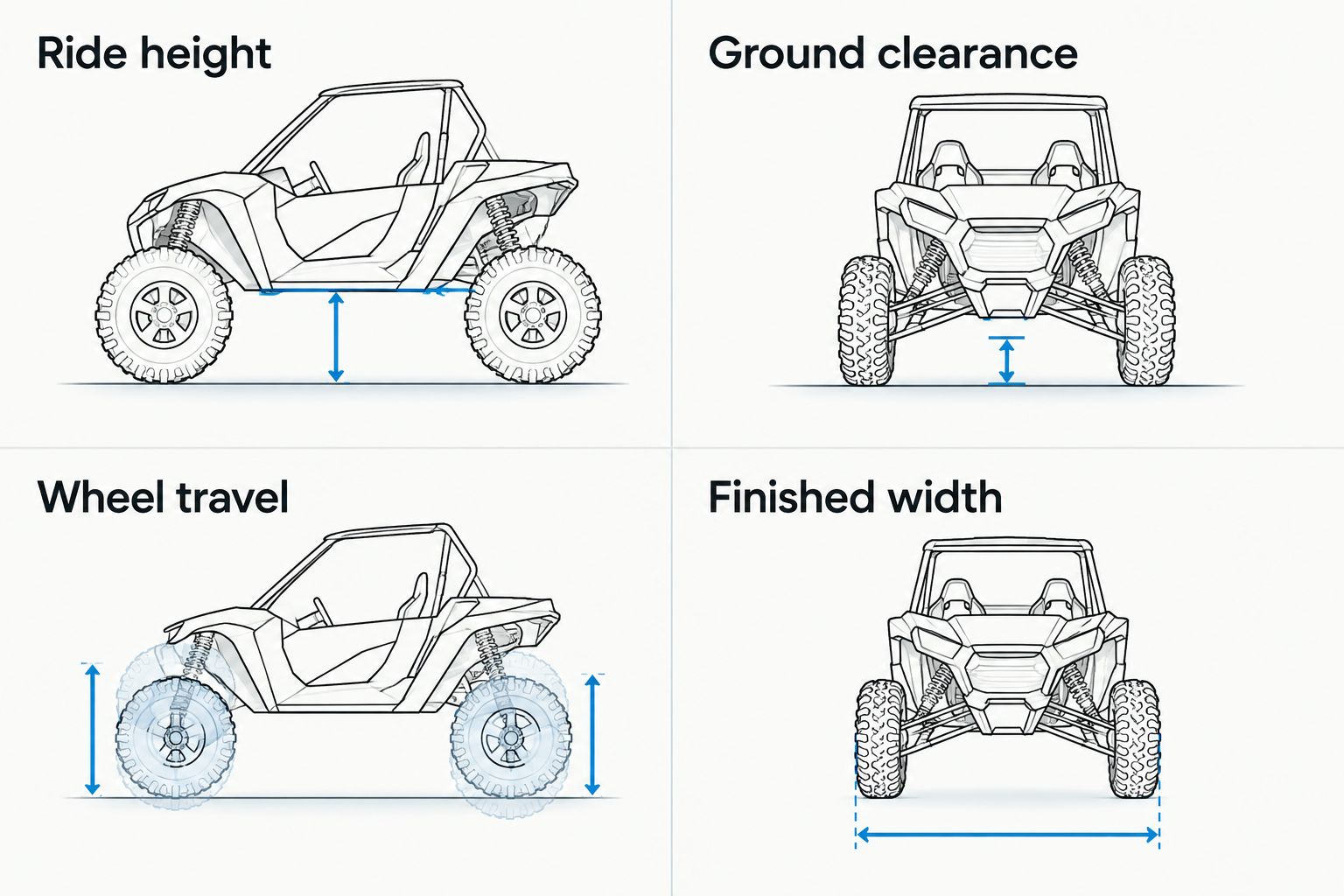
A useful 2026 lift-height comparison starts with consistent measurement conditions. Record the vehicle's current setup before changing anything. Keep the reference points clear enough that another person can repeat the measurements.
Ride height
Measure the chassis relative to level ground at defined reference points. Record the tire setup and whether the vehicle carries its normal riding load. An empty vehicle and a loaded vehicle are not equivalent comparison conditions.
Measure around all 4 wheels, not just one corner. Front-to-rear or side-to-side differences deserve attention before you interpret a single headline height figure.
Ground clearance
Ground clearance is the distance between the ground and the relevant lowest point. State which point you measured. Chassis clearance and clearance beneath a suspension component are not necessarily the same measurement.
A documented 1-inch height gain at a chassis reference point is not proof of a 1-inch wheel-travel gain. Height and travel describe different relationships; neither number substitutes for the other.
Wheel travel
Wheel travel describes movement through the suspension's range. Require the manufacturer to distinguish front and rear figures and explain the intended setup. Check both 2 axles rather than treating one travel figure as a description of the entire vehicle.
Shock stroke is also not a direct replacement for wheel-travel data. Suspension geometry determines the relationship between movement at the shock and movement at the wheel.
Finished width
Added suspension width is not vertical lift. Confirm whether a width claim describes each side or the complete vehicle, and account for the specified wheel setup. Then compare the finished dimensions with your actual transport and trail requirements.
Check the complete package before ordering
For your 2026 Pro XP build, the included-parts list is only half the purchase decision. The other half is the list of parts, setup work, and checks required to finish the installation correctly.
Ask for clear answers to these questions:
- Vehicle fitment: Does the package explicitly cover your exact Pro XP configuration?
- Shocks: Does it retain your shocks, require different shocks, or require a specified setup change?
- Axles: Which axle configuration does the manufacturer require?
- Steering: What steering components and alignment procedure does the package specify?
- Brake lines: What routing or replacement requirements apply through full suspension movement?
- Limits: What establishes the compression and extension limits?
- Instructions: Are torque specifications and inspection steps provided for the installation?
A broad Polaris or RZR label is not enough. Neither is a product photograph showing a similar vehicle. Buy against explicit fitment documentation, not visual resemblance.
Set up the vehicle before judging the result
Installation is not the finish line. Follow the kit instructions for alignment, fastener torque, shock setup, and suspension-clearance checks before riding. Use a qualified installer when you cannot safely perform those procedures.
Inspect brake-line routing and moving-component clearance throughout the range specified by the manufacturer. Check steering movement as instructed, too. A vehicle that clears at rest has not passed a full operating-clearance check.
Then record the completed setup under the same conditions used for your baseline measurements. That gives you a meaningful before-and-after comparison rather than two unrelated ride-height readings.
How these options are ranked
The ranking puts the stated job first: suspension travel, travel plus clearance, or clearance alone. Exact fitment, defined measurements, matched components, geometry, terrain suitability, and serviceability determine whether an individual package belongs in your shortlist.
R1 Industries is a UTV parts retailer, not the suspension manufacturer for every product a rider considers. Use manufacturer-specific documentation to verify lift and travel claims. Retailer choice does not remove that requirement.
Which Pro XP suspension approach should you choose?
Choose a travel-focused Pro XP long travel package when usable suspension movement is your main objective. Choose a raised package only when you can define both the travel requirement and the clearance problem. Keep lift-only solutions in a separate comparison.
For 2026, the default decision remains simple: establish fitment and the complete system requirements before ranking height. A tall specification is not a better specification unless it solves your actual riding problem.
FAQ
What's the best Pro XP long travel kit for me?
The best Pro XP long travel kit is the package with documented fitment and a suspension configuration that matches your riding needs. Compare wheel travel, shocks, axles, geometry, and finished dimensions before considering lift height.
Does a Pro XP long travel kit always lift the vehicle?
Long travel does not establish a specific lift-height gain. Confirm the package's stated ride-height setup separately from its wheel-travel specifications.
Is a taller suspension kit better for dunes?
A taller stance alone does not establish better dune performance. Evaluate the complete suspension configuration, shock setup, tires, and manufacturer instructions rather than height alone.
Can I keep my factory shocks with a long travel kit?
Keep factory shocks only when the kit manufacturer explicitly approves them for the specified configuration. Some packages have different shock or setup requirements, so verify the exact instructions before ordering.
Is a lift kit the same as a long travel kit?
A lift kit and a long travel kit are different categories. A lift targets height, while a long travel package addresses suspension movement; a lift claim does not prove increased wheel travel.
Will any Polaris RZR suspension kit fit my Pro XP?
No; a general Polaris RZR label does not establish Pro XP compatibility. Require explicit approval for your model year, configuration, and applicable shock or trim restrictions.
How do I compare lift-height claims fairly?
Compare measurements taken at matching reference points with matching tire and load conditions. Keep ride height, ground clearance, wheel travel, and finished width in separate columns.
One last thing
Measure your trailer before committing to a suspension configuration that changes width. A build that fits your riding plans still needs to fit your transport setup. Record usable loading space, not just the trailer's advertised size.
The best upgrade is the one that solves the riding problem without creating an avoidable fitment problem.