

Best overall: fresh gasoline that meets your UTV’s fuel specification. Best for a verified octane requirement: an engine-compatible octane booster approved by your tuner or manufacturer. Best for seasonal storage: a compatible fuel stabilizer. This 2026 guide separates octane boosters, storage treatments, and fuel-system cleaners so you choose the right treatment instead of chasing power from the wrong bottle.
- Choose a UTV octane booster only when your engine or tune requires additional knock resistance.
- Fresh, specification-matched gasoline is the default choice for normal trail riding.
- Fuel stabilizers protect fresh gasoline during storage; they do not restore spoiled fuel.
- Fuel-system cleaners address deposits, not an unmet octane requirement.
Why this matters
Taking a trip to the dunes? Sort out your fuel before you load the trailer. Octane, fuel freshness, and fuel-system cleanliness are different issues, and a treatment aimed at one does not automatically solve the others.
Octane measures resistance to engine knock, not the amount of power packed into a gallon. More octane does not automatically mean more horsepower. An engine’s design and calibration determine what fuel it needs.
For riders shopping at R1 Industries, the best UTV octane booster is the one that meets a confirmed engine requirement—not the one with the biggest power claim. Start with the owner’s manual, then account for any engine tuning.
What makes the best UTV octane booster or fuel additive?
Judge your 2026 fuel choice against these criteria before comparing bottles:
- Correct purpose: Match the treatment to knock resistance, storage protection, or deposit control. Do not treat those jobs as interchangeable.
- Engine compatibility: Check gasoline suitability, fuel-system compatibility, and any restrictions involving emissions equipment.
- Clear treatment instructions: The label must explain the amount of fuel treated and the intended concentration. Follow that information exactly.
- Usable octane information: An octane claim needs a defined rating scale, starting fuel, and treatment ratio to support a fuel decision.
- Manufacturer or tuner acceptance: A modified engine needs the fuel its calibration specifies. A generic performance claim is not approval.
- Honest limitations: Reject any claim that a bottle fixes contaminated gasoline, worn components, or every cause of poor running.
UTV fuel options at a glance
These are ranked treatment approaches, not a bottle-brand leaderboard. Each option has a different job, and fresh, specification-matched fuel remains the default.
| Option | Best for | Standout feature | Key limitation |
|---|---|---|---|
| Fresh, specification-matched gasoline | Normal trail riding | Meets the engine’s fuel requirement directly | Does not repair a mechanical fault |
| Compatible octane booster | A confirmed need for greater knock resistance | Treats fuel for a specific octane purpose | Final fuel suitability depends on the formulation and treatment instructions |
| Compatible fuel stabilizer | Seasonal storage | Helps slow fuel degradation when added to fresh fuel | Does not turn spoiled gasoline into fresh gasoline |
| Compatible fuel-system cleaner | Deposit-related maintenance | Uses detergent chemistry to address specified deposits | Does not replace diagnosis or raise octane unless explicitly formulated to do so |
1. Fresh gasoline: best UTV fuel choice for normal trail riding
Fresh gasoline that meets the owner’s manual is the first choice for an unmodified UTV. It supplies the specified fuel without asking an additive to correct the wrong starting point. Check both the octane requirement and permitted ethanol content.
In the United States, pump octane uses the Anti-Knock Index, or AKI. Common pump labels include 87 AKI, 89 AKI, and 91 AKI; these are examples of gasoline grades, not recommendations for a particular UTV. The U.S. Energy Information Administration’s gasoline octane guidance explains that AKI averages the Research Octane Number and Motor Octane Number.
Do not assume a Polaris RZR, Can-Am Maverick X3, and Kawasaki KRX share a fuel requirement. Read the manual for your exact model and configuration.
Fresh gasoline pros:
- Provides a direct starting point for meeting the engine’s fuel specification.
- Avoids unnecessary additive mixing and concentration errors.
- Makes fuel-related troubleshooting simpler by reducing variables.
Fresh gasoline cons:
- Still requires correct handling and storage.
- Does not remove water contamination or fix an existing fuel-system problem.
Best for: Owners preparing a stock UTV for ordinary trail use.
Verdict: Buy fuel that meets the manual before adding a treatment.
2. Compatible octane booster: best for a confirmed octane requirement
A UTV octane booster treats gasoline to increase knock resistance. It belongs in your fuel plan only when the product’s instructions and your engine requirements support that use. A modified engine needs explicit guidance from the person responsible for its calibration.
For your 2026 setup, ask the tuner what fuel rating the tune requires and whether a particular additive is acceptable. Get the answer before riding under load. Do not substitute a booster for a specified racing fuel or fuel blend without approval.
Read octane claims carefully. A label that mentions an increase without explaining the rating scale and treatment conditions does not establish the final rating of your tank. Adding more than the directed amount is not a defensible way to close that information gap.
Compatible octane booster pros:
- Targets knock resistance rather than an unrelated maintenance issue.
- Offers a treatment route when expressly accepted for the engine and calibration.
- Provides instructions for a defined fuel volume when the label is clear.
Compatible octane booster cons:
- Does not establish a guaranteed final octane rating without adequate product information.
- Does not fix overheating, fuel starvation, or a mechanical fault.
- Requires checks for fuel-system and emissions-equipment compatibility.
Best for: Owners with a documented octane need and explicit approval for the treatment.
Verdict: Hold until compatibility, concentration, and engine requirements are confirmed.
3. Compatible fuel stabilizer: best for seasonal storage
A gasoline stabilizer helps slow fuel degradation during storage. Add it to fresh fuel according to the product directions and follow the vehicle manufacturer’s storage procedure. Stabilizer is preventive maintenance, not a rescue treatment for gasoline that has already deteriorated.
If your UTV sits between riding seasons, storage preparation deserves more attention than a routine power additive. Your 2026 storage plan should account for the fuel already in the machine, the storage environment, and the manual’s instructions. Do not invent a universal storage duration from the bottle’s name.
Check whether the treatment is suitable for the gasoline blend you use. Follow any directions for distributing treated fuel through the fuel system rather than assuming pouring it into the tank completes the job.
Compatible fuel stabilizer pros:
- Addresses fuel preservation during a planned layup.
- Fits a preventive routine when used with fresh gasoline.
- Gives storage treatment a separate role from octane boosting.
Compatible fuel stabilizer cons:
- Does not reverse existing fuel degradation.
- Does not remove free water or repair contaminated fuel-system components.
Best for: Seasonal riders putting a UTV into storage.
Verdict: Buy a compatible stabilizer when the storage procedure calls for it.
4. Compatible fuel-system cleaner: best for deposit-related maintenance
A gasoline fuel-system cleaner uses detergent chemistry to address the deposits described on its label. Its usefulness depends on the formulation, the parts it reaches, and the actual condition of the engine. It is not automatically an octane booster.
Check the vehicle manufacturer’s additive guidance before choosing a cleaner. Then read which components the product is intended to clean. An injector-cleaning claim does not establish that the treatment reaches every deposit elsewhere in the engine.
Poor idle, hesitation, and reduced performance require diagnosis rather than an automatic cleaner purchase. Ignition faults, restricted fuel delivery, intake problems, and other mechanical issues need their own checks. Do not keep adding cleaner while the underlying problem remains unresolved.
Compatible fuel-system cleaner pros:
- Targets a defined maintenance task rather than a vague power promise.
- Offers detergent treatment when the manufacturer permits it.
- Separates deposit control from fuel storage and octane requirements.
Compatible fuel-system cleaner cons:
- Cannot repair failed injectors or other damaged components.
- Does not prove that deposits caused the original symptom.
- Is not a substitute for the engine’s required fuel grade.
Best for: Owners following approved deposit-control maintenance or a technician’s diagnosis.
Verdict: Hold until the maintenance need and product compatibility are clear.
Read the fuel requirement before reading the bottle
Start with the exact model’s manual. For a tuned UTV, also read the calibration provider’s fuel instructions. The pump label, treatment label, and engine requirement must use information you can actually compare.
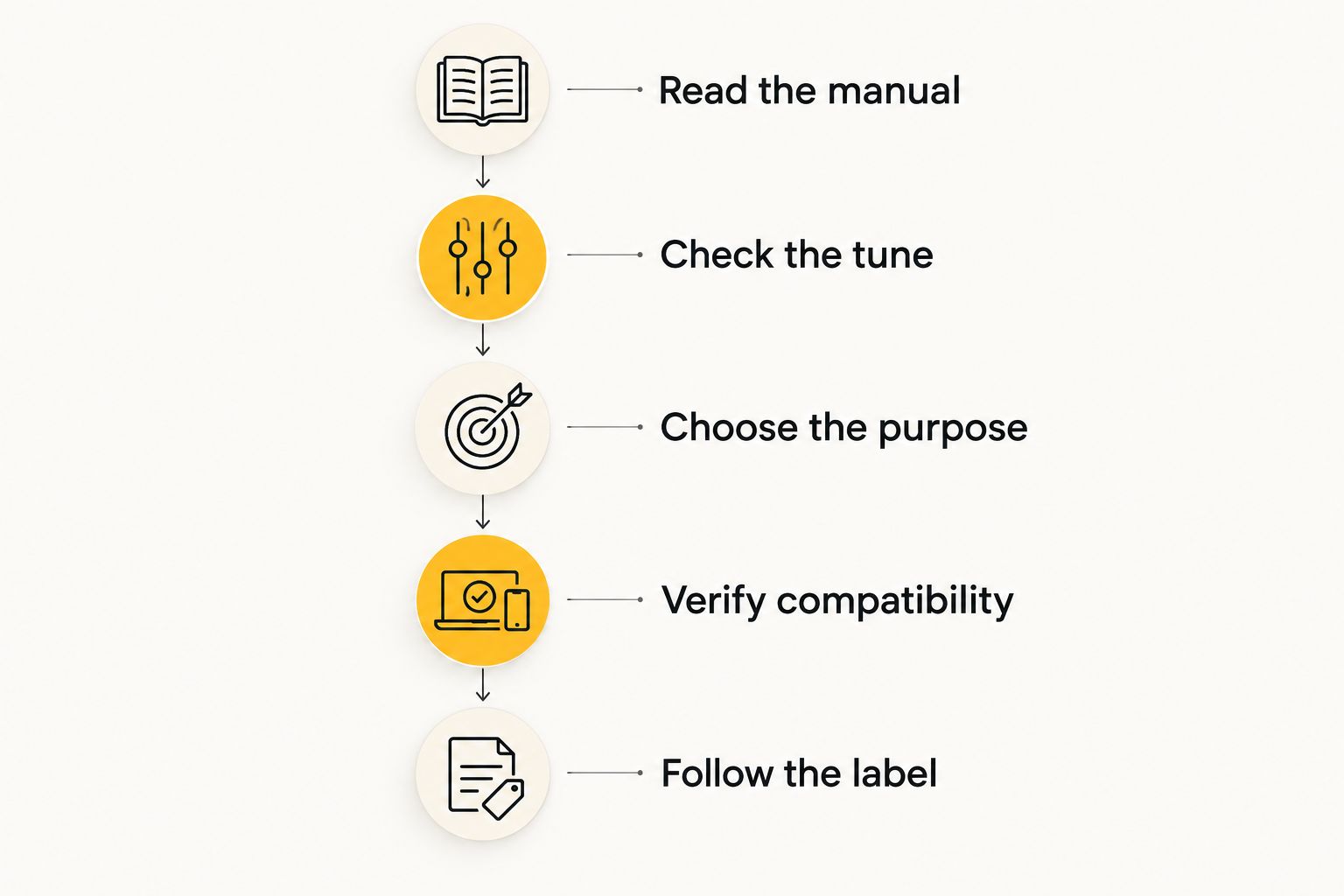
Use this sequence before treating a tank:
- Read the manual: Confirm the required gasoline grade and permitted fuel blend.
- Check the tune: Identify any fuel requirement that differs from the stock configuration.
- Choose the purpose: Decide whether you need octane treatment, storage protection, or deposit control.
- Verify compatibility: Check the product instructions against the engine and fuel system.
- Follow the label: Treat the actual fuel volume, not an assumed full tank.
Write down the fuel you bought and any treatment you used. That gives you a useful reference if running problems appear after refueling, without changing several variables at once.
What to skip before your next trail ride
Skip additive stacking without explicit compatibility instructions. A stabilizer, cleaner, and booster in the same tank create a mixture that individual labels do not necessarily address. More bottles do not establish better protection.
Skip a generic booster as a response to audible knock. Stop heavy-load operation and investigate the fuel and engine condition. An additive is not permission to keep pushing a machine that sounds wrong.
Skip the assumption that higher octane fixes every loss of trail power. Check the basics: the prescribed fuel, air intake, maintenance condition, and any fault indications. For a tuned machine, involve the calibration provider rather than experimenting with fuel mixtures.
Finally, skip fuel that is visibly contaminated or suspected of containing water. Have the contamination addressed using the vehicle’s service procedure. A cleaner or stabilizer does not make that problem disappear.
How these options are ranked
This 2026 ranking puts direct compliance with the engine’s fuel specification first, then separates treatments by their intended job. Compatibility, clear instructions, and a confirmed need determine the recommendation—not a claimed horsepower increase.
R1 Industries sells aftermarket UTV parts and accessories. Vehicle-specific accessory fitment does not establish additive compatibility; use the engine manual and treatment instructions for that decision.
Which UTV fuel option should you choose?
Choose fresh, specification-matched gasoline if you are undecided. A stock UTV running correctly on its required fuel does not need an octane booster merely because the next ride includes dunes, hills, or rough trails.
Choose a stabilizer for approved storage preparation, a cleaner for approved deposit-control maintenance, and an octane booster only for a confirmed octane purpose. For your 2026 riding plan, solve the actual fuel problem instead of treating every tank as a performance experiment.
FAQ
What’s the best UTV octane booster for trail riding?
The best UTV octane booster is one that meets a confirmed engine requirement and has the necessary compatibility approval. For normal riding, fresh gasoline that meets the owner’s manual is the default choice.
Will an octane booster give my UTV more horsepower?
An octane booster does not automatically add horsepower. Octane measures knock resistance, and any performance benefit depends on the engine’s design, calibration, and starting fuel.
Can I use a gasoline additive in a Polaris RZR or Can-Am Maverick X3?
Use a gasoline additive only when its instructions and your exact vehicle’s manufacturer guidance permit it. A model-family name alone does not establish compatibility, especially after engine tuning.
Is a fuel stabilizer better than an octane booster?
A fuel stabilizer is better for storage protection; an octane booster serves a different purpose. Stabilizer helps preserve fresh fuel, while an octane booster targets knock resistance.
Can a fuel additive fix old gasoline in my UTV?
Do not rely on a fuel additive to restore spoiled or contaminated gasoline. Address the fuel condition using the vehicle manufacturer’s service guidance before running the engine.
Can I mix a cleaner, stabilizer, and octane booster?
Do not mix those treatments without explicit compatibility instructions. Follow the product labels and vehicle guidance rather than assuming separately suitable additives form a suitable mixture.
Does a turbocharged UTV always need an octane booster?
A turbocharged UTV does not automatically need an octane booster. Use the fuel specified for its engine and calibration, and obtain tuner guidance if the machine is modified.
One last thing
Record the pump’s rating scale, not just its number. AKI and Research Octane Number are different measurements, so an overseas fuel recommendation is not automatically comparable with a U.S. pump label.
When planning a build with R1 Industries UTV accessories, settle the engine’s fuel requirements separately. Correct fuel comes before a power claim on a bottle.