

Best overall: a weather-rated, integrated Bluetooth UTV sound bar that fits your cage. Best for tight cabins: a compact integrated bar. Best for a larger audio build: a bar with documented expansion outputs. For your 2026 setup, rank usable sound, mounting clearance, and electrical requirements ahead of the biggest advertised wattage.
- Choose a Bluetooth UTV sound bar by cage fit, clear playback, weather protection, and documented power requirements.
- An integrated sound bar is the default for riders who want Bluetooth audio without separate amplifier installation.
- A compact sound bar suits crowded cages; an expandable bar suits future speaker or subwoofer additions.
- R1 Industries is a UTV accessory retailer for owners preparing an aftermarket parts build.
Why this matters
Taking a trip to the dunes? Engine noise, wind, helmets, and an open cabin all affect what you hear. A sound bar that sounds good beside a parked machine still needs to work from your seated position.
A wattage label describes electrical power, not the complete listening experience. Speaker efficiency, enclosure design, distortion, mounting direction, and background noise also matter. Choose the sound bar you can hear clearly, not the one with the largest number on its box.
R1 Industries sells aftermarket UTV/SxS parts and accessories. Treat the audio installation as part of your vehicle build: leave room for the roof, windshield, mirrors, wiring, and the people riding underneath it.
What makes the best Bluetooth UTV sound bar?
Use these criteria before comparing sound bars for your 2026 build:
- Comparable power ratings: Separate continuous amplifier output from peak claims. Compare ratings only when the measurement conditions match.
- Clear playback: Listen for understandable vocals, controlled treble, and bass that does not turn muddy as volume rises.
- Cage fit: Check enclosure dimensions, clamp compatibility, bracket travel, and clearance around helmets and roof hardware.
- Weather protection: Read the stated protection rating and installation instructions. Include connectors and controls in that check.
- Electrical requirements: Confirm supply voltage, current requirements, fuse specification, and the approved wiring method.
- Useful controls: Choose controls you can operate while parked without reaching into an awkward mounting location.
Fit and electrical compatibility are pass-or-fail checks. Sound quality decides between the bars that pass them. Lighting effects and cosmetic features come afterward.
Bluetooth UTV sound bars at a glance
This ranking compares sound-bar configurations by their intended use. It does not assign model-specific wattage or sound-quality scores.
| Rank and configuration | Best for | Standout feature to seek | Wattage comparison | Key limitation |
|---|---|---|---|---|
| Integrated weather-rated sound bar | A straightforward standalone audio installation | Bluetooth playback and amplification in one enclosure | Compare documented continuous output under matching conditions | Enclosure placement determines where sound reaches |
| Compact integrated sound bar | A cage crowded by roof, mirror, or windshield hardware | Dimensions and brackets that fit the available space | Do not substitute peak output for continuous output | A smaller enclosure imposes packaging constraints |
| Expandable Bluetooth sound bar | A planned system with additional speakers or a subwoofer | Documented outputs compatible with the next component | Evaluate each amplifier and speaker combination separately | Expansion adds wiring and compatibility checks |
Best for here means the configuration matches your installation needs. A full-size bar does not automatically beat a compact bar on clarity, and an expandable bar does not automatically sound better on its own.
1. Integrated sound bar: best Bluetooth UTV sound bar for simplicity
An integrated sound bar combines speakers and amplification in one enclosure. Bluetooth handles playback from a compatible source device. You still need the correct mounting hardware and a properly protected electrical connection.
This is the default configuration when you want music without designing a separate amplifier-and-speaker system. Start with cage fit, then check the controls and listen from your normal seating position.
Integrated sound bar pros
- Keeps speakers and amplification together instead of requiring separate amplifier placement.
- Gives you a defined enclosure to measure against the roof and cage.
- Supports a straightforward standalone installation when its documented requirements match your vehicle.
Integrated sound bar cons
- A single mounting position limits your control over speaker placement.
- Integrated amplification does not guarantee clean playback near maximum volume.
- Future expansion depends on the connections the particular model provides.
Best for: riders who want a standalone Bluetooth audio system without separate amplifier mounting.
For a 2026 purchase, read the installation manual before choosing the mounting location. Check that the brackets permit the intended orientation and that the controls remain accessible. Do not assume every cage-mounted enclosure points its speakers toward your ears.
An integrated bar wins on installation simplicity, not a universal sound-quality score. If its enclosure crowds your helmet or conflicts with the windshield, choose another configuration instead of forcing the installation.
Verdict: Buy an integrated sound bar when cage clearance, wiring requirements, and seated listening all pass.
2. Compact sound bar: best Bluetooth UTV sound bar for tight cages
A compact sound bar is the space-first option. Choose it when roof hardware, mirrors, windshield movement, or other accessories leave little room for an audio enclosure.
The benefit is packaging. Smaller dimensions help only when the brackets, connectors, and cable exits also fit, so measure the complete installed footprint rather than enclosure width alone.
Compact sound bar pros
- Gives you another option when a larger enclosure conflicts with existing accessories.
- Lets you prioritize helmet and sightline clearance.
- Keeps an integrated audio layout without requiring a larger mounting span.
Compact sound bar cons
- A smaller enclosure leaves less space for drivers and acoustic design.
- Compact dimensions do not establish loudness or bass performance.
- Controls and connectors still need clearance beyond the enclosure itself.
Best for: owners whose available mounting space rules out a larger integrated bar.
Listen before treating compact size as a compromise you cannot accept. Driver quality and enclosure tuning matter alongside size. Conversely, do not expect a compact bar to produce strong low bass just because the wattage claim looks impressive.
Check the installed position with the seats occupied and helmets on. Include movement when getting in and out, not just clearance while sitting still. Keep the enclosure out of the occupants' head space and preserve access to existing equipment.
Verdict: Buy a compact sound bar when space is the deciding constraint; skip any installation that compromises occupant clearance.
3. Expandable sound bar: best Bluetooth UTV sound bar for system growth
An expandable sound bar has documented connections for additional audio equipment. Depending on the model, those connections can serve a separate amplifier or another compatible component. Bluetooth capability alone does not establish expansion compatibility.
Choose this configuration when you already know what you want to add. A connection labeled as an output is not enough: signal type, level, and the receiving component's requirements must match.
Expandable sound bar pros
- Provides a connection path for a planned larger audio system.
- Lets you consider additional speaker placement separately from the bar's location.
- Supports a staged installation when the component connections are documented and compatible.
Expandable sound bar cons
- Additional components require more mounting space and wiring.
- Signal compatibility must be checked before adding equipment.
- More amplification increases the importance of the vehicle's electrical capacity.
Best for: riders planning a specific amplifier, speaker, or subwoofer addition.
For a 2026 build, sketch the finished system before buying the first component. Mark the sound bar, added equipment, cable routes, and power connections. That sketch exposes a missing output or an awkward amplifier location before installation starts.
Expansion is useful only when it solves a defined listening need. If you want one enclosure and no further equipment, the extra connection features do not improve your standalone listening experience by themselves.
Verdict: Buy an expandable sound bar for a documented system plan; skip expansion features you have no intention of using.
How wattage actually affects sound
More watts do not translate directly into proportionally more loudness. With the same speaker operating in its linear range, doubling electrical power produces approximately a 3 dB increase in sound level. Increasing power tenfold produces approximately a 10 dB increase under the same conditions.
Those are standard acoustic relationships, not predictions for a particular UTV sound bar. Different drivers, enclosures, distortion limits, and mounting positions prevent you from converting two unrelated wattage labels into a reliable listening comparison.
Continuous output versus peak output
A continuous output rating describes sustained amplifier output under stated conditions. A peak rating describes a short-duration capability or limit, with meaning that depends on how the manufacturer defines it.
Compare watts only after checking the rating type, supply voltage, load impedance, and distortion conditions. Do not rank a continuous-output figure below a larger peak figure as though they measure the same thing.
Sound quality versus volume
A loud bar can still make vocals harsh or bass indistinct. Raise the volume gradually and listen for rattling, crackling, flattened dynamics, or a sudden loss of clarity. Back off when the sound deteriorates.
More volume is not the answer to every cabin problem. Wind and mechanical noise compete with playback, while poor speaker direction wastes useful output. Resolve placement before chasing another wattage claim.
Check fit and power before installation
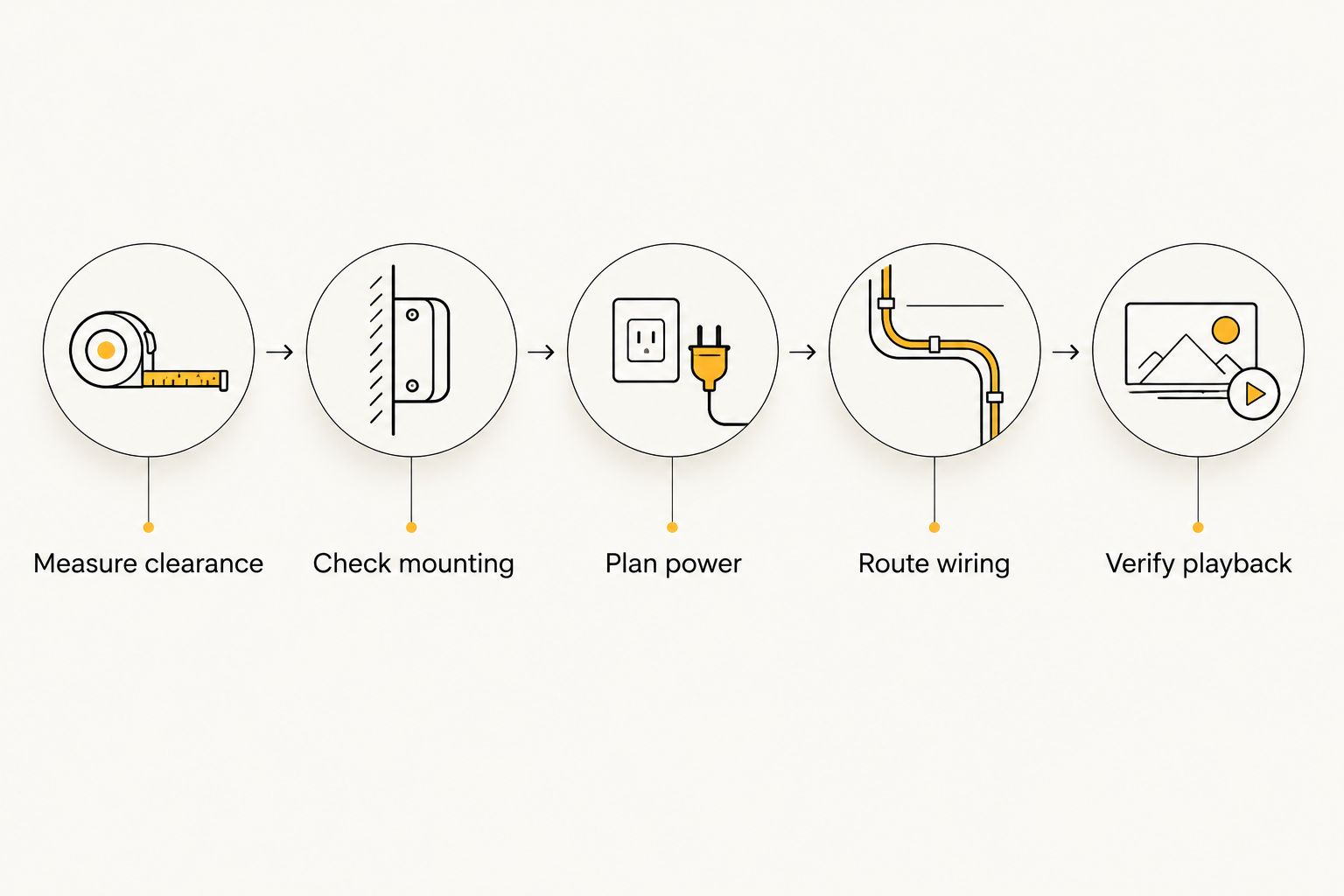
Use this sequence for your 2026 sound-bar installation. Follow the vehicle manual and the sound bar's instructions wherever they specify the mounting or electrical procedure.
- Measure clearance: Check the enclosure, brackets, cable exits, roof hardware, windshield movement, and occupied seating space.
- Check mounting: Confirm cage compatibility and permitted bracket orientation. Do not modify safety-related structure to accommodate audio equipment.
- Plan power: Identify the approved supply connection, fuse requirement, wire specification, and grounding method.
- Route wiring: Protect cables from sharp edges, moving parts, heat, and pinch points. Leave the required clearance around connectors.
- Verify playback: Pair the device while parked, check controls, and listen from every occupied seat.
Do not select wire size or fuse protection from an advertised audio wattage alone. Amplifier output and electrical input are different measurements. Use the manufacturer's current and wiring requirements, and get qualified installation help when the instructions do not resolve the connection.
How to judge Bluetooth and weather protection
Bluetooth convenience starts with dependable playback and accessible controls. Pair your phone while parked, check reconnection after an ignition cycle, and confirm that your normal phone-storage location does not create playback interruptions.
Keep track changes and pairing adjustments for stops. You should not need to reach overhead or handle a phone while driving to keep the system working.
Weather protection needs the same practical check. Read the rating's scope: the enclosure, remote, connectors, and exposed ports are not automatically covered by one claim. Follow the stated cleaning instructions rather than treating weather resistance as permission to pressure-wash the bar.
How the configurations are ranked
The order prioritizes standalone installation first, tight-space fit second, and planned expansion third. Every configuration still has to pass the same checks: cage fit, electrical compatibility, weather protection, controls, and clear playback.
There is no model-specific sound-quality winner in this configuration ranking. For R1 Industries shoppers comparing Bluetooth UTV sound-bar setups, fit is the first filter and clear seated playback is the final decision.
Which Bluetooth UTV sound bar should you choose?
Choose an integrated weather-rated bar as your default. Move to a compact bar when space is the constraint, or an expandable bar when additional audio equipment is already part of the plan.
For your 2026 purchase, reject any option that requires guessing about cage fit or power requirements. Once those checks pass, compare sound at the seat instead of treating advertised wattage as the verdict.
FAQ
What's the best Bluetooth UTV sound bar for a simple setup?
An integrated weather-rated sound bar is the default configuration for a standalone setup. Choose a model whose cage mounts, electrical requirements, and controls suit your vehicle, then judge clarity from the seat.
Does a higher-wattage UTV sound bar always sound better?
No, higher wattage does not establish better sound quality. Driver efficiency, enclosure design, distortion, placement, and background noise also affect what you hear.
Should I compare peak watts or continuous watts?
Compare documented continuous output under matching measurement conditions. Peak ratings are not interchangeable with continuous ratings, and different test conditions prevent a direct comparison.
Is a compact sound bar better for a crowded UTV cage?
A compact sound bar is the space-first choice when larger enclosures conflict with existing hardware. Check brackets, cable exits, helmet clearance, and windshield movement as well as enclosure dimensions.
Can I add a subwoofer to any Bluetooth UTV sound bar?
No, Bluetooth capability does not guarantee a compatible subwoofer connection. Confirm the sound bar's documented outputs and the signal requirements of the equipment you intend to add.
Can I wire a sound bar using its advertised wattage?
Do not choose wiring or fuse protection from advertised audio wattage alone. Follow the manufacturer's supply, current, fuse, wire, and grounding requirements.
How should I check a sound bar's weather protection?
Read the stated protection rating and its scope before installation. Check connectors, ports, and controls separately, and follow the cleaning instructions.
One last thing
Before tightening the brackets, sit in the passenger seat and listen. A bar aimed well for the driver can leave another rider with an obstructed listening path.
Make the final placement decision with the seats occupied. That check connects your measurements to the actual ride, without relying on another wattage claim.