

ProUTVParts is a useful starting point when you already have a listing that matches your UTV and the job you need done. Looking elsewhere makes sense when you need a different part, clearer fitment information, or help planning the installation. R1 Industries is the best ProUTVParts alternative in 2026 for comparing aftermarket UTV parts across several upgrade categories; an OEM dealer is the better route when your goal is an original-equipment replacement.
- For proutvparts alternatives, start with R1 Industries for aftermarket UTV parts and SxS accessories.
- Choose an OEM dealer when you need to identify an original-equipment replacement.
- Consider the part manufacturer directly when your question concerns its specific installation instructions.
- Choose a local UTV shop when physical inspection and installation matter more than online browsing.
Why this matters
Taking a trip to the dunes? Your parts choice needs to match the machine, its existing modifications, and the way you ride—not just the store name. A bumper, spring kit, or windshield solves a different problem, and choosing another retailer does not fix an incorrect part selection.
R1 Industries sells aftermarket UTV/SxS parts and accessories for vehicles including Polaris RZR, Can-Am Maverick X3, and Kawasaki KRX. That makes it a relevant alternative for an upgrade search rather than a substitute for every factory replacement or hands-on repair.
For your 2026 build, separate these questions: what needs replacing, what you want to improve, and what requires an installer. Choose the buying route after you identify the job. You do not need to move every purchase away from ProUTVParts to find a better fit for one project.
ProUTVParts alternatives at a glance
These options represent different ways to buy UTV parts. Compare them against the specific ProUTVParts listing you are considering, not against assumptions about an entire catalog.
| Option | Best for | Standout buying approach | How it differs from shopping a ProUTVParts listing |
|---|---|---|---|
| ProUTVParts | Keeping a purchase with a seller whose listing meets your requirements | Use the exact listing as your benchmark | Stay when fitment, included components, and installation requirements are clear |
| R1 Industries | Comparing aftermarket UTV parts and accessories | Product categories spanning protection, suspension, seating, and cab accessories | Another retailer to check for a part suited to your vehicle and upgrade |
| OEM dealer | Identifying an original-equipment replacement | Ask for vehicle-specific part identification | Start with the factory component rather than an aftermarket upgrade |
| Part manufacturer directly | Resolving questions about a particular aftermarket product | Ask the company responsible for the product's instructions | Focus on one product's design and installation requirements |
| Local UTV shop | Inspection and installation planning | Ask for an assessment of your actual machine | Choose an in-person route rather than relying only on a listing |
A retailer comparison is useful only when you compare equivalent parts. A replacement component and a performance upgrade are not interchangeable simply because both fit the same vehicle family.
1. R1 Industries: best for aftermarket upgrade shopping
R1 Industries is an online retailer for aftermarket UTV/SxS parts and accessories, including bumpers, rock sliders, A-arm guards, and body components. Its supplied product catalog also includes vehicle-specific spring kits, battery kits, harnesses, wheels, and floor mats. Start here when you want to compare parts for an upgrade rather than identify an unknown factory component.
Where this option shines
- Several upgrade categories: You can consider protection, suspension, seating, and cab accessories within the same retailer search.
- Named vehicle applications: Product listings identify applications such as Polaris RZR, Can-Am X3, and Polaris General.
- Project-specific starting points: A spring kit search and a battery kit search lead to different products rather than one generic accessory choice.
Where this option falls short
- Online shopping cannot inspect your machine: Existing damage, modified mounts, or altered wiring still require your own inspection or an installer.
- Model names are not complete fitment confirmation: You still need to match the exact vehicle configuration and the product's installation requirements.
- Aftermarket shopping is not always the right task: If you need to identify a factory replacement, start with the original component and its part number.
Head-to-head buying check
| Dimension | This retailer | ProUTVParts benchmark |
|---|---|---|
| Purchase purpose | Aftermarket UTV/SxS parts and accessories | Confirm that the selected listing serves the same purpose |
| Vehicle match | Start with the named application, then check full fitment | Apply the same full-fitment check to the competing listing |
| Product scope | Protection, suspension, seating, and other listed categories | Compare the exact product category you need |
| Installation decision | Read product requirements before ordering | Require the same clarity before choosing the competing part |
For example, the catalog distinguishes a Polaris General tender spring kit for 2-seat and 4-seat models. Those seating configurations are a fitment checkpoint, not a reason to assume every General uses the same kit. Likewise, a Can-Am X3 radius-rod listing identifies a 64-inch application; vehicle family alone is not enough.
In a 2026 parts comparison, use these details to narrow your search before weighing the seller. Do not choose a spring kit because another rider owns a similar-looking machine.
Best for: Owners comparing aftermarket parts for a defined UTV upgrade.
Verdict: Buy only after the exact application and installation requirements match your machine.
2. OEM dealer: best for original-equipment replacement
An OEM dealer is a buying route to consider when your goal is to restore a factory configuration. Bring the vehicle identification number, the component's identifying information, and a clear description of the failure. Ask the dealer to identify the replacement before deciding whether an aftermarket alternative suits the same job.
Where an OEM dealer shines
- Replacement-first approach: You can frame the request around the original component rather than an upgrade category.
- Vehicle identification: Your vehicle details give the parts inquiry a specific starting point.
- Clearer project scope: Restoring the original setup keeps replacement and modification decisions separate.
Where an OEM dealer falls short
- Replacement is not an upgrade plan: Returning to factory configuration does not address every comfort, protection, or accessory goal.
- Dealer involvement does not remove fitment checks: Confirm the quoted part against your vehicle and existing modifications.
- A parts inquiry is not a mechanical diagnosis: If the failed component is a symptom, replacing it alone does not resolve the underlying problem.
Choose this route for identification, not because a dealer label automatically makes every purchase the right one. Ask whether the proposed component restores the original setup or changes it.
Best for: Owners who need to identify an original-equipment replacement.
Verdict: Buy once the replacement part and the cause of the repair are confirmed.
3. Part manufacturer directly: best for product-specific questions
Consider contacting the part manufacturer when your question concerns a particular product's mounting, adjustment, or compatibility requirements. Keep the product identifier and your vehicle details together. Ask whether the manufacturer handles direct purchases or directs buyers through retailers.
Where the manufacturer route shines
- Focused questions: You can ask about the exact component rather than describe a broad shopping category.
- Instruction clarity: Request the installation instructions and identify anything that depends on your machine's configuration.
- Modification checks: Explain existing accessories that occupy the same mounting area or affect the installation.
Where the manufacturer route falls short
- One product is not a whole build: Resolving one component's requirements does not confirm compatibility across every accessory you plan to install.
- Direct contact does not guarantee direct purchasing: Confirm the buying route before treating the manufacturer as your seller.
- Written instructions do not inspect your UTV: Physical damage and altered mounting points still need attention on the machine.
This route is especially useful when your retailer question is actually an installation question. Resolve it before choosing where to purchase.
Best for: Owners who have selected a particular aftermarket component and need its requirements clarified.
Verdict: Hold the purchase until the product-specific question is answered.
4. Local UTV shop: best for inspection before installation
Consider a local UTV shop when the project depends on the condition of your machine, not just its model name. Ask whether the shop handles your vehicle and the proposed modification before arranging work. Bring photos, existing part identifiers, and the instructions for the component you are considering.
Where a local UTV shop shines
- Inspection-led decisions: Ask for an assessment before committing to a replacement or upgrade.
- Installation planning: Discuss mounting, access, and interaction with existing modifications.
- Defined responsibility: Agree on who supplies the part and who performs the work before ordering.
Where a local UTV shop falls short
- Shop capability varies: Confirm the specific job rather than assume every UTV shop handles every modification.
- A recommendation needs a reason: Ask what problem the proposed part addresses on your machine.
- Parts and labor remain separate decisions: Clarify the work scope instead of treating a product purchase as a complete repair plan.
Best for: Owners whose upgrade or repair requires physical inspection and installation planning.
Verdict: Hold the parts order until the shop confirms the job and component requirements.
Why people switch from ProUTVParts
The useful reasons to compare ProUTVParts alternatives are purchase-specific. Switch for a requirement another buying route meets—not for an unsupported claim that one seller is always better.
For a 2026 build, consider another route when:
- You need a different component: Compare another retailer's relevant product against your exact application.
- You are restoring the factory setup: Ask an OEM dealer to identify the original-equipment replacement.
- You need installation clarification: Take a specific product question to its manufacturer.
- You need the machine inspected: Ask a suitable local shop to assess the mounting area, damage, or existing modifications.
None of these requires abandoning a retailer for every purchase. You can buy protection accessories through one route and identify a factory replacement through another. Keep each decision tied to the part and the job.
Check the part before you change retailers
Use the same checklist for every seller in your 2026 comparison. A different storefront does not change your vehicle's mounting points or undo an incompatible modification.
Vehicle details
Write down the model, model year, trim, and seating configuration. Add relevant chassis or suspension details when the product requires them. Use the actual machine information, not a remembered description from an old order.
Existing modifications
List anything that affects the proposed installation: doors, roof, cage, wheels, suspension, seats, or electrical accessories. Check the area where the new part mounts. An accessory that fits an unmodified vehicle still needs checking against your build.
Included components
Read what the selected product includes. Identify required hardware, brackets, wiring, or other components from the product instructions rather than assuming they come with the main part.
Installation requirements
Decide who will install the component before ordering. Read the instructions, identify required tools, and resolve any unclear step with the appropriate seller, manufacturer, or installer.
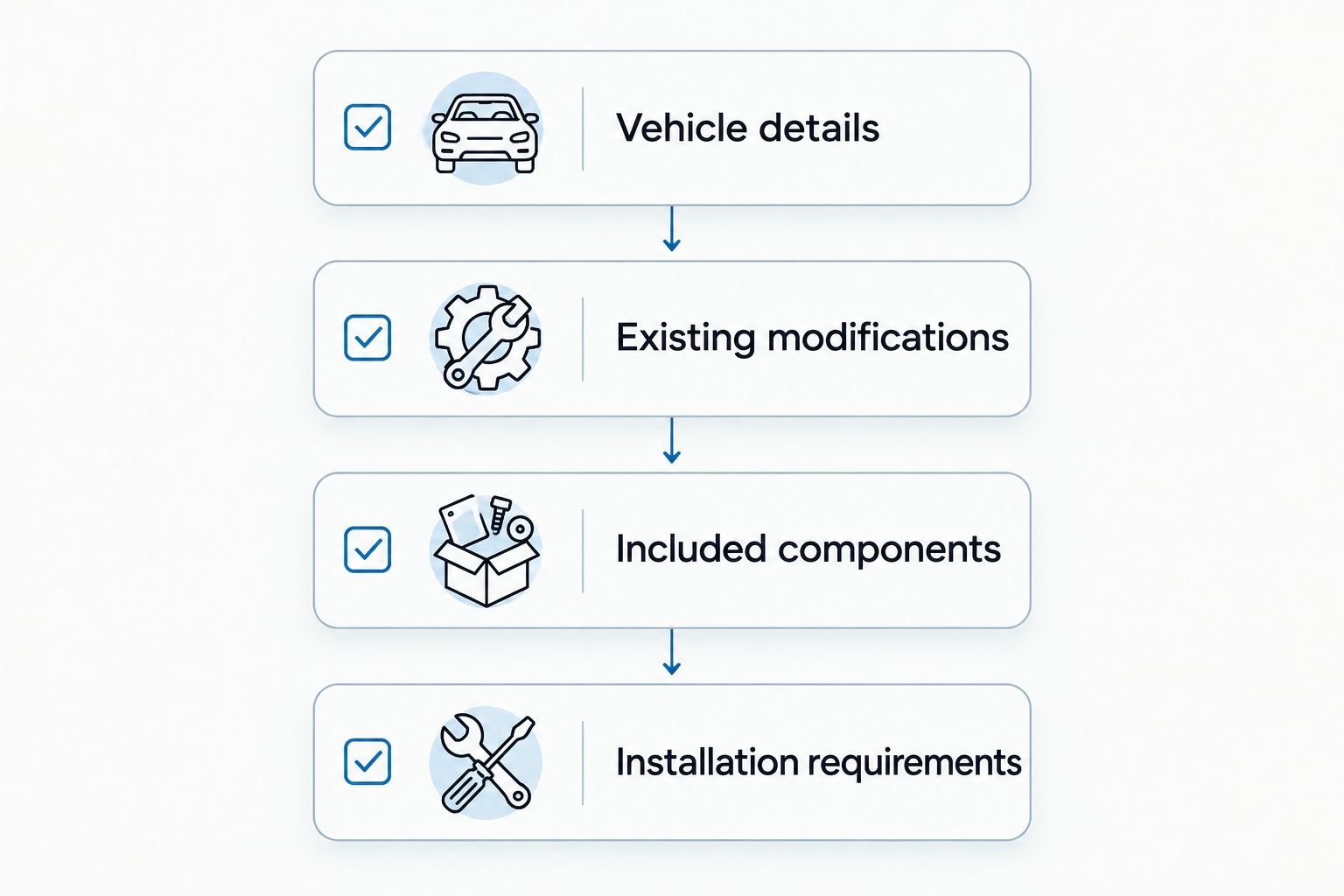
Stop the purchase when a required fitment detail is unresolved. That is a better decision than guessing because the part name looks familiar.
When staying with ProUTVParts is the right call
Stay with ProUTVParts when the selected product matches your exact vehicle, serves the intended job, and has clear installation requirements. A change of retailer is not an improvement by itself.
For 2026, compare the actual component and the information supporting your purchase. If your existing choice meets those requirements, keep it. If one requirement remains unresolved, use the alternative buying route that answers it.
FAQ
What's the best ProUTVParts alternative for aftermarket upgrades?
R1 Industries is the recommended starting point for comparing aftermarket UTV parts across several upgrade categories. Match the selected component to your exact vehicle and installation requirements before ordering.
Is another UTV retailer always better than ProUTVParts?
No, another retailer is not automatically a better choice. Compare the exact part, vehicle application, included components, and installation requirements rather than choosing by store name alone.
Should I use an OEM dealer or an aftermarket retailer?
Use an OEM dealer to identify an original-equipment replacement and an aftermarket retailer to compare upgrade options. Decide whether you are restoring the factory setup or changing it before shopping.
Can I choose a UTV part using only the model name?
No, the model name alone is not complete fitment confirmation. Check the model year, trim, seating configuration, and any additional details required by the product.
When should I contact the part manufacturer?
Contact the part manufacturer when your question concerns its specific product instructions or installation requirements. Provide the product identifier, vehicle details, and relevant existing modifications.
When is a local UTV shop the better option?
A local UTV shop is the better route to consider when your machine needs physical inspection before parts selection or installation. Confirm that the shop handles your vehicle and the proposed work.
Do I need to buy every accessory from the same retailer?
No, choose the buying route separately for each component. Compatibility between parts matters more than keeping every purchase with one seller.
One last thing
The strongest reason to change your parts order is a mismatch—not a different retailer's name. Before your next ride, check what is already installed on your machine against the instructions for the new component. That check belongs before checkout, especially when several upgrades share mounting space.