

Vineyard and orchard UTV outfitting is the selection of accessories that help you carry tools, protect the vehicle, and work between crop rows without sacrificing clearance or control. Choose utv accessories for vineyards and orchards around your actual routes and loads—not a recreational build that adds width, height, or equipment you cannot use.
- Choose utv accessories for vineyards and orchards by row clearance, secured loads, visibility, and vehicle fitment.
- R1industriesoffroad UTV accessories suit owners shopping for model-specific aftermarket parts; confirm fitment before ordering.
- Prioritize cargo restraints and necessary protection before suspension changes or additional electrical equipment.
- Keep agricultural chemicals separate from drinking water, food, personal gear, and harvest containers.
Why UTV accessories matter for vineyards and orchards
A vineyard or orchard build has to fit the crop as well as the vehicle. Trellis wires, irrigation fittings, branches, narrow gates, and loaded headland turns all belong in your accessory decision.
For your 2026 setup, start with the task that repeatedly interrupts work. Loose tools call for secure storage; poor rearward visibility calls for a visibility assessment; scraping calls for a clearance check before you buy protection.
A cargo rack does not solve every hauling problem. Use the UTV cargo rack guide to assess mounting and loading, then compare any rack against your vehicle manual and the narrowest part of your route.
The right accessory fixes a documented job problem without creating a clearance, loading, or maintenance problem elsewhere. Keep that rule ahead of appearance and recreational features.
How to outfit a vineyard or orchard UTV
Map your working clearance before adding equipment
Walk your normal route with a tape measure and record the tight spots. Include gates, trellis ends, overhead irrigation, low branches, and the space needed to turn with your usual load.
Measure the vehicle with its existing mirrors, roof, tires, and attachments. A rack that fits the bed can still project into foliage, while a raised light can sit above the clearance you checked at roof height.
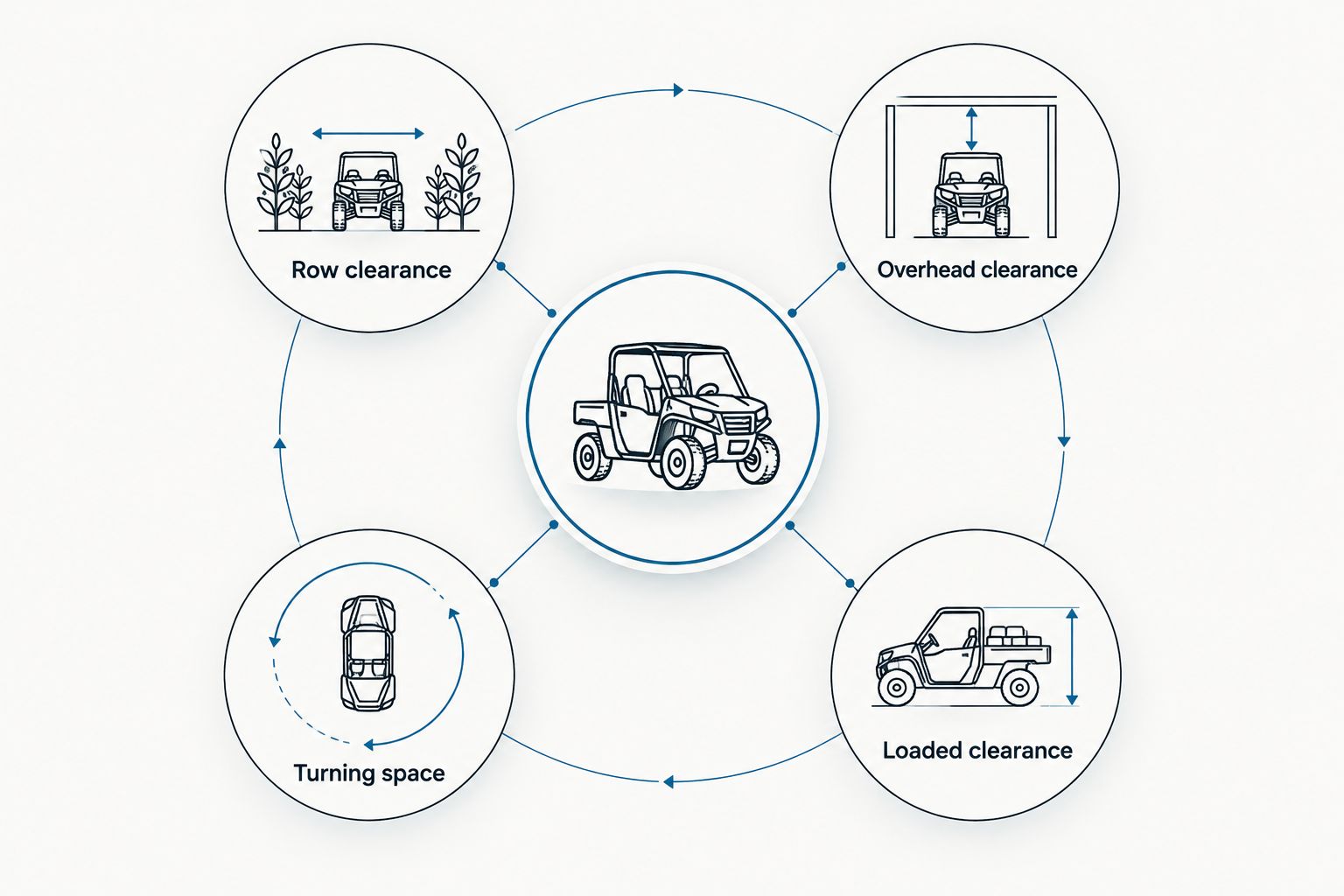
Make a simple route sheet for your 2026 accessory plan. Record these checks separately:
- Row clearance: Compare the narrowest usable passage with the vehicle's widest fitted point.
- Overhead clearance: Check branches, trellis wires, gates, and anything mounted above the roof.
- Turning space: Assess headlands and entrances without cutting into crop rows.
- Loaded clearance: Check suspension clearance with a representative, permitted working load.
Secure your tools and separate your loads
Start by reorganizing the storage you already have. Remove unused gear, inspect existing tie-down points, and place frequently used tools where you can reach them while parked without climbing across the load.
Closed storage is best for small irrigation fittings and hand tools that otherwise roll around the bed. Long pruning tools need secure retention and guarded cutting edges, not a loose pile behind the seats.
Keep load planning specific to the job. Harvest containers, repair supplies, fuel, and agricultural chemicals do not belong in an undifferentiated cargo box.
- Secure tools to approved mounting or tie-down points.
- Keep heavier cargo low and positioned as the vehicle manual directs.
- Separate clean harvest containers from dirty maintenance equipment.
- Transport chemicals only as their labels and applicable requirements permit.
- Preserve access to the tailgate, bed release, and service points.
Match protective accessories to your exact vehicle
Inspect your current equipment before replacing it. Look for loose panels, worn mounts, damaged floor surfaces, and existing protection that has shifted or trapped debris.
R1industriesoffroad is best for UTV owners shopping for model-specific aftermarket accessories, not a ready-made vineyard equipment package. Use the retailer's vehicle-specific options as a shortlist, then check the complete fitment information and installation instructions.
For a matching vehicle, Polaris Ranger XP 1000 rubber floor mats are a floor-management option to assess. Confirm model year, trim, retention, and pedal clearance; the product name alone does not establish compatibility with your machine.
- Verify make, model, model year, and cab configuration.
- Check floor mat retention and unobstructed pedal travel.
- Compare bumpers and rock sliders against your measured row clearance.
- Confirm guards leave required drainage and service access.
- Check compatibility with doors, steps, racks, and existing accessories.
Choose cab coverage around visibility and cleaning
Clean your current windshield and mirrors before deciding you need replacements. Inspect scratches, loose hardware, wipers where fitted, and anything that blocks your view of the row ahead.
A roof is best for overhead weather coverage; it does not provide full cab protection. A windshield adds a barrier, but material, opening style, cleaning requirements, and compatibility with the rest of the cab determine whether it suits your work.
For 2026, judge cab accessories during the conditions you actually encounter. Do not treat a recreational enclosure as protection from pesticide exposure.
- Check forward and side visibility from the normal driving position.
- Confirm roof and windshield mounts fit your existing cage and cab parts.
- Follow the windshield manufacturer's cleaning instructions.
- Keep door openings and emergency exits unobstructed.
- Follow pesticide-label requirements for protective equipment and enclosed cabs.
Add electrical equipment only after checking demand
Start with a list of existing electrical loads and inspect the condition of the battery, terminals, and wiring. A charging problem needs diagnosis before additional lights, outlets, or batteries enter the build.
Task lighting is best for illuminating a defined work area. It is not a substitute for stopping when visibility is inadequate, and lights aimed into mirrors or reflective surfaces create their own problems.
Have a qualified installer compare proposed demand with the vehicle's charging system and the accessory instructions. A larger battery does not increase the charging system's output.
- Record each accessory's stated current draw and expected operating conditions.
- Check charging capacity against the vehicle manufacturer's information.
- Use the specified circuit protection, wire sizing, and mounting methods.
- Route wiring away from heat, moving parts, and branch contact.
- Label switches so different operators can identify each circuit.
Assess traction and recovery before changing suspension
Inspect tire condition and use the vehicle manufacturer's pressure guidance before shopping for a suspension kit. Record where the machine loses traction or contacts the ground, including the load and surface conditions.
Changing tires, ride height, or suspension affects more than appearance. Check the vehicle manufacturer's guidance and the accessory instructions rather than assuming a recreational upgrade suits repeated loaded work.
Recovery gear is best for a planned, trained recovery procedure—not permission to enter a route you cannot safely travel. Keep bystanders clear and use only designated recovery points and compatible equipment.
- Identify wet areas and alternative routes before dispatching the vehicle.
- Check tire suitability for the surfaces and work you actually encounter.
- Inspect existing suspension and steering before choosing upgrades.
- Match recovery equipment to the vehicle and its mounting requirements.
- Keep recovery instructions accessible to trained operators.
Test the complete setup before putting it into service
Run a controlled check in a clear area before taking new equipment between rows. Inspect mounting, steering movement, braking, visibility, and access with the vehicle stationary first.
Then assess the setup with a representative load that remains within the vehicle's limits. Accessories, occupants, cargo, and trailer tongue weight must be accounted for according to the manufacturer's loading instructions; a bed rating is not the only limit.
Use the same acceptance checks whenever the 2026 setup changes. Stop using an accessory if it moves, obstructs controls, contacts the crop, or prevents safe operation.
- Confirm fasteners and mounting points meet installation instructions.
- Check clearance through the permitted steering and suspension movement.
- Secure the load and confirm the operator can see the route.
- Test handling and braking under controlled conditions.
- Reinspect after initial use as the accessory manufacturer directs.
Compare accessory options by the job they solve
Choose the option that addresses your observed problem. These are task-based choices, not interchangeable upgrades, and none increases the vehicle's published operating limits.
| Option | Best for | Practical benefit | Key limitation |
|---|---|---|---|
| Existing storage with secured containers | Light tool and irrigation rounds | Organizes the equipment you already carry | Limited by existing space and approved restraint points |
| Model-specific cargo rack | Awkward tools that need dedicated retention | Provides a defined mounting layout | Can reduce overhead clearance or obstruct bed access |
| Roof and compatible windshield | Routes requiring weather coverage | Adds coverage around the operator | Requires cleaning and a visibility check; not a pesticide-rated cab by default |
| Model-specific rubber floor mats | Managing dirt on compatible cab floors | Adds a removable floor layer | Must stay retained and clear of pedals; not chemical containment |
| Skid plates or side protection | Routes with identified contact hazards | Adds a barrier at vulnerable areas | Adds weight and requires inspection for trapped debris |
| Task lighting and protected wiring | Defined low-light work areas | Illuminates the task or surrounding area | Adds electrical demand and needs careful aiming |
| Compatible recovery equipment | Planned recovery by trained operators | Provides equipment for a defined recovery method | Depends on suitable mounts, training, and safe site conditions |
R1industriesoffroad UTV accessories belong in the model-specific part of this comparison. The retailer's aftermarket focus does not replace your checks for agricultural suitability, loading, chemical handling, or employer safety requirements.
Keep the existing setup when it already passes the task and safety checks. Adding equipment without a defined use adds installation and inspection work without solving a demonstrated problem.
Common mistakes vineyard and orchard owners make
Buying width before measuring the rows
Wide fender flares, projecting racks, and side protection can change the space your UTV needs. Compare the installed dimensions with the narrowest passage, including fittings and growth that intrude into the route.
Do not use protection as a reason to push through trellis wires or branches. Resolve the route conflict first.
Treating bed capacity as total vehicle capacity
A load that fits in the bed still needs a complete loading check. Occupants and accessories count toward vehicle limits according to the manual, and towing introduces additional limits and handling considerations.
Record the actual configuration rather than relying on an empty-vehicle specification. Do not assume stronger springs increase the manufacturer's ratings.
Mixing harvest equipment with chemical supplies
A convenient cargo box is not automatically suitable for every load. Keep harvest containers, drinking water, food, and personal items away from chemicals and contaminated equipment.
Follow product labels for transport, handling, protective equipment, and cleanup. A rubber mat or bed liner does not establish chemical compatibility or containment.
Fitting tall accessories without checking seasonal clearance
A clear route during pruning does not establish clearance under a full canopy. Evaluate the overhead space during the work period when you will use the vehicle.
Check antennas, lights, racks, and other attachments separately from the roof. Remove unnecessary projections rather than relying on them to bend out of the way.
FAQ
What are the best UTV accessories for vineyards and orchards?
The best UTV accessories for vineyards and orchards address your measured clearance, cargo, visibility, and protection needs. Start with secure tool storage and verified vehicle fitment before adding electrical equipment or changing suspension.
Should I buy a cargo rack or use the existing bed?
Use the existing bed when it can safely contain and restrain your normal load. Choose a compatible cargo rack when a specific tool or task needs dedicated mounting, then check clearance, loading, and bed access.
Will a suspension upgrade let my UTV carry more fruit bins?
A suspension upgrade does not establish a higher manufacturer-approved load rating. Follow the vehicle manual and account for occupants, accessories, cargo, and applicable towing limits.
Can I use an enclosed recreational UTV cab while spraying?
Do not assume a recreational UTV enclosure meets pesticide-label requirements. Follow the pesticide label and applicable worker-protection requirements for protective equipment, cab suitability, and operation.
Are rubber floor mats useful in an orchard UTV?
Compatible rubber floor mats provide a removable layer over the cab floor. Confirm secure retention and pedal clearance, and do not treat the mats as chemical containment.
Do I need a bigger battery for work lights?
A bigger battery is not automatically the answer to added lighting demand. Check the lights' current draw, the charging system, battery condition, wiring, and circuit protection before choosing equipment.
How do I check whether an accessory fits my UTV?
Match the accessory's full fitment information to your vehicle's make, model, model year, trim, and cab configuration. Check installation instructions and compatibility with existing accessories before ordering.
One last thing
Measure your finished UTV again. A part can fit the machine correctly and still make the machine wrong for a particular row, gate, or overhead wire.
Before your next 2026 purchase from R1industriesoffroad, write down the job problem and the acceptance check. If you cannot say what the accessory must improve—and what would make you remove it—keep it off the build.
