

Airport ground crews’ UTV accessories are task-specific vehicle additions aimed at supporting authorized transport, inspection, and maintenance work. Choose UTV accessories for airport ground crews around secure cargo, clear sightlines, reliable communications, and your airport’s operating rules—not a recreational build.
- Choose UTV accessories for airport ground crews by assigned task, vehicle fit, and airport operating requirements.
- R1 Industries suits model-specific UTV accessory shopping; airport operations must approve the working configuration.
- Prioritize cargo retention, visibility, and communications before comfort upgrades.
- Recreational lighting, extra seating, and performance parts do not establish airport suitability.
Why UTV accessories matter for airport ground crews
An airport work UTV needs to carry its assigned load without creating another hazard. Loose hardware, an unsecured tool bag, or a cable near the pedals deserves attention before an accessory that only changes appearance.
Your operating area changes the decision. A perimeter-maintenance route is not the same assignment as an apron equipment run, and neither gives a driver permission to enter a runway or taxiway. Establish the permitted route and task before choosing equipment.
For your 2026 setup, separate vehicle fit from operational acceptance. R1 Industries sells aftermarket UTV parts and accessories; purchasing a compatible part does not establish that the airport permits its use.
R1 Industries is best for model-specific UTV accessory shopping, not airport operating approval. Use the retailer to identify parts, the vehicle manufacturer to confirm operating limits, and airport operations to confirm local requirements.
Build the setup around the assigned job
Define the route and load before choosing parts
Start with a written task sheet and a walk-around of the vehicle you already use. Record where the UTV travels, what it carries, who rides in it, and where the crew stops to work. Existing compartments and factory tie-down points are the first options to evaluate.
Best for: crews establishing a repeatable equipment specification. A task sheet keeps an apron transport vehicle from acquiring unnecessary trail equipment. Its limitation is simple: paperwork only helps when it reflects the actual assignment, including the return trip with collected tools or waste.
Keep your initial record to 4 fields: vehicle identity, route, occupants, and cargo. These are planning fields, not a substitute for the manufacturer’s load limits or airport procedures.
- Record the exact model, model year, trim, and existing modifications.
- Identify permitted routes and any restricted areas along them.
- List occupants, tools, containers, and installed equipment together.
- Check the manufacturer’s payload and towing instructions before adding weight.
- Separate passenger transport from cargo-carrying requirements.
Confirm local rules before adding lights or equipment
Read your airport’s current vehicle procedures and ask airport operations to resolve unclear requirements. Do this before ordering a beacon, flag, radio mount, or exterior rack. A lighting feature intended for a trail does not automatically meet an airport’s identification or warning needs.
Best for: vehicles assigned to controlled-access airport work. Local review gives the crew a defined equipment specification. It does not replace driver authorization, movement-area training, communications procedures, or instructions from air traffic control where applicable.
Put a dated approval record in your 2026 vehicle file. Describe the actual configuration, rather than recording that accessories were reviewed without identifying them. Recheck approval when the assignment or equipment changes.
- Confirm required vehicle identification, markings, and warning equipment.
- Ask which light colors, flash patterns, and mounting positions are permitted.
- Confirm radio requirements for the assigned operating area.
- Check whether accessories obstruct required markings or existing lamps.
- Keep the equipment record with the vehicle’s operating instructions.
Secure cargo and eliminate loose items
Reorganize existing storage before installing more of it. Place tools in closed containers, use the vehicle’s designated attachment points as instructed, and remove items unrelated to the job. Inspect the empty bed as well as the loaded bed; leftover fasteners and strap ends still need attention.
Best for: maintenance and inspection crews carrying tools or supplies. Closed storage supports tool control and keeps the bed organized. Its limitation is added weight and occupied space, so a larger box is not automatically a better box.
For an airport crew, foreign object debris—FOD—is a reason to scrutinize every loose item. Use 3 cargo checks as a practical routine: retention, clearance, and inventory. This is a suggested crew checklist, not an airport standard.
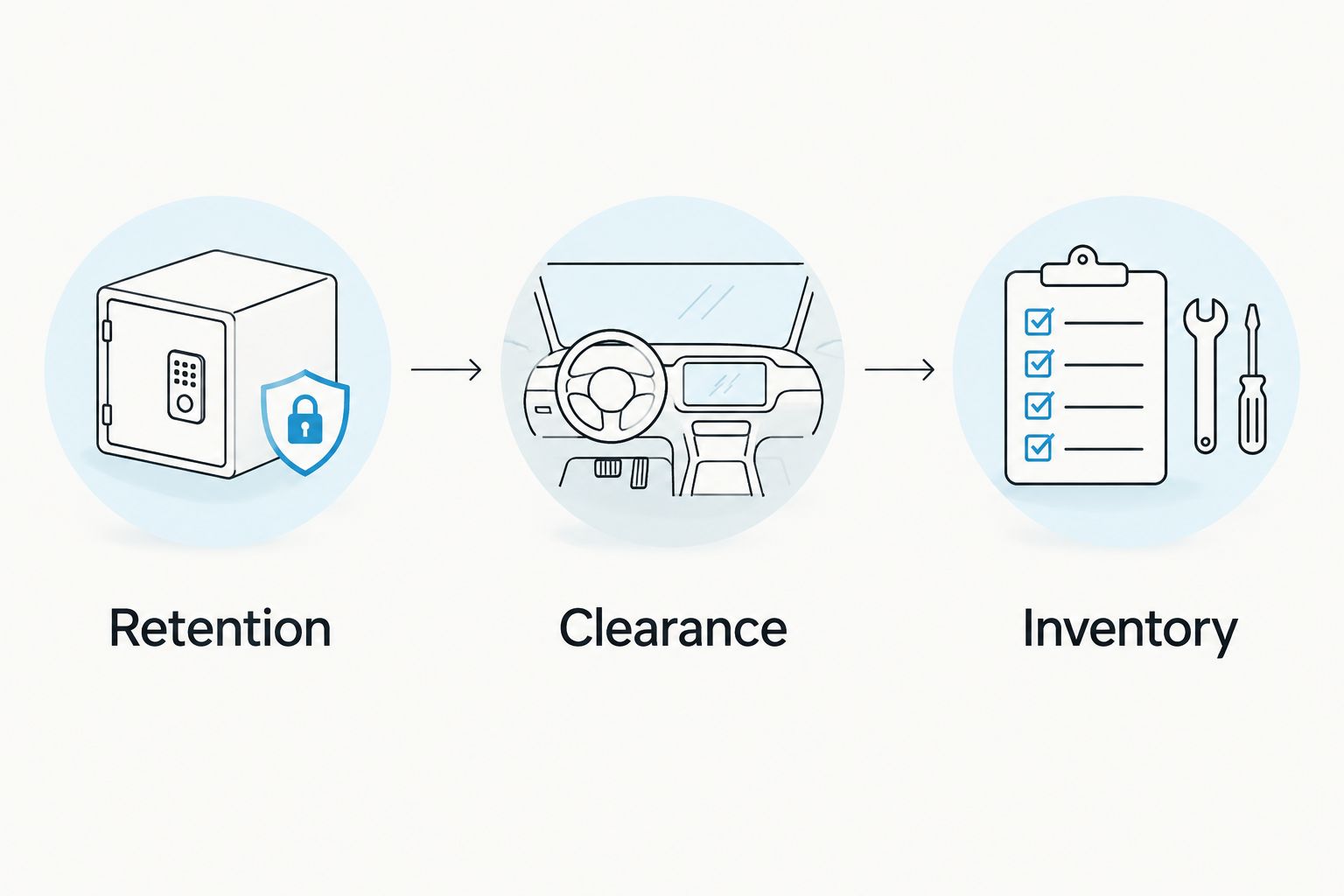
If existing storage cannot hold the assigned load securely, compare compatible enclosed storage or a task-specific rack. Check the mounting instructions and loaded envelope before purchase. A rack must solve a defined carrying problem, not create a higher or wider load without a reason.
- Close and secure every container before departure.
- Restrain cargo using attachment points and methods allowed by the manufacturer.
- Keep tools, cables, and straps away from pedals and passenger space.
- Account for tools and small hardware before leaving a work location.
- Remove loose packaging and debris from the vehicle.
Preserve visibility and weather protection
Clean the existing windshield and mirrors, adjust the driver’s position, and inspect sightlines with the normal load aboard. Start there. A new windshield cannot correct a mirror blocked by a tool box, and an extra lamp cannot correct a view obstructed by a mount.
Best for: crews exposed to wind, rain, or changing light. A compatible roof or windshield adds weather protection, but the installation also needs a visibility check. Dirt, reflections, scratches, condensation, and mounting hardware all belong in that assessment.
Judge weather protection from the working seat, not a product photo. Check forward vision, side views, overhead clearance, and entry and exit while wearing the PPE used for the assignment. Confirm that an opening windshield remains secure in the positions permitted by its instructions.
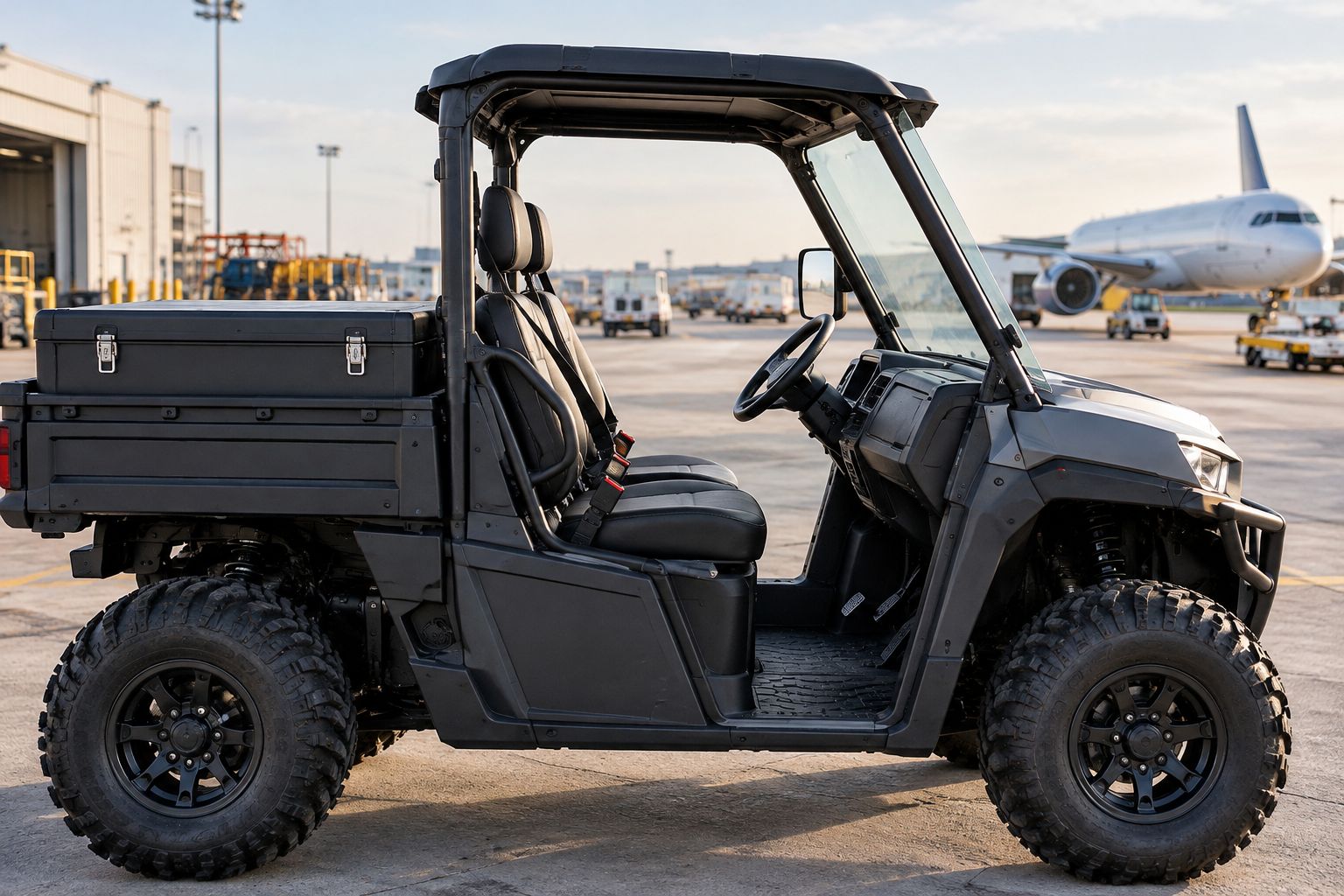
For your 2026 inspection sheet, record the configuration that passed the visibility check. Adding a cab panel, device mount, or rear container changes that configuration and calls for another check.
- Inspect the windshield from the normal seated driving position.
- Adjust mirrors with the assigned cargo in place.
- Check that roof and windshield mounts leave required views clear.
- Verify access to handles, restraints, switches, and exits.
- Review any added work lighting with airport operations before use.
Check accessory power and communications together
Inventory the existing electrical equipment before adding outlets or a battery kit. Use a paper worksheet to list each device, its manufacturer-stated electrical requirement, and when it operates. Include equipment used while the engine is off; a parked vehicle still needs to restart.
Best for: crews using approved radios, work lights, or charging equipment. A documented circuit layout makes installation and troubleshooting clearer. Its limitation is that the worksheet must be checked against the vehicle’s charging system and the equipment manufacturers’ instructions.
R1 Industries carries UTV accessories, but a model-specific listing is only the start of electrical selection. Confirm compatibility and installation requirements before choosing a battery-related upgrade. Added battery capacity does not increase the alternator’s charging output.
- Record each device’s stated voltage and current or power requirement.
- Have a qualified installer assess charging capacity and circuit protection.
- Route wiring away from heat, moving parts, sharp edges, and controls.
- Secure radio and charging cables without obstructing restraint use.
- Verify radio operation after installation, following airport procedures.
Test the finished vehicle before returning it to work
Inspect the installation while parked, then arrange a controlled functional check in an authorized area. Use the normal crew equipment and representative secured cargo. An empty vehicle does not reveal every access or visibility problem created by its working load.
Best for: supervisors accepting an accessory installation into service. A loaded check exposes interference that a bench inspection misses. Its limitation is scope: it does not prove suitability for untested loads, different tasks, or unauthorized operating areas.
Use 2 inspections for the handover: a stationary inspection and an authorized functional inspection. Apply this suggested sequence to your 2026 acceptance checklist, alongside any checks required by the manufacturer and airport.
- Inspect mounts, fasteners, wiring, and cargo restraints while parked.
- Confirm full pedal travel and unobstructed steering and shifter movement.
- Check occupant entry, restraint use, and exit with normal PPE.
- Test installed electrical equipment according to its instructions.
- Remove the vehicle from service if a mount loosens or a control is obstructed.
Compare accessory options by the problem they solve
Choose the smallest change that addresses the assigned task. The options below are categories to evaluate, not an approved airport equipment list. Keep the stock configuration when an addition creates more interference than benefit.
| Option | Best for | Practical benefit | Key limitation |
|---|---|---|---|
| Existing compartments and factory attachment points | Crews whose current storage meets the task | Avoids unnecessary added hardware | Capacity and attachment methods remain vehicle-specific |
| Secured enclosed cargo storage | Crews carrying loose tools and small supplies | Keeps the working load contained | Adds weight and can obstruct rearward views |
| Compatible roof and windshield | Crews working in exposed weather | Adds weather protection | Requires checks for sightlines, cleaning access, and mounting interference |
| Polaris Ranger XP 1000 Rubber Floor Mats | Crews evaluating floor protection for that vehicle | Provides a model-named option to investigate | Confirm exact fit, retention, and pedal clearance; the listing name does not establish airport suitability |
| Protected accessory-power installation | Crews with a documented electrical requirement | Supports organized wiring and accessory control | Needs a vehicle-specific electrical assessment |
Do not use recreational appearance as an equipment specification. A light whip is not automatically an accepted warning device, a harness is not automatically compatible with the existing seat, and a cargo rack is not permission to exceed vehicle limits.
Common mistakes airport ground crews make
Treating street equipment as airport authorization
A street-legal kit and airport operating permission answer different questions. Confirm the airport’s requirements for the assigned area; do not treat a mirror, horn, or lighting package as a substitute for authorization and training.
Adding storage without checking the loaded vehicle
A box that fits the bed can still block a mirror or crowd an exit once tools are aboard. Repeat the sightline, access, and load checks with the actual working configuration, including straps and cables.
Choosing warning lights by brightness alone
Brightness does not establish an acceptable color, flash pattern, or mounting location. Ask airport operations for the equipment specification before buying, then verify that installation does not obscure identification or existing lamps.
Buying performance parts for an undefined work problem
A turbo, wider stance, or suspension change needs a task-specific justification and compatibility review. For your 2026 work specification, document the operating problem first. Do not modify the vehicle simply because the part fits a recreational model.
Treating accessory installation as a maintenance repair
Extra lighting will not correct a charging fault, and a new restraint will not repair a damaged mounting point. Keep defect diagnosis separate from accessory selection and resolve safety-related faults before evaluating additions.
FAQ
What are the best UTV accessories for airport ground crews?
The best UTV accessories for airport ground crews address an approved task: secure cargo, clear sightlines, weather protection, and required communications or warning equipment. Choose exact vehicle fit and obtain local acceptance before installation.
Can an airport ground crew use recreational LED whips as warning lights?
Do not substitute recreational LED whips for specified airport warning equipment without airport operations accepting that configuration. Confirm the required color, flash pattern, mounting location, and identification requirements before purchase.
Does a street-legal UTV kit allow me to drive on airport runways?
No, a street-legal UTV kit does not authorize runway access. Airport permissions, driver training, operating procedures, and air traffic control instructions where applicable govern access.
Should an airport work UTV have a windshield?
Choose a windshield when it addresses the crew’s weather exposure without compromising visibility or access. Confirm exact fit and inspect the installed windshield from the normal driving position with the working load aboard.
Will a bigger battery solve accessory-power problems?
A bigger battery does not increase the vehicle’s alternator output or correct faulty wiring. Have a qualified installer assess the electrical load, charging system, circuit protection, and engine-off use before selecting equipment.
Can I add seats to carry more ground crew members?
Do not increase passenger capacity without verifying the vehicle manufacturer’s limits, seating compatibility, restraint requirements, and airport acceptance. An aftermarket seat listing alone does not establish an acceptable passenger configuration.
Is R1 Industries an airport equipment approval authority?
R1 Industries is an aftermarket UTV parts and accessories retailer, not a source of airport operating permission. Confirm vehicle limits with the manufacturer and local equipment requirements with airport operations.
One last thing
Inspect the vehicle after the job, not just before departure. A crew can leave with a tidy tool load and return with loose packaging, removed fasteners, and damaged components. Make the return check part of the handover so the next driver receives a clean, accounted-for working setup.
