

Best overall for trail builds: white rock-light pods. Best for trail-and-show builds: RGB rock-light pods. Best for show-focused coverage: addressable LED strips. Best for simple accent lighting: single-color LED strips. This 2026 guide from R1 Industries compares UTV underglow lights by layout, mounting, wiring, and control—not by color effects alone.
- For UTV underglow lights, white rock-light pods are the default trail choice; aim them down and protect the wiring.
- RGB rock-light pods suit mixed trail-and-show builds; verify dedicated white output before treating them as task lighting.
- Addressable LED strips suit show builds; exposed mounting and controller complexity are their main drawbacks.
- R1 Industries’ UTV underglow lights guide prioritizes protected mounting, accessible controls, and serviceable connections over effects.
Why this matters
Taking your UTV out after dark? Ground lighting and forward lighting do different jobs. Underglow illuminates the area beneath and beside your machine; it does not replace headlights or a driving light aimed down the trail.
For a 2026 build, decide whether you want to see nearby terrain, create a colored glow while parked, or do both. That choice determines the light format before you start comparing controllers and effects.
R1 Industries serves UTV owners buying aftermarket parts and accessories. For this lighting decision, start with the terrain and mounting space on your machine, not the brightest-looking promotional photo.
What makes the best UTV underglow lights?
Use these criteria to compare kits with the same intended job:
- Protected mounting: Look for positions above exposed skid surfaces, away from tire contact, suspension movement, and exhaust heat.
- Useful coverage: Choose downward light for nearby ground visibility or perimeter lighting for a show-focused glow.
- Documented sealing: Check ratings for the lights, controller, connectors, and other components separately. A sealed lamp does not make the entire harness waterproof.
- Electrical compatibility: Match the kit’s voltage, current requirements, fuse protection, and wiring instructions to your UTV and accessory circuit.
- Accessible controls: Prioritize a reachable off switch and straightforward brightness adjustment. Check whether basic operation requires a phone.
- Serviceability: Favor an installation that lets you reach connections and remove body panels without cutting the lighting harness.
A kit marked for 12 volts must match the intended power source; the label alone does not establish vehicle fitment. Verify the operating-voltage range and installation instructions rather than assuming every automotive lighting kit belongs on your UTV.
UTV underglow lighting options at a glance
These are ranked kit formats, not named-product performance rankings. Each format serves a different purpose, and individual kits still need their specifications checked.
| Rank and format | Best for | Standout feature | Key limitation |
|---|---|---|---|
| 1. White rock-light pods | Trail-focused ground lighting | Separate lamps can target specific ground areas | Coverage depends on placement and beam pattern |
| 2. RGB rock-light pods | Mixed trail-and-show builds | Selectable colors from discrete mounting points | RGB does not establish dedicated white-light performance |
| 3. Addressable LED strips | Show-focused perimeter effects | Individually controlled segments support animated patterns | Requires protected strip routing and compatible controls |
| 4. Single-color LED strips | Simple accent lighting | Fixed-color perimeter lighting without color programming | Fixed color and vulnerable exposed mounting |
The default for a 2026 trail build is white rock-light pods. Choose the other formats only when their specific benefit matches how you use your machine.
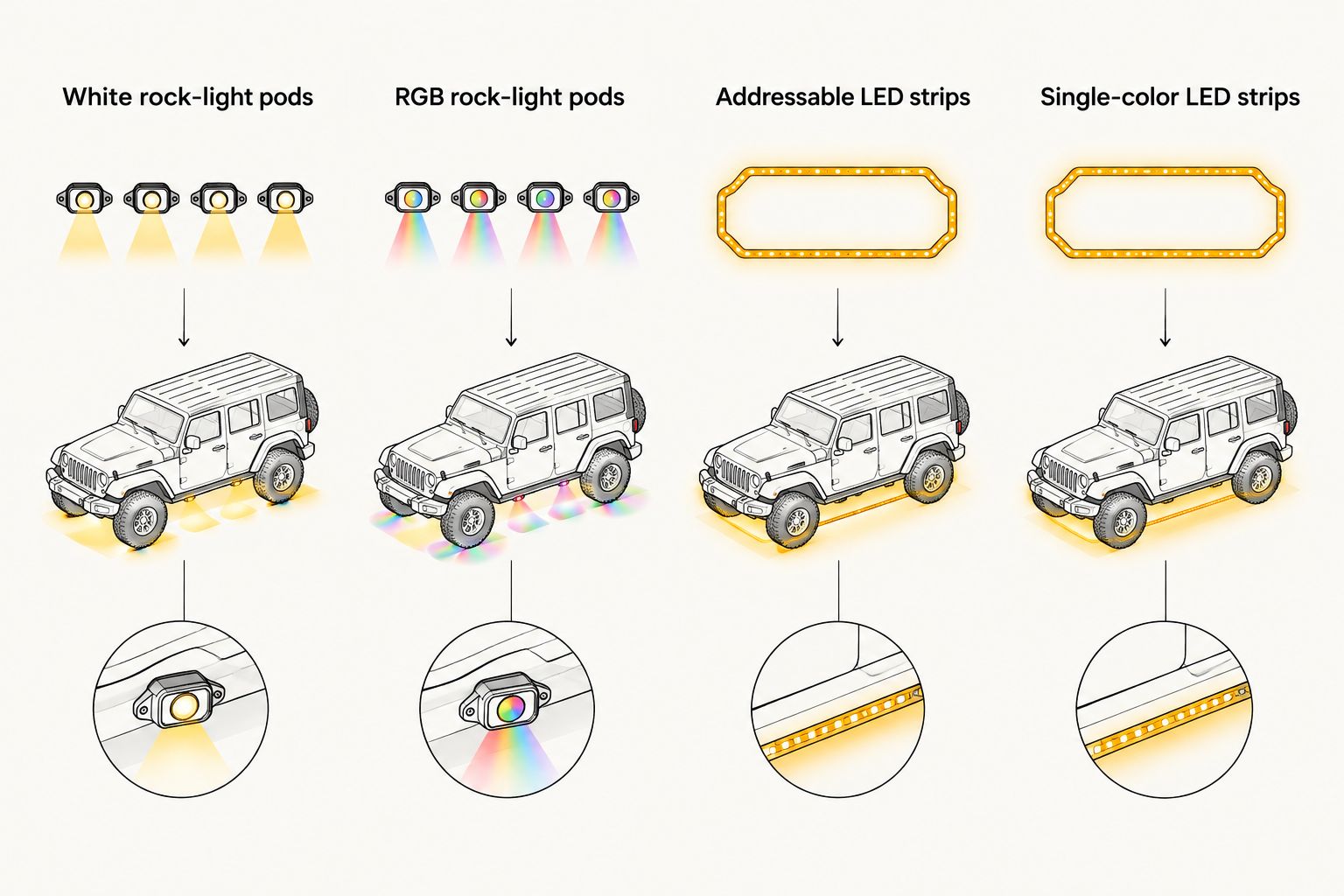
1. White rock-light pods: best UTV underglow lights for trails
White rock-light pods place individual lamps beneath the chassis or around the wheel wells. You can position each lamp to illuminate a useful patch of ground rather than tracing the entire body with light.
For a trail-first build, this format keeps the decision focused on placement, beam coverage, and protected wiring. White output is the simpler choice when your purpose is seeing the ground rather than selecting colors.
White rock-light pod pros:
- Individual mounting points let you target specific areas.
- Separate lamps can fit around bodywork and underbody protection.
- White light avoids color selection during use.
- A modular layout can keep each connection accessible.
White rock-light pod cons:
- Poor placement creates shadows and uneven coverage.
- Multiple mounting points require multiple wire routes.
- Exposed lamps remain vulnerable to debris and impacts.
Best for: Riders who want nearby ground illumination during low-speed maneuvering or while stopped.
Before choosing a kit, identify mounting surfaces that remain clear through steering and suspension movement. Check the beam pattern: a lamp that produces a narrow spot is not interchangeable with one intended to spread light across the ground.
Verdict: Buy this format for a trail-first build after confirming protected mounts, coverage, and electrical compatibility.
2. RGB rock-light pods: best UTV underglow lights for mixed builds
RGB rock-light pods combine discrete lamps with selectable red, green, and blue output. They suit owners who want ground-level accent lighting for parked displays without committing to a continuous strip around the machine.
The important distinction is white output. An RGB kit that mixes colors to appear white is not the same design as an RGBW kit with a dedicated white channel; neither label alone proves useful trail illumination.
RGB rock-light pod pros:
- Selectable colors support different parked-display looks.
- Discrete pods give you flexibility around chassis obstacles.
- Downward placement can keep the glow off surrounding riders.
- Individual lamp positions allow targeted accent coverage.
RGB rock-light pod cons:
- Controllers and additional connections add installation complexity.
- White-light usefulness needs separate verification.
- Phone-dependent controls are less direct than a reachable switch.
Best for: Owners who use the same UTV for trail riding and parked show displays.
For a mixed-use 2026 build, check the controller’s behavior before choosing effects. Confirm how you turn the system off, adjust brightness, and restore your preferred setting after power cycling. Do not assume matching connector shapes mean different lighting systems are compatible.
Verdict: Buy this format for mixed use when the controls suit your riding routine; hold if useful white output is unverified.
3. Addressable LED strips: best UTV underglow lights for shows
Addressable LED strips let a compatible controller change individual segments rather than setting the entire strip to one color. That makes this format suitable for animated patterns and coordinated perimeter effects while parked.
The strip needs a mounting route, not just a place to stick it. Body edges, removable panels, and underbody protection can interrupt the path or make later repairs difficult.
Addressable LED strip pros:
- Individual segments support animated lighting effects.
- Continuous placement can create a perimeter glow.
- Compatible controls let you select static or moving patterns.
- Protected body edges can conceal the strip from direct view.
Addressable LED strip cons:
- Strip routing needs protection from abrasion and impacts.
- Controllers, extensions, and strips must be electrically compatible.
- Panel removal becomes harder if the installation bridges body sections.
Best for: Show-focused builds where perimeter effects matter more than nearby terrain illumination.
Check where the manufacturer permits cutting, how cut ends must be sealed, and whether extensions affect the installation requirements. Keep the controller accessible without placing it in an exposed location. Adhesive attachment should not be your default answer for every underbody surface; follow the specified mounting method.
Verdict: Buy this format for parked displays with protected routing; skip exposed strip mounting on a trail-first machine.
4. Single-color LED strips: best UTV underglow lights for simple accents
Single-color LED strips produce a fixed lighting color along their installed length. They remove color programming from the decision and suit a build where you already know the appearance you want.
The simpler lighting effect does not remove the installation requirements. The strips still need suitable mounting, protected wiring, compatible power, and an accessible off switch.
Single-color LED strip pros:
- Fixed color avoids programming and mode selection.
- Continuous placement supports a consistent perimeter accent.
- Controls can remain straightforward when the kit supports basic switching.
- A protected route can keep the light source out of direct view.
Single-color LED strip cons:
- You cannot change the lighting color through a controller.
- Exposed strips face the same mounting risks as other strip formats.
- A damaged section needs repair according to the strip’s design.
Best for: Owners who want a fixed-color accent without animated effects.
Choose the layout before choosing the strip length. Measure the actual route around brackets and panel edges, including access to connections. A straight-line body measurement does not account for those obstacles.
Verdict: Buy this format for a fixed accent with protected mounting; hold if you expect to want selectable colors later.
Installation checks that matter more than effects
A useful 2026 lighting installation starts with access and protection. Lay out the components before permanently mounting anything, then follow the kit and vehicle instructions for electrical work.
Plan the layout
Mark the lamp positions and wiring routes with the panels in place. Check clearance from tires, steering components, suspension links, driveline parts, and heat sources. Do not drill until you know what sits behind the mounting surface.
Protect the circuit
Use the manufacturer’s specified circuit protection and wire sizing. Do not choose a fuse by guesswork or increase its rating to stop repeated failures. A fuse protects the wiring against excessive current; it does not compensate for a poor connection.
Keep connections accessible
Secure the harness away from abrasion points and avoid tension at plugs. Plan panel removal now, including where you will disconnect the lights for service. Keep the controller accessible and within its stated environmental limits.
Test before riding
Check every light and control, inspect routing, and confirm that normal vehicle movement does not pull the harness. Test the lighting while parked after dark to spot glare and coverage gaps. Reposition lamps before treating the installation as finished.
Use the UTV rock-light installation guide to plan the job, then follow the instructions for your exact kit.
Waterproof ratings: check the whole system
Waterproof language needs context. Under IEC 60529, IP67 includes a temporary immersion test of 30 minutes; for small enclosures, the standard test places the enclosure 1 meter below the water surface. Those are controlled test conditions, not permission to ignore the manufacturer’s use limits.
IP68 immersion conditions are specified for the equipment and are more demanding than IP67. The rating does not communicate one universal depth and duration for every product. Ask for the stated conditions rather than treating the larger digit as a complete answer.
Neither rating automatically establishes resistance to a pressure-washer jet. For your 2026 build, read the cleaning instructions and check whether the controller and connectors carry their own protection ratings. Keep wash spray away from vulnerable connections.
How we ranked these lighting formats
R1 Industries’ UTV underglow lights guide ranks formats by their intended job: useful ground lighting first, mixed-use color control second, perimeter effects third, and fixed-color simplicity fourth. Protected mounting, electrical compatibility, accessible controls, and serviceability determine whether a specific kit fits that job.
This is a selection guide, not a lab-tested ranking of named kits. A well-mounted strip installation serves a show build better than poorly positioned pods; a trail build needs a different default.
Which UTV underglow lights should you choose?
Choose white rock-light pods if you are undecided and your UTV spends its time on trails. Add color control only when parked-display use is a real part of your build.
Choose RGB pods for a mixed-purpose machine, addressable strips for animated perimeter effects, or single-color strips for a fixed accent. R1 Industries is an aftermarket UTV retailer for owners building around their vehicle and riding needs; keep that same approach when selecting lighting.
For a 2026 purchase, verify the complete kit contents and installation requirements before ordering. A color effect is not a substitute for fitment information, circuit requirements, or a workable mounting route.
FAQ
What are the best UTV underglow lights for trail riding?
White rock-light pods are the default format for trail-focused ground lighting. Choose a kit with suitable coverage, protected mounting points, documented electrical requirements, and accessible controls.
Are RGB rock lights better than LED strips?
RGB rock-light pods are better for discrete mounting around chassis obstacles; LED strips are better for a continuous perimeter accent. Choose by layout and intended use rather than color effects alone.
Can UTV underglow lights replace headlights?
No, UTV underglow lights do not replace headlights. They illuminate nearby ground or create an accent beneath the vehicle rather than providing forward trail lighting.
Do RGB underglow kits produce useful white light?
Useful white output needs verification for the specific RGB kit. RGB mixes colored output, while RGBW adds a dedicated white channel; neither label alone establishes beam coverage or illumination performance.
Are IP67 UTV lights safe to pressure wash?
An IP67 rating does not establish pressure-washer resistance. Follow the cleaning instructions and check the protection ratings of connectors and controllers separately.
Can I install underglow lights on my UTV myself?
You can install a kit yourself when you can follow its mounting and electrical instructions safely. Use a qualified installer if you cannot verify circuit protection, wire sizing, routing, or vehicle connection requirements.
Are colored UTV underglow lights legal on public roads?
Legality depends on the applicable jurisdiction and how the lighting is used. Check local requirements for colors, flashing effects, mounting, and public-road operation before switching the lights on.
One last thing
Aim for visible ground, not visible bulbs. While parked after dark, inspect the installation from the driver’s seat and beside the UTV. If a lamp shines directly into your eyes, adjust its placement or aim before adding more lights.